
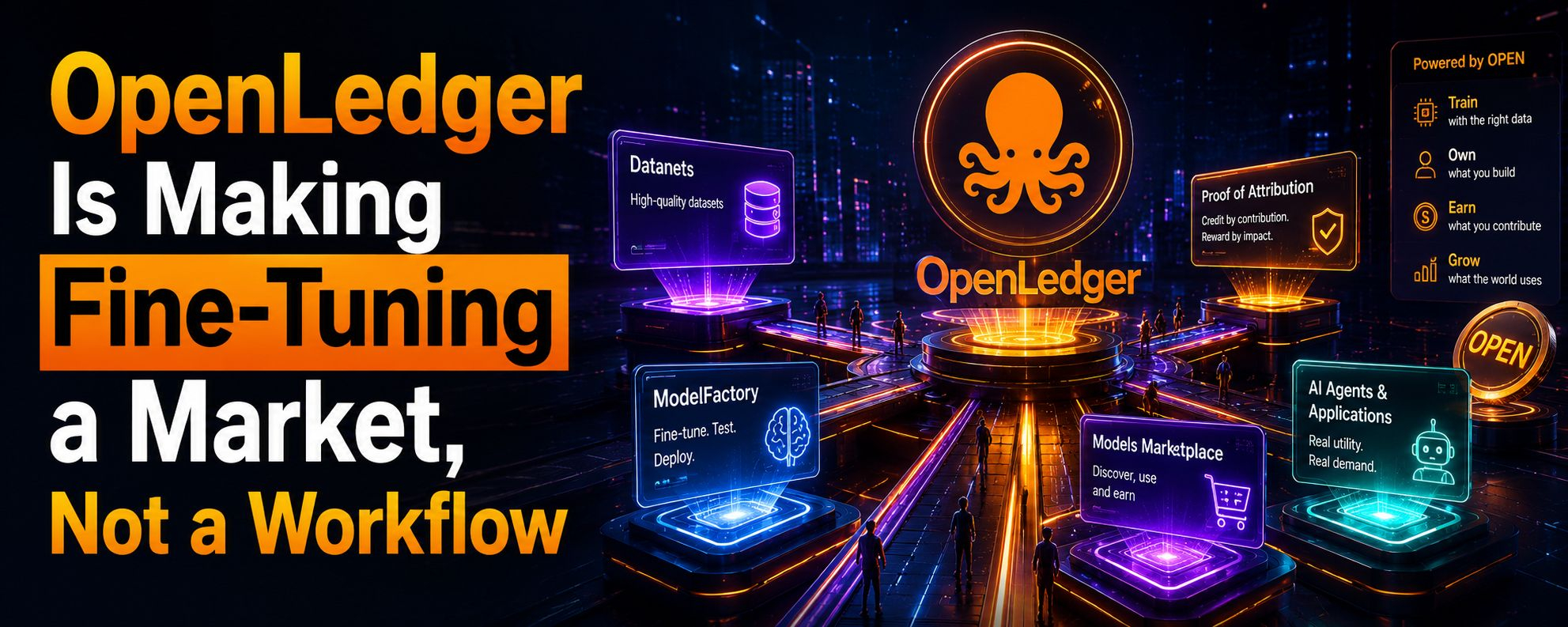

When I look at ModelFactory, I do not see another AI feature trying to make developers’ lives easier. I see something more unusual: OpenLedger is trying to make fine-tuning feel like a market decision.
That is the part I think many people will underestimate.
Fine-tuning used to feel private and technical. A team collected data, adjusted a model, tested the output, and kept the result inside its own product. The market rarely saw the process. Users only saw the final AI tool and never knew which data shaped it, who contributed to it, or why one model became more useful than another. That made fine-tuning important, but invisible.
ModelFactory changes that feeling. It brings the process closer to the surface. A builder can choose a base model, connect specialized data through Datanets, tune the model, test it, and then deploy it into OpenLedger’s wider ecosystem. That may sound like a simple workflow, but to me it looks like the early shape of a marketplace where intelligence can be created, compared, used, and eventually rewarded.
The reason this matters is because I do not think the next AI cycle will be won only by the biggest models. Big models are impressive, but they are also becoming increasingly similar from the user’s point of view. The real edge is moving toward context. A model trained around trading behavior, gaming economies, medical research, legal documents, local culture, or community-specific language can be more useful than a general model that knows a little about everything.
That is where OpenLedger’s idea starts to make sense. Datanets are not just data folders. They represent organized knowledge. Proof of Attribution is not just a credit system. It is an attempt to remember which inputs actually helped create value. ModelFactory sits in the middle of that loop and turns raw knowledge into a working model.
I find that more interesting than the usual AI-token narrative. Most projects talk about data ownership like it is enough by itself. But ownership without usefulness is weak. A dataset only becomes economically meaningful when it can improve something people actually use. ModelFactory gives that data a path to become productive. It turns information into behavior, and behavior into something the market can judge.
That is why I see ModelFactory less like a factory and more like a bazaar. In a factory, everything follows one blueprint. In a bazaar, value comes from variety. Some builders may create models for finance. Others may focus on gaming, agents, research, support, or niche communities. Not every model needs to become huge. It only needs to become useful to the right demand.
This also changes how I think about OPEN’s utility. The important question is not only whether people are talking about the token. The better question is whether OPEN becomes part of repeated AI production: accessing data, training models, deploying outputs, using specialized agents, and rewarding contribution. Speculation can create attention, but production creates memory. ModelFactory matters because it could give the token an actual role inside the creation of useful intelligence.
The risk is real, though. Easy model creation can also create noise. If low-quality data floods the system, the marketplace becomes crowded with weak models. If attribution is not trusted, contributors may not feel rewarded fairly. If users do not return to use the deployed models, the whole thing becomes a beautiful interface without economic gravity.
But even with those risks, the direction feels important.
ModelFactory suggests that fine-tuning is no longer just a developer task hidden behind the scenes. It is becoming a public economic action. People will not only build models. They will compete through the quality of their data, the usefulness of their tuning, and the demand their models attract.
That is the bigger shift OpenLedger is pointing toward. The future of AI may not be one giant model answering everything. It may be thousands of specialized models, each shaped by different communities, datasets, and use cases. If that happens, ModelFactory is not just helping people fine-tune AI. It is helping turn specialized intelligence into a marketplace.