
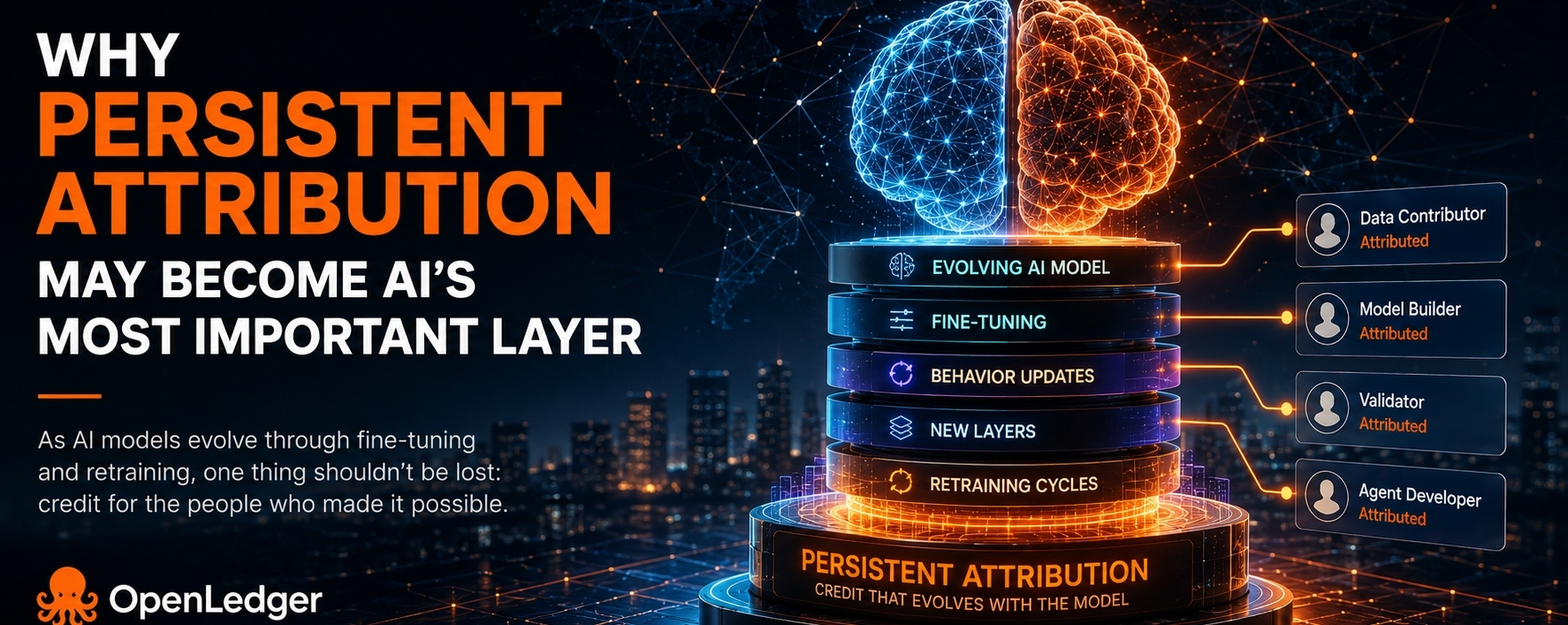

The strange thing about AI models is that nobody expects them to stay the same anymore. A model that stops evolving usually becomes irrelevant fast. So the real value is no longer sitting in a single training moment. It’s sitting in the constant reshaping afterward. New fine tunes. New behaviors. New layers added quietly over time.
And the more I thought about that, the more one question started bothering me.
If a model keeps evolving forever, what happens to the people whose data helped shape it in the first place?
Because that’s the part nobody really talked about.
Models are not static anymore. A useful AI model keeps changing constantly. New weights get added. Behaviors shift. Agents adapt it for different use cases. Entire layers get retrained over time. But in most systems, contributor attribution quietly breaks somewhere during that process.
Your data may still influence outputs months later. You just stop getting recognized for it.
That’s why OpenLedger’s Attribution Engine update in January 2026 felt more important to me than the market reaction around it.
The update itself sounded technical on paper. OpenLedger made attribution persistent even as models continue evolving through retraining and fine-tuning cycles. But honestly, I think the real meaning sits deeper than the engineering.
They’re trying to solve continuity.
And continuity is becoming one of the hardest problems in AI economies.
I think crypto people sometimes underestimate how fragile incentive systems really are. Contributors only stay engaged when they believe the relationship remains fair over time. If attribution disappears the moment a model changes, then participation eventually becomes short-term and extractive.
People stop caring about model quality.
They optimize for quick rewards instead.
That dynamic matters a lot inside OpenLedger because the whole network depends on ongoing AI participation. Data contributors, model builders, agents, validators. Everyone exists inside the same economic loop. The network is not just storing AI activity on-chain for transparency theater. It’s trying to turn AI coordination itself into an on chain economy.
Without persistent attribution, that structure starts leaking value very quickly.
What I find interesting is how naturally this update fits OpenLedger’s broader architecture. The blockchain layer already connects AI activity directly with wallets, smart contracts, and programmable incentives. Ethereum compatibility matters here because contributors are not locked into isolated infrastructure. Ownership and rewards move through familiar on-chain systems.
The model becomes something alive economically, not just technically.
And I think that changes how people behave around it.
If contributors know their attribution survives future model updates, they have a reason to think long term. Their history compounds with the network instead of resetting every time the model evolves. OpenLedger is basically saying your contribution should grow with the intelligence you helped shape.
That idea feels small until you compare it to how most AI systems work today.
Usually the value capture becomes centralized very quickly. Early contributors help create model quality, but future monetization flows elsewhere once the system scales. OpenLedger seems unusually focused on preventing that separation from happening.
Still, I don’t think the system magically solves everything.
I keep wondering whether open incentive structures can really maintain high-quality data at scale. Crypto markets always attract farming behavior eventually. People learn how to optimize rewards faster than protocols learn how to measure genuine value.
AI makes this even messier because bad data is not always obvious immediately. Sometimes weak inputs only reveal themselves after the model evolves further.
And there’s another thing I’m unsure about.
Do people actually care about persistent ownership? Or do they mostly care about immediate earnings while the AI narrative is still hot?
Crypto talks a lot about decentralization ideals. Real user behavior is usually much more practical than ideological. Most participants follow incentives first. Philosophy comes later.
Maybe OpenLedger understands that better than most projects. Their design choices feel less romantic and more behavioral. They assume contributors need durable economic reasons to stay aligned with the network long term.
That’s probably why the Attribution Engine update stayed in my head longer than I expected.
It didn’t feel like a marketing announcement. It felt like OpenLedger quietly admitting something the industry still avoids saying openly: AI models are becoming permanent moving systems. If attribution cannot survive evolution, then ownership inside AI will always remain temporary.
And temporary ownership eventually stops meaning much at all.
I’m just not sure the market fully sees the importance yet.
Most people still trade AI projects like short-cycle narratives. Attention moves fast. Capital moves faster. OpenLedger is building around persistence instead. Around memory that survives model evolution.
That may become incredibly valuable later.
Or maybe the project is simply arriving before most people realize why attribution after fine-tuning was the real problem all along.