
I’ll be honest I almost ignored OpenLedger the first time I read about it.
Not because the idea was necessarily bad, but because the crypto industry has developed a habit of flattening every complicated technological shift into the same predictable narrative cycle. Add “AI,” add “decentralized,” mention ownership, mention incentives, and suddenly every project starts sounding like it’s describing the future of civilization while explaining almost nothing about the actual structure underneath it.
After a while, you stop reacting to the language entirely.
But OpenLedger stayed in my head longer than I expected, mostly because the deeper I looked, the less it felt like a project trying to tokenize hype and the more it felt like an attempt to grapple with a genuinely uncomfortable problem that most people still don’t fully see.
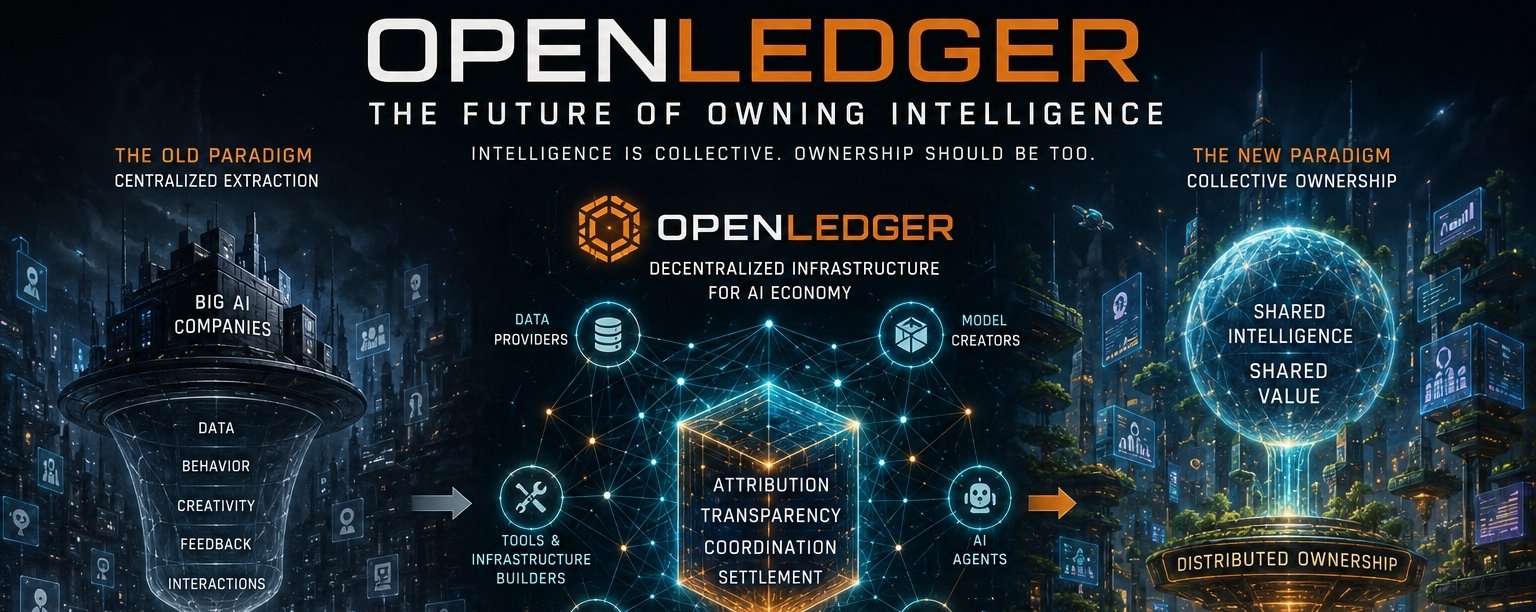
The modern AI economy runs on invisible extraction.
That sounds dramatic at first, but the more time I spend watching how these systems evolve, the harder it becomes to describe them any other way. Every major AI model today is built on top of an enormous ocean of human contribution that rarely remains visible once the system becomes commercially useful. Data is collected, behavior is absorbed, creative output becomes training material, feedback loops refine performance, and eventually a polished interface appears that feels detached from the millions of small human traces that made it possible.
The strange thing is that most people accept this process almost naturally because AI systems feel abstract. They don’t look like factories. They don’t look industrial. But underneath the clean interfaces sits a massive coordination machine consuming human knowledge at planetary scale.
And once you see that clearly, a deeper question starts forming beneath the surface:
Who actually owns intelligence once intelligence becomes collective?
That question is much harder than people pretend.
Traditional technology companies solved this problem in the simplest possible way. They centralized everything. Data went in, models came out, ownership remained concentrated, and users mostly accepted the arrangement because the systems were useful enough to justify the imbalance.
But AI changes the scale of that imbalance.
The more advanced these systems become, the more valuable contribution itself becomes. Not just computational contribution, but informational contribution. Context. Feedback. Specialized knowledge. Human interaction patterns. Synthetic outputs generated by other systems. Eventually intelligence production starts looking less like software development and more like an economic ecosystem where countless invisible actors continuously shape the final result.
That’s the point where OpenLedger became more interesting to me.
Not because it claims to decentralize AI entirely — I’m still skeptical of anyone promising that — but because it seems to understand that the real issue may not be intelligence generation itself. The real issue may be attribution.
Modern AI systems are incredibly good at absorbing value while erasing the path that value traveled to get there.
OpenLedger appears to be trying to reverse that process.
At first glance, the project describes itself as infrastructure for monetizing data, models, and agents. Honestly, that phrase didn’t mean much to me initially because crypto projects often describe themselves in broad economic language that sounds profound until you try mapping it onto reality.
But the architecture underneath the idea is more thoughtful than the branding suggests.
What OpenLedger seems to be building is less about storing AI on-chain and more about preserving economic visibility around contribution. That distinction matters because most decentralized AI conversations become trapped in the wrong debate. People obsess over whether AI computation itself should be decentralized, but computation is only one layer of the system. The more difficult problem is figuring out how contribution remains economically legible once intelligence becomes compositional.
And AI is becoming deeply compositional.
One dataset influences another model. One model fine-tunes another. Autonomous agents interact with each other, generate outputs, refine processes, and feed downstream systems. Human users continuously shape behavior through interaction. Over time, intelligence production stops resembling a single product and starts resembling a dense web of interconnected influence.
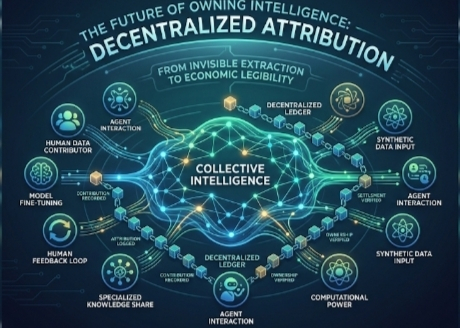
Traditional ownership structures struggle inside environments like that because they depend on clear boundaries. AI dissolves boundaries constantly.
OpenLedger’s use of blockchain infrastructure suddenly makes more sense from this perspective.
Not because every AI interaction belongs on-chain — that would probably become unusable very quickly — but because the ledger functions more like persistent memory than raw computation infrastructure. It creates a way to record contribution, attribution, coordination, and settlement across systems that would otherwise become economically opaque.
That idea feels far more important than most people realize.
Because once attribution disappears, power consolidates naturally around whoever controls the largest models and distribution layers. The entire economy starts tilting toward centralized ownership simply because nobody else can prove where value originated anymore.
In a strange way, OpenLedger feels less like an AI project and more like an accounting system for intelligence.
And accounting systems quietly shape civilizations more than people notice.
The problem, though, is that attribution sounds cleaner in theory than it becomes in practice.
The moment you try assigning economic value to contribution, the system becomes political whether you want it to or not. Someone has to determine what counts as useful contribution. Someone has to validate quality. Someone has to prevent spam, manipulation, and low-value participation designed purely to farm incentives.
That’s where decentralized idealism starts colliding with reality.
Because decentralized systems never eliminate power. They redistribute it into governance structures, staking systems, reputation layers, validator coordination, and economic weighting mechanisms. The language changes, but the struggle over influence remains.
OpenLedger doesn’t escape this tension.
If anything, the project exposes how difficult decentralized coordination becomes once intelligence itself turns into an asset class.
And honestly, I think that’s part of why I kept thinking about it afterward. The protocol doesn’t feel naïve about complexity. It feels aware that building decentralized AI infrastructure is not simply a technical challenge. It’s a social challenge disguised as infrastructure.
That distinction matters.
Most technological systems eventually fail at the human layer, not the computational layer. Incentives drift. Governance ossifies. Early openness slowly reconstructs hidden hierarchies. The AI economy will probably amplify those tendencies because intelligence is inherently difficult to measure objectively.
A dataset ignored today could become foundational tomorrow. A small refinement might produce enormous downstream effects later. An autonomous agent could generate indirect value impossible to isolate cleanly.
How do you price contribution inside systems where causality itself becomes blurry?
There is no perfect answer to that question, and I don’t think OpenLedger pretends there is.
But the attempt itself feels significant because most existing AI systems avoid the problem entirely by collapsing ownership into corporate abstraction. OpenLedger at least seems willing to confront the reality that intelligence production is becoming too distributed for old economic models to describe honestly.
What makes this even more complicated is that AI naturally centralizes around scale.
This is the uncomfortable truth that many crypto narratives still struggle to accept. Larger compute clusters produce stronger models. Stronger models attract more users. More users generate more feedback and refinement opportunities. Efficiency compounds into dominance incredibly quickly.
That gravitational pull toward concentration is real.
So when people talk about decentralized AI, I think they sometimes imagine a future where centralization disappears entirely. I doubt that happens. The economics of scale are probably too powerful.
What seems more plausible is a layered future where foundational model development remains relatively concentrated while surrounding systems — attribution, coordination, settlement, validation, ownership accounting, agent interaction — become more decentralized over time.
And that’s where OpenLedger starts looking structurally important.
Not as a replacement for large AI labs, but as infrastructure attempting to make the surrounding intelligence economy more transparent, interoperable, and economically visible.
Maybe that sounds less exciting than promises about fully decentralized superintelligence. But honestly, it feels more believable.
The longer I watch this industry evolve, the more I suspect the deepest power won’t come from the models themselves. It will come from whoever controls the systems determining how value flows around those models.
Because once intelligence becomes economic infrastructure, attribution becomes power.
And maybe that’s the strange philosophical shift sitting underneath projects like OpenLedger. They force us to confront the possibility that the future of AI may not simply be about building smarter machines. It may be about redefining ownership itself in a world where intelligence is increasingly collective, synthetic, recursive, and impossible to isolate cleanly.
I still have doubts about whether systems like this can scale without recreating the same asymmetries they were designed to resist. Governance can become bureaucratic. Incentives can distort behavior. Speculation can overwhelm utility. Coordination complexity can suffocate adoption long before philosophical ideals materialize.
But I also think ignoring these questions entirely would be worse.
Because if AI continues evolving without new attribution systems, then the default outcome is probably obvious: intelligence becomes concentrated into a handful of platforms while the human contribution underneath it disappears into statistical invisibility.
And maybe that’s why OpenLedger stayed in my mind longer than I expected.
Not because it offers a perfect solution.
But because it’s one of the few projects that seems genuinely interested in asking the uncomfortable question most of the industry still avoids:
If intelligence is built collectively, then who should actually own the future it creates?
