
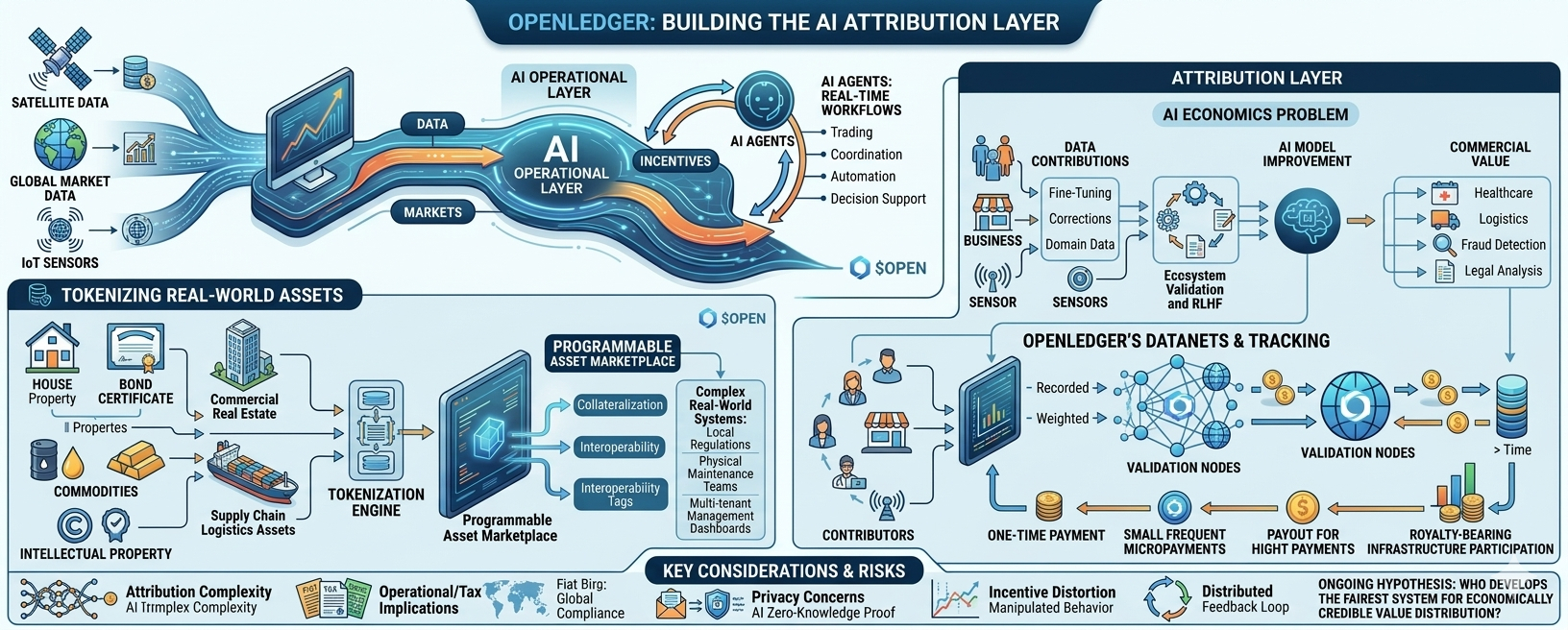
OpenLedger ($OPEN) is working on something. It is trying to build a system that connects intelligence and real-world assets. This system is called the Attribution Layer.
At a level OpenLedger is an artificial intelligence blockchain that helps get value from data, models and artificial intelligence agents. This means artificial intelligence systems will not just be tools that we use when we need them. They will be a part of the operational environments all the time.
Artificial intelligence will not just give us outputs. It will also be a part of workflows like trading, coordination, automation and decision support. This is not just about making artificial intelligence tools. It is about making intelligence a part of the infrastructure.
Most artificial intelligence applications are like layers. They are like chat interfaces, copilots or automation tools that respond to what we say. OpenLedger is trying to make artificial intelligence a on operational layer. This layer will interact with data, markets and incentives in time.
In this system artificial intelligence agents will process signals adjust strategies and contribute to workflows that change all the time. For example in environments where assets are tokenized an artificial intelligence system can help manage pricing, maintenance timing, liquidity conditions or risk exposure based on live data.
Real-world systems are not simple. They have constraints, human behavior, incomplete data and unpredictable edge cases. So the question is not whether artificial intelligence can understand reality perfectly. It is whether artificial intelligence can improve coordination at scale compared to systems that only have humans.
OpenLedger is also talking about tokenizing real-world assets. These assets can include property, bonds, commodities or even intellectual property. The idea is that these assets become programmable. They can be traded, fractionalized and integrated into blockchain-based systems.
In practice real-world assets are complex. A house is not a financial object. It exists within systems, local markets, maintenance cycles, tenant relationships and regulatory frameworks. Turning assets into digital representations does not make them simple. It just moves the complexity to layers of abstraction.
This is where people start to question things. Are we making reality simpler. Are we just building more structured ways to manage its complexity?
The Attribution Problem in Artificial Intelligence Economics is a part of OpenLedgers idea. Modern artificial intelligence systems get most of their value not from the base models. From the ecosystem of fine-tuning, corrections, workflows and domain-specific data that shape them after they are deployed.
In environments like healthcare, logistics, fraud detection and legal analysis these refinements are what make artificial intelligence commercially viable.. The people who contribute to this improvement cycle are usually paid only once if at all. The term economic value of their input is not tracked or shared.
OpenLedgers concept of datanets and contribution tracking is trying to fix this problem. It wants to create a framework where contributions to intelligence systems can be recorded weighted and potentially compensated over time. The goal is not attribution, but economically credible attribution that markets can operate on.
If this works it will change intelligence from a one-time labor procurement model to something closer to royalty-bearing infrastructure participation.
There are risks and open questions though. Attribution in intelligence is messy. Contributions overlap, evolve and interact in ways. Assigning ownership percentages may be impossible in many cases.
There are also operational concerns. Revenue-sharing models introduce complexity, tax implications and contractual uncertainty. Privacy is another issue since many valuable training datasets come from sensitive enterprise or personal contexts.
Any system that rewards contributions over time also risks incentive distortion. Participants may optimize for reward signals than genuine quality improvements introducing spam or manipulation into the ecosystem.
OpenLedger should be seen as a system, not a final one. It reflects a shift in thinking: from intelligence as isolated intelligence toward artificial intelligence as an evolving economic system and from ownership-based value models toward participation-based ones.
Whether $OPEN becomes a layer in this transition is uncertain.. The questions it raises—about attribution, value distribution and programmable economies—are likely to persist regardless of any single projects outcome.
In the end OpenLedger is less about a product and more about a hypothesis: if intelligence becomes continuously produced and continuously monetized then the next infrastructure battle is not about who builds the model—but who builds the fairest system, for deciding who gets paid for it.