
Most people are still looking at AI through the lens of convenience. Better search results, smarter assistants, faster content creation, cleaner workflows. The public conversation continues revolving around visibility what AI can generate, how naturally it can respond, how quickly it can replace repetitive human tasks. On the surface, it still feels like a consumer technology cycle.
But underneath that public layer, another transition is already accelerating far more aggressively.
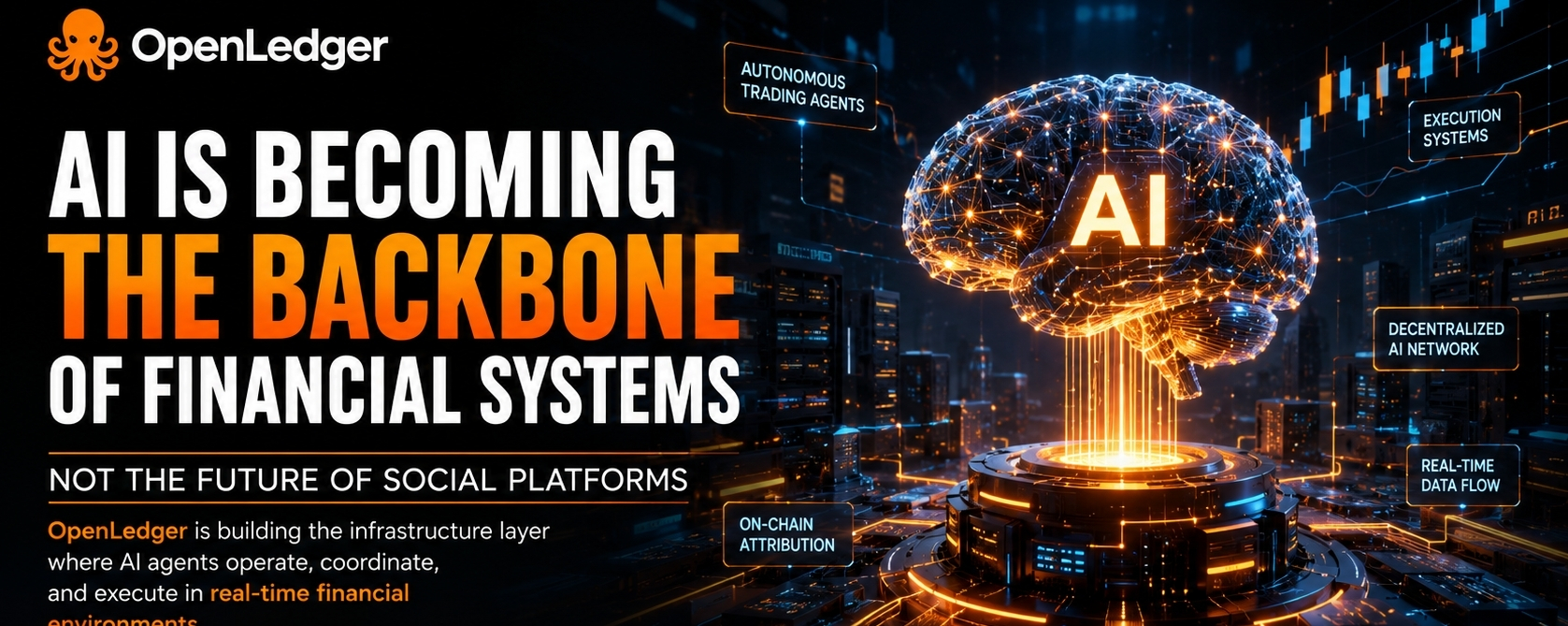
Projects like OpenLedger are pointing toward a version of AI that no longer behaves like a feature attached to applications. Instead, AI is beginning to evolve into infrastructure itself an operational layer designed to run continuously beneath markets, data networks, liquidity systems, and autonomous financial coordination.
That distinction matters more than most people realize.
Consumer technology succeeds through engagement. Infrastructure succeeds through reliability. The expectations are completely different. If a social platform crashes temporarily, users get frustrated and move on. But systems connected to financial execution, autonomous trading environments, intelligent coordination layers, or persistent AI-driven operations cannot afford instability the same way. Every second of inconsistency carries economic consequences.
This is exactly where the direction around OpenLedger becomes increasingly important.
The project appears aligned with an environment where AI agents are expected to operate persistently rather than interact occasionally. That means the conversation shifts away from “how intelligent the model sounds” toward deeper requirements like operational continuity, attribution systems, execution integrity, coordination efficiency, and real-time adaptability under changing market conditions.
In other words, AI stops being judged like software and starts being judged like infrastructure.
That transition changes the competitive landscape entirely.
The next phase of AI dominance may not belong to whoever creates the most entertaining chatbot or the most viral assistant interface. It may belong to the ecosystems capable of building stable operational networks where autonomous agents can continuously exchange information, coordinate actions, manage execution, and sustain economic activity without interruption.
This is where OpenLedger stands out from many surface-level AI narratives.
Instead of focusing only on interaction, the direction feels increasingly tied to machine-driven economic architecture systems where AI becomes embedded into the mechanics of finance itself. Trading coordination, decentralized intelligence flow, execution frameworks, attribution models, and autonomous operational structures all point toward a future where AI quietly disappears into the infrastructure layer powering digital economies underneath.
And historically, the technologies that reshape industries most deeply are usually the ones people stop noticing entirely because they become foundational.
Cloud computing was once visible hype before it became invisible infrastructure. The internet itself followed the same path. Financial networks evolved similarly. AI now appears to be entering that exact transition phase.
The market still treats most AI conversations like a race for attention. But beneath that noise, another race is forming the race to build the systems capable of sustaining autonomous economic activity at scale.
That is why projects like @OpenLedger feel increasingly important over time. Not because they represent another AI application, but because they hint at a future where artificial intelligence becomes part of the operational fabric of financial systems themselves.
And once AI reaches the infrastructure layer, the conversation around the entire industry changes permanently.