
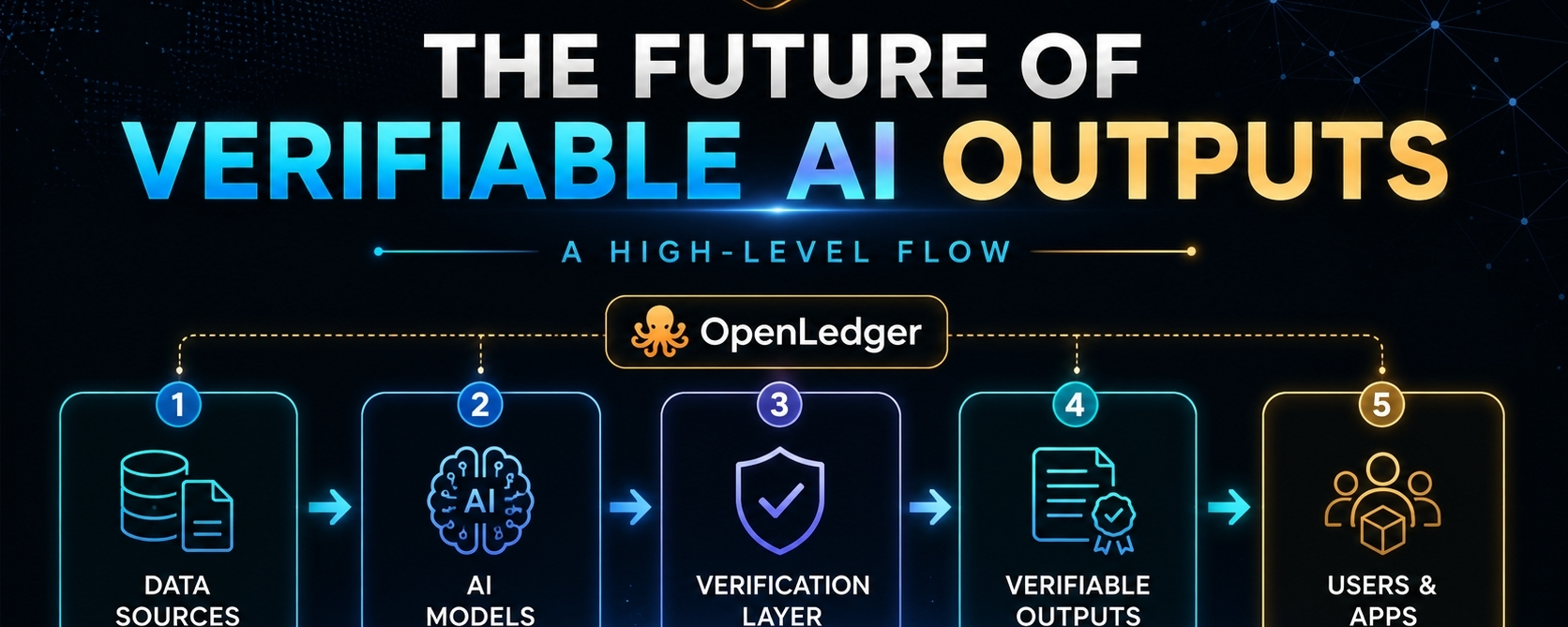
Sometimes I wonder if the next big question in crypto is not “how fast can this chain move?” or “which token is next?” but something a bit more uncomfortable: how do we know what we are trusting?
That question feels even more important now that AI is everywhere. We ask AI tools for market summaries, code help, trading ideas, research, risk checks, and even explanations of projects we barely understand. The weird part is, most of the time we just accept the output because it sounds confident. And anyone who has been in crypto long enough knows confidence and truth are not always the same thing.
This is where OpenLedger becomes interesting to think about. Not in the usual hype cycle way, where every new project gets treated like it is about to change everything overnight. I mean interesting as a sign of where the market might be heading. OpenLedger is trying to connect AI with blockchain based verification, especially around data, models, agents, and outputs. That idea may sound technical at first, but the basic problem is simple. If AI is going to play a bigger role in crypto, then users will eventually want proof, not just polished answers.
I’ve noticed that crypto users are already trained to think this way. We check transactions on explorers. We verify contract addresses. We look at wallet activity. We compare on chain data with exchange behavior. Even when people make mistakes, the culture of crypto still pushes toward verification. “Don’t trust, verify” is not just a slogan here. It is almost a survival habit.
AI, on the other hand, often works like a black box. You type a question, it gives an answer, and unless you know the topic well, you might not notice whether it is missing context, using weak data, or just making a confident guess. That might be fine for casual questions, but in crypto, a bad answer can become a bad trade, a wrong assumption, or a poor risk decision.
What’s interesting is that OpenLedger sits right at this tension point. Crypto wants transparency. AI often gives convenience. The future probably needs both. We want fast answers, but we also want to know where those answers came from, what data shaped them, and whether there is some trail behind the output.
Think about a simple market research scenario. A user asks an AI agent to explain why a certain sector is moving. The agent gives a clean answer about volume, wallet activity, social attention, and protocol updates. Sounds useful. But then the real question appears: which data did it use? Was the data fresh? Was it pulled from reliable sources? Did it ignore something important? Was the model trained on outdated assumptions? In a market that moves as fast as crypto, those details matter.
From my perspective, this is why verifiable AI outputs could become more than a niche idea. If AI agents start helping users trade, manage portfolios, monitor smart contracts, or interact with DeFi, people will need better ways to audit what those agents are doing. Not every user will inspect every detail, of course. Most people do not read every line of a smart contract either. But the fact that verification is possible changes the trust model.
There is also the data contribution side. AI models depend on data, and crypto has always been good at creating incentive systems around participation. OpenLedger’s idea of community owned datasets feels aligned with that broader Web3 mindset. Instead of data quietly disappearing into a closed model, contributors may eventually expect attribution, rewards, or at least visibility into how their input is being used.
That matters because the AI economy has a strange imbalance right now. Data is valuable, but the people or communities creating it often do not see much of that value. In crypto, we have seen many experiments around ownership, royalties, liquidity, and participation. Some worked, many did not, but the instinct is still there. People want open systems where value does not only flow upward into closed platforms.
Of course, none of this is easy. Verifying AI outputs is not the same as verifying a token transfer. A transaction either happened or it did not. An AI answer can be partly right, partly wrong, outdated, biased, or missing key context. That makes verification more complicated. It is not just about proving that an output exists. It is also about understanding the quality of the inputs and the path that produced the result.
One thing that stood out to me is how this could change the way we judge AI tools in crypto. Right now, many tools compete on speed, design, or how smart the answers sound. In the future, maybe the better question becomes: can this output be traced? Can the data behind it be checked? Can the agent’s action history be reviewed? Can contributors see how their data helped shape a model?
That would be a pretty big shift. It would move AI from “trust me, I know” toward “here is the trail.” And honestly, that feels much more native to crypto culture.
I also think traders will be one of the first groups to care, even if they do not describe it in technical terms. Traders already compare signals from different places. They watch funding rates, volume, news, whale wallets, unlock schedules, and sentiment. If an AI tool gives a summary, traders will eventually want to know whether that summary is grounded in real, current, traceable data or just recycled market noise.
Builders may care even more. If AI agents begin handling actions inside apps, games, DeFi platforms, or analytics tools, then verifiability becomes part of user safety. Imagine an agent that recommends a strategy, signs an action, or filters risk for a user. Without a record of what it saw and why it acted, mistakes become hard to understand. With better traceability, users and developers can at least investigate what went wrong.
Still, I do not think we should pretend this future is already solved. Crypto has a habit of naming a problem, building a narrative around it, and then acting like the solution is finished before users have even tested it properly. Verifiable AI sounds powerful, but the real test will be whether normal users can actually benefit from it without needing to become data scientists or protocol engineers.
That is the part I keep coming back to. The best infrastructure usually becomes invisible. People do not want to think about every technical layer underneath an answer. They just want stronger confidence that the answer is not floating in midair. If OpenLedger and projects in this area can make verification feel simple, useful, and natural, then this category could become important in ways that are not obvious yet.
For everyday crypto users, the future of verifiable AI outputs might not look dramatic at first. It might look like better research tools, cleaner audit trails, more trustworthy AI agents, and a little less blind faith in confident answers. That may not sound as exciting as a huge market narrative, but it is probably healthier.
Crypto has always been about reducing the need to trust middlemen. AI is now asking us to trust machines that speak with confidence. Somewhere between those two worlds, a new standard has to form. OpenLedger is one example of that direction, and whether it becomes a major piece of the puzzle or simply pushes the conversation forward, the question it raises feels worth paying attention to: in an AI driven crypto world, who verifies the answer?