
I don’t want to look at OpenLedger only from the usual “AI token” angle, because that space is already too crowded. Every project is talking about models, agents, compute, and the future of intelligence. But with $OPEN, the part that keeps pulling me in is not just the AI branding. It is the question behind it: who actually owns the data, who helped train the model, and who gets rewarded when that model becomes useful?
That is why ModelFactory caught my attention.
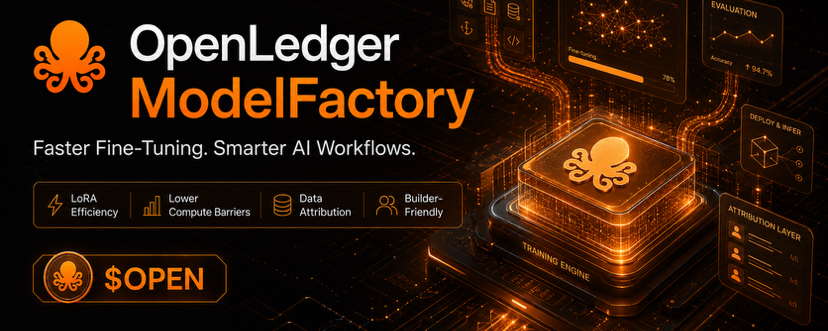
On the surface, ModelFactory looks like a tool for building and fine-tuning AI models. But I think the bigger point is that OpenLedger is trying to make AI creation easier for smaller builders, not only large teams with heavy compute budgets. Binance Research describes Model Factory and OpenLoRA as end-to-end infrastructure for training, fine-tuning, and hosting models, with LoRA adapters verified on-chain. It also highlights OpenLedger’s Proof of Attribution system, which is designed to identify how data influences model outputs and reward contributors in $OPEN.
This matters because AI development is still not equal. Big companies have better GPUs, better datasets, better teams, and better pipelines. Smaller builders may have strong ideas or niche knowledge, but they often cannot afford the same infrastructure. If OpenLedger can reduce that barrier through lighter model tuning, data networks, and on-chain attribution, then $OPEN becomes more than a trading narrative. It becomes part of a bigger shift where AI building becomes more open.
But I’m also not blindly impressed by performance claims. Faster training sounds great, especially when LoRA or QLoRA-style methods can reduce memory and compute pressure. Research around quantized LoRA methods shows that lower-bit fine-tuning can reduce memory costs, but it can also introduce quality trade-offs if not handled carefully. So for me, the real test is not just whether ModelFactory looks good in a clean benchmark. The real test is whether it still works well with messy datasets, small datasets, noisy inputs, and real users who do not behave like a lab test.
That is where OpenLedger’s Datanets idea becomes important. Datanets are built around domain-specific, community-driven datasets that can be used for more focused AI training. This connects with my bigger thesis that the future of AI may not only belong to massive general models. It may belong to specialized models trained on cleaner, more useful, more traceable data.
And honestly, this is where $OPEN becomes interesting to me.
If a dataset improves a model, that contribution should not disappear inside a black box. If a model earns value because someone’s data made it better, then the reward should be traceable. OpenLedger’s Proof of Attribution is trying to build that link between data, model output, and contributor rewards. That sounds simple, but it is actually one of the hardest problems in AI right now.
Still, there are risks. Once rewards are attached to data, people will try to game the system. Low-quality contributions, repeated data, fake value, weak labeling, and attribution disputes can all happen. So OpenLedger does not only need good tools. It needs strong validation, clean incentives, and real usage from builders.
My view is simple: $OPEN is worth watching because it is not only chasing AI hype. It is trying to connect model creation, data ownership, attribution, and rewards into one infrastructure layer. If ModelFactory helps more people build AI models, and Proof of Attribution proves who actually created value, OpenLedger could sit in a very important lane.
The market may still judge it by candles, but I’m watching the deeper question: can @OpenLedger make AI data valuable, traceable, and fair?