
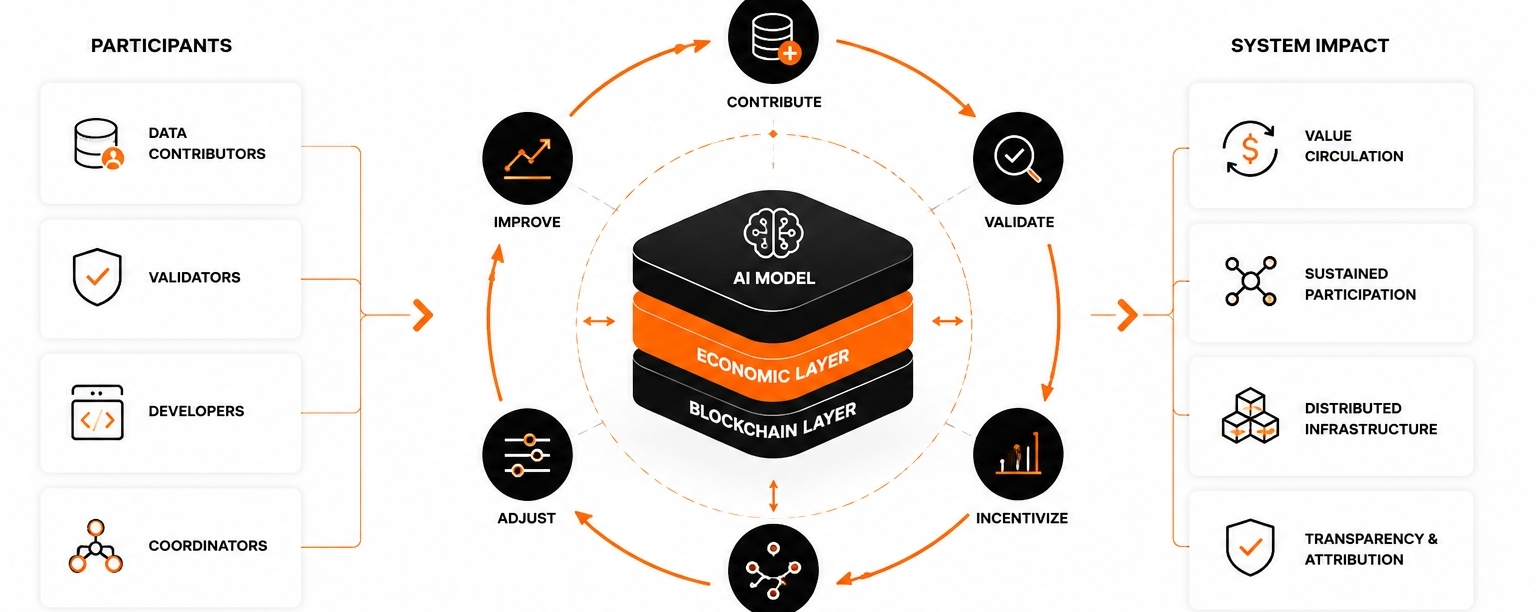

@OpenLedger There’s a moment when you stop looking at AI systems through their outputs and start noticing what they quietly depend on to keep existing at all.
With OpenLedger, that moment doesn’t come through anything loud or visible. It comes almost sideways. A slow realization that what looks like an intelligence problem is actually a coordination problem stretched across many unseen participants.
Most systems try to hide this. Or smooth it out. The interface becomes clean, the model becomes central, and everything underneath gets compressed into background infrastructure. But the cost of that compression is always the same contribution becomes invisible the moment the system becomes stable enough to trust.
And OpenLedger seems to sit right inside that tension rather than escaping it.
Not as a simple fusion of AI and blockchain, but as a place where AI development is treated like something closer to ongoing economic negotiation. Participation isn’t just input. It is continuously structured, recorded, incentivized, adjusted. The model stops being an isolated object and starts feeling like a temporary surface on top of a much longer coordination process.
That shift is subtle at first.
But once you notice it, it becomes difficult to unsee how much of AI is actually maintained by systems of attribution and incentive rather than intelligence itself. Data doesn’t just exist it is curated through effort that rarely stays visible. Validation is not just technical it is economic maintenance. Even “model improvement” starts to look like the outcome of distributed alignment between participants who never fully meet each other.
OpenLedger’s blockchain layer enters here in a quieter form than expected. Not as a financial spectacle but as a recording surface for participation itself. A way of keeping trace of who contributed, when, and under what economic conditions that contribution made sense to sustain.
It doesn’t loudly redefine AI. It quietly refuses to let contribution disappear.
And that changes how the system feels.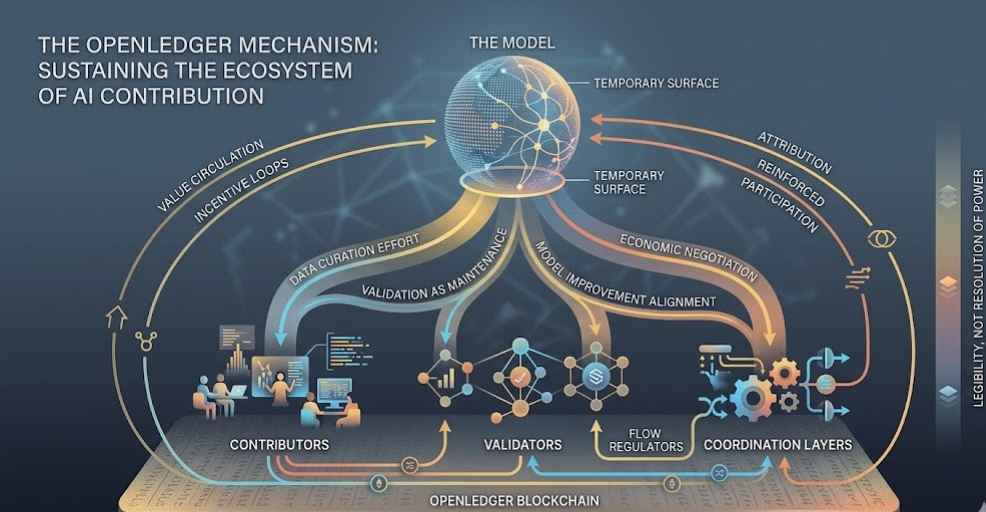
As usage flows through the network, value doesn’t just accumulate at the level of the model. It circulates back into the infrastructure maintaining it validators, contributors, coordination layers. That circulation reinforces further participation, which then feeds more data, more validation, more refinement. The loop is not dramatic. It is slow, almost procedural, but it keeps folding back into itself in a way that is hard to separate into clean beginnings or endings.
Still, something unsettled remains underneath it.
Because even when contribution becomes traceable, power does not automatically distribute evenly. Even when systems are decentralized, influence still finds shape sometimes quietly, sometimes structurally, sometimes through repetition rather than design. OpenLedger doesn’t resolve this contradiction. It simply makes it more legible.
And legibility is not the same as resolution.
At a certain point, the distinction between AI infrastructure and economic infrastructure starts to blur in a way that feels less theoretical and more lived. The network funds intelligence. The intelligence increases network activity. Incentives stop acting like external design choices and start behaving like internal memory shaping what the system continues to become.
Maybe that is what makes OpenLedger hard to categorize cleanly.
It is not just hosting intelligence.
It is hosting the conditions under which intelligence remains possible.
And if you watch it long enough, a quieter question begins to surface underneath everything else not about what AI is becoming, but about what kind of memory a system needs in order to remember who made its intelligence economically survivable in the first place?