
For the longest time, I thought most AI blockchain projects were just recycled narratives wearing a fresh coat of paint. Every few months, a new project appears claiming it will “revolutionize AI,” and somehow adding a token instantly makes people talk about billion-dollar valuations. After seeing so many versions of the same idea, I became naturally skeptical. But the deeper I looked into OpenLedger and the idea behind the open ecosystem, the more I realized this project is trying to solve a problem that almost nobody in the AI industry wants to openly discuss.
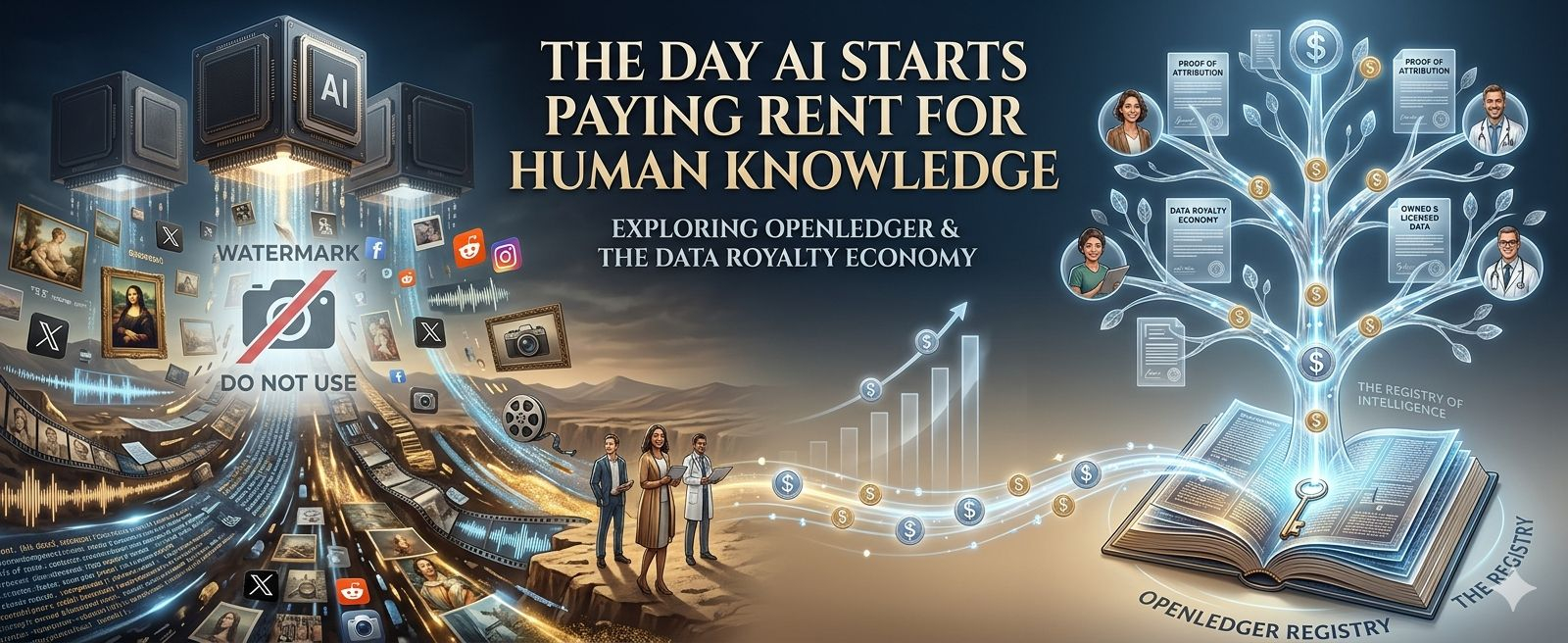
Right now, the internet feels like a digital gold rush with no real rules. AI companies are collecting data from everywhere — movies, articles, artwork, voice samples, Reddit discussions, social media posts, even personal writing styles. The bigger the excavator, the more data gets extracted. In 2024 alone, Hollywood studios continue filing lawsuits against AI companies for training models on copyrighted material, while artists across X and Reddit are watermarking their work with messages begging AI systems not to use their content anymore. And honestly, when you step back and look at the situation, it becomes obvious why people are uncomfortable. The entire AI economy today runs on information that was mostly gathered for free.
That is where OpenLedger caught my attention because they are not trying to compete with Ethereum on smart contracts, and they are not trying to become another decentralized compute network like Bittensor. Their focus seems very different. OpenLedger is trying to build what could become the ownership layer for AI data itself. The simplest way I can describe it is this: they are attempting to create a “data royalty economy.”
Most people think data is valuable because it exists, but OpenLedger’s idea goes one step deeper. They are not just trying to put a price tag on raw datasets. They are trying to measure how much influence specific data actually has on an AI model’s output through something called Proof of Attribution. That concept completely changes the conversation. Today, AI models work like giant black boxes. Billions of pieces of information are thrown into the system, mixed together, and eventually the model produces answers with absolute confidence. But nobody really knows which datasets were responsible for shaping those answers. OpenLedger wants to make that traceable.
Imagine a hospital holding an extremely rare MRI dataset. Under the current system, selling that information directly creates massive legal and privacy risks. Most institutions would never feel comfortable handing over ownership permanently. But OpenLedger’s model introduces another possibility. Instead of selling the data outright, the hospital could license access for AI training while still retaining ownership. Every time that dataset contributes value to future AI systems, the contributor could receive rewards through the $OPEN ecosystem. In simple terms, it becomes less like selling land and more like renting property while still collecting income from it over time.
That idea feels important because the future AI economy may not belong only to the companies with the largest GPUs or the fastest models. It may eventually belong to whoever controls high-quality, trustworthy, and legally usable data. Ethereum became the accounting system for decentralized finance. Bittensor is building marketplaces around AI computation. Meanwhile, OpenLedger seems to be aiming for something more invisible but potentially just as important — becoming the registry that tracks where intelligence actually comes from.
And if that vision works, it could create one of the biggest shifts in the AI industry. The current system benefits enormously from untracked information. Most large AI models today thrive because data moves freely without attribution. But the moment attribution becomes normal, the economics change completely. Suddenly, creators, researchers, artists, hospitals, publishers, and communities all have leverage because their contributions can no longer disappear inside a black box without recognition. In that world, $OPEN stops looking like a normal token and starts looking more like the economic rail behind data ownership itself.
Of course, this is also where the biggest risk appears. Web3 has always struggled with incentive abuse. Whenever rewards exist, spam follows immediately. Ten million low-quality tweets should never be worth more than a rare medical dataset, but systems built around rewards often attract farming behavior very quickly. If OpenLedger cannot build a strong enough mechanism to separate meaningful data from useless noise, the entire model could collapse under manipulation. Proof of Attribution sounds powerful, but Proof of Quality may ultimately matter even more.
Still, I think the reason this project stands out is because it touches a very real tension already happening across the internet. People are beginning to ask who owns intelligence when AI is trained on human creativity at global scale. That question will only become louder over the next few years. And whether OpenLedger succeeds or fails, I believe the core idea behind it is pointing toward something inevitable: the era of free and invisible data extraction may not last forever.
Maybe the next phase of AI will not just be about building smarter models. Maybe it will be about finally figuring out who deserves to be paid when those models become intelligent in the first place.
