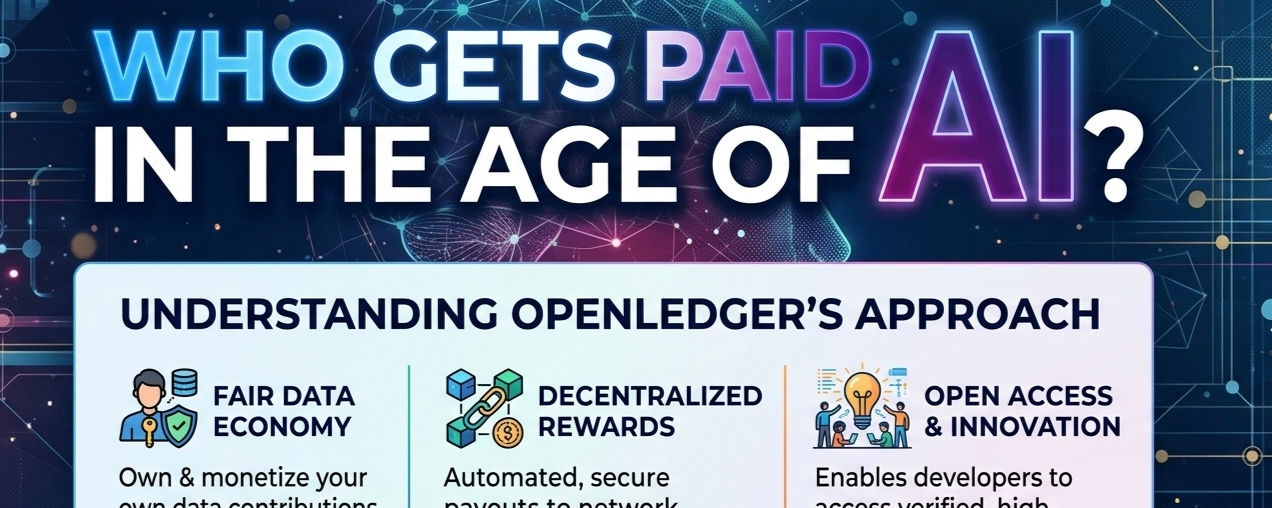
I think of OpenLedger as one of those ideas that sits right on the edge between genuinely necessary innovation and slightly over-ambitious infrastructure design. When I look at it through my own lens, what stands out first is not the blockchain layer or the token mechanics, but the emotional problem it is trying to respond to: I see a world where almost all modern intelligence is built on data that people and institutions generate, yet the rewards for that intelligence flow almost entirely to a very small number of platform owners.
That imbalance has been building for years, but AI makes it much more visible. Every interaction, every dataset, every labeled medical image, every clickstream, every clinical note quietly becomes part of systems that generate enormous economic value. I think OpenLedger is essentially trying to say: what if that hidden labor was no longer invisible, and what if it could actually be tracked and compensated in a structured way?
When I try to be both optimistic and skeptical at the same time, I feel two things in parallel. The optimistic side of me sees something almost fair in the idea. If a hospital contributes imaging data that improves cancer detection models, or if thousands of users indirectly improve a fraud detection system just by existing in the dataset, then it feels intuitive that some form of value should flow back to them. There is a kind of moral simplicity in that idea that is very appealing, especially in healthcare where the stakes are literally life and death.
But the skeptical side of me immediately runs into the complexity wall. I know how machine learning actually works in practice. Most value does not come from a single data point or a clearly traceable contribution. It comes from massive aggregation, noisy signals, and statistical interactions that are almost impossible to decompose cleanly. So when I hear about “monetizing data contributions,” I immediately ask myself: how do you actually measure that without turning it into an approximation that eventually becomes arbitrary?
In real-world healthcare workflows, for example, I imagine something like radiology AI. Hospitals generate MRI and CT scans every day. Those scans get anonymized, cleaned, labeled, and then used to train diagnostic models. Today, the hospital typically doesn’t get ongoing compensation once the data leaves its system. If OpenLedger-style infrastructure were applied, each scan could theoretically be registered as a data asset with consent metadata attached, and every time it contributes to model training or inference improvement, a micro-attribution reward could be triggered back to the source institution.
But then I immediately think about what that would actually require operationally. You would need extremely robust anonymization, regulatory compliance across different jurisdictions, and a trusted system that can prove usage without exposing sensitive patient information. In healthcare, even the perception of weak privacy guarantees can stop adoption entirely. So while the idea sounds clean on paper, in practice it becomes a regulatory and engineering negotiation more than a pure technical solution.
I also think about finance as another real-world parallel. Fraud detection systems rely heavily on shared behavioral signals across institutions. If those signals were tokenized and tracked, in theory every contributing bank could be compensated based on how much their data improves predictive accuracy. That sounds elegant, but I know from experience in data science that attribution in multi-variable models is incredibly unstable. The system does not behave like a set of isolated contributions; it behaves like a blended probability surface. So any attempt to assign precise economic value to individual contributions risks becoming more of a narrative than a measurement.
What I find interesting about OpenLedger, though, is that even if perfect attribution is impossible, imperfect attribution might still be useful. If it can at least create directional incentives—rewarding high-quality data providers, discouraging low-quality or spam data, and making data lineage more visible—that alone could change how AI pipelines are built. I think that is where the most realistic value lies, not in perfect accounting, but in better visibility and partial economic feedback loops.
When I think about who would actually use this, I don’t imagine individual users benefiting directly in most cases. I think it would be institutions: hospitals, biotech firms, large SaaS companies, maybe even governments. These are entities that already struggle with data governance, compliance, and monetization. For them, having a structured layer that tracks data usage across AI systems could be valuable even if the payments are indirect or pooled.
At the same time, I cannot ignore the operational friction. The AI industry in 2026 is already moving toward hybrid infrastructure—centralized model training with stricter data governance, plus selective decentralization for provenance and auditability. In that environment, anything that adds complexity to training pipelines is at risk of being ignored unless it integrates seamlessly. Developers care about performance, latency, and compliance first. Ideology comes later.
I also think there is a subtle psychological risk here. When you turn data into a financial asset at a very granular level, you risk incentivizing behaviors that are not aligned with quality. People may start optimizing for “rewardable data generation” rather than meaningful signal creation. In sensitive domains like healthcare, that could even distort data collection practices in subtle ways.
Still, I don’t dismiss the direction entirely. I think there is something real happening underneath all of this: data is becoming a first-class economic object. We are slowly moving from a world where models are the main product to a world where data provenance, exclusivity, and legality are the real competitive advantage. In that shift, systems like OpenLedger are trying to build early infrastructure for something that may become standard later, even if the current implementation is imperfect.
So my overall feeling is not that this is either clearly right or clearly wrong. It feels more like an early, slightly uncomfortable attempt to formalize something that the AI industry has not yet fully figured out how to handle. I find it intellectually compelling, but I remain cautious about how directly it can translate into real-world economic precision.
If it succeeds, I think it will not be because it perfectly solves data monetization. It will be because it makes data lineage, consent, and usage more transparent in ways that enterprises actually adopt without disrupting their workflows. And if it fails, it will probably be because the system becomes too abstract, too heavy, or too detached from the practical reality of how AI systems are built and deployed today.