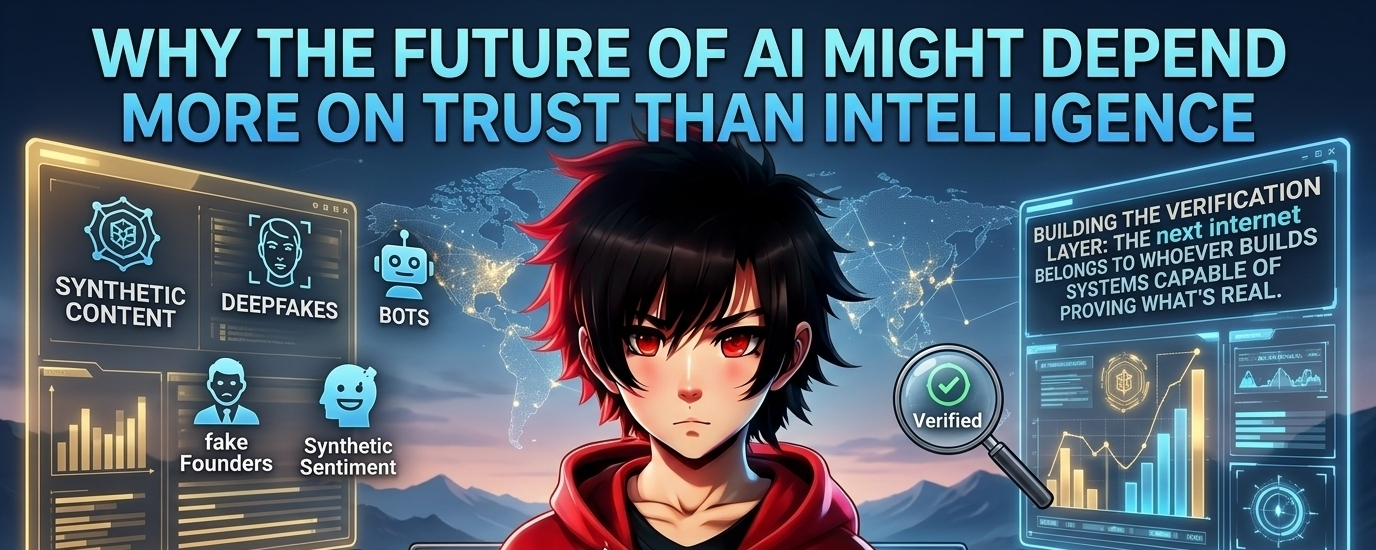
A few years ago, the internet had flaws, but at least it still felt human.
Now everything feels slightly distorted.
Threads are written by AI.
Replies are written by AI.
News summaries are generated before real people even process the event itself.
Sometimes I read a viral post and genuinely can’t tell whether there’s an actual person behind it or just a system optimized to imitate conviction.
That’s not a small shift.
And I think people in crypto are underestimating how much this changes market behavior.
Because markets don’t only run on liquidity.
They run on trust.
Trust in information.
Trust in narratives.
Trust that the person on the other side of the screen is even real.
The strange part is that AI is quietly eroding all three at the same time.
You can already feel it happening.
Projects manufacturing artificial engagement.
Fake founders building fake communities around fake momentum.
Bots amplifying sentiment until perception itself becomes detached from reality.
Honestly, the internet is starting to feel less like a network of humans and more like an environment of competing algorithms pretending to be human.
That thought sits in the back of my mind more than it probably should.
Because once trust collapses, digital economies become fragile very fast.
And this is where OpenLedger becomes interesting to me.
Not from a hype perspective.
From an infrastructure perspective.
Most AI projects today are obsessed with acceleration:
more scale, more automation, more output.
Very few are asking the harder question:
How do you build systems people can still verify once AI becomes deeply integrated into finance, media, governance, and online identity?
That’s a completely different problem.
OpenLedger positioning itself around trusted AI infrastructure feels more important than the market currently realizes.
Not because trust sounds exciting.
Actually, trust is usually invisible when it works correctly.
Nobody thinks about internet infrastructure until it fails.
Nobody thinks about financial plumbing until withdrawals stop.
Nobody thinks about verification layers until manipulation becomes impossible to ignore.
And maybe that’s where all this is heading.
Because the next internet probably won’t belong to whoever creates the smartest AI model.
It’ll belong to whoever builds the systems capable of proving what’s real inside an environment flooded with synthetic intelligence.
That future feels closer than most people are comfortable admitting.