Over the last few months, I’ve noticed something subtle changing with OpenLedger.Not hype. Not sentiment. Not the usual cycle where people suddenly start forcing a narrative because the market is bored.
I mean the project itself is starting to feel more like a system that actually wants to be used.
That shift matters to me because there’s a big difference between a protocol that sounds intelligent and one that survives contact with real users. Earlier on, I honestly wasn’t sure which category OpenLedger would fall into. A lot of AI + blockchain projects can look convincing from a distance. Clean branding, ambitious architecture, endless promises about “redefining data ownership.” But once you zoom in, you realize most of the activity is still conceptual.
Lately though, OpenLedger feels a little different.
The ecosystem surface is getting harder to dismiss as just theory. There’s more visible infrastructure now — explorer activity, AI tooling, staking flows, AI Studio, wallet integrations, actual product pathways. None of this automatically means success, but it does change the conversation. A project starts getting judged differently once people can interact with it instead of only imagining what it might become someday.
That’s probably why the Trust Wallet integration caught my attention more than the average partnership announcement usually does.
Not because partnerships alone mean anything. Most don’t.
But if OpenLedger’s verifiable AI layer actually gets embedded into a consumer-facing wallet experience, that’s one of the first moments where the project’s ideas could collide with normal user behavior instead of crypto-native speculation. And honestly, that’s where most systems either mature or break.
The theory sounds strong: AI interactions tied to attribution, explainability, and ownership inside products people already use. But theory is always cleaner than reality. Real users are impatient. Edge cases appear everywhere. Infrastructure suddenly matters more than vision decks.
That’s the part I’m watching closely now.
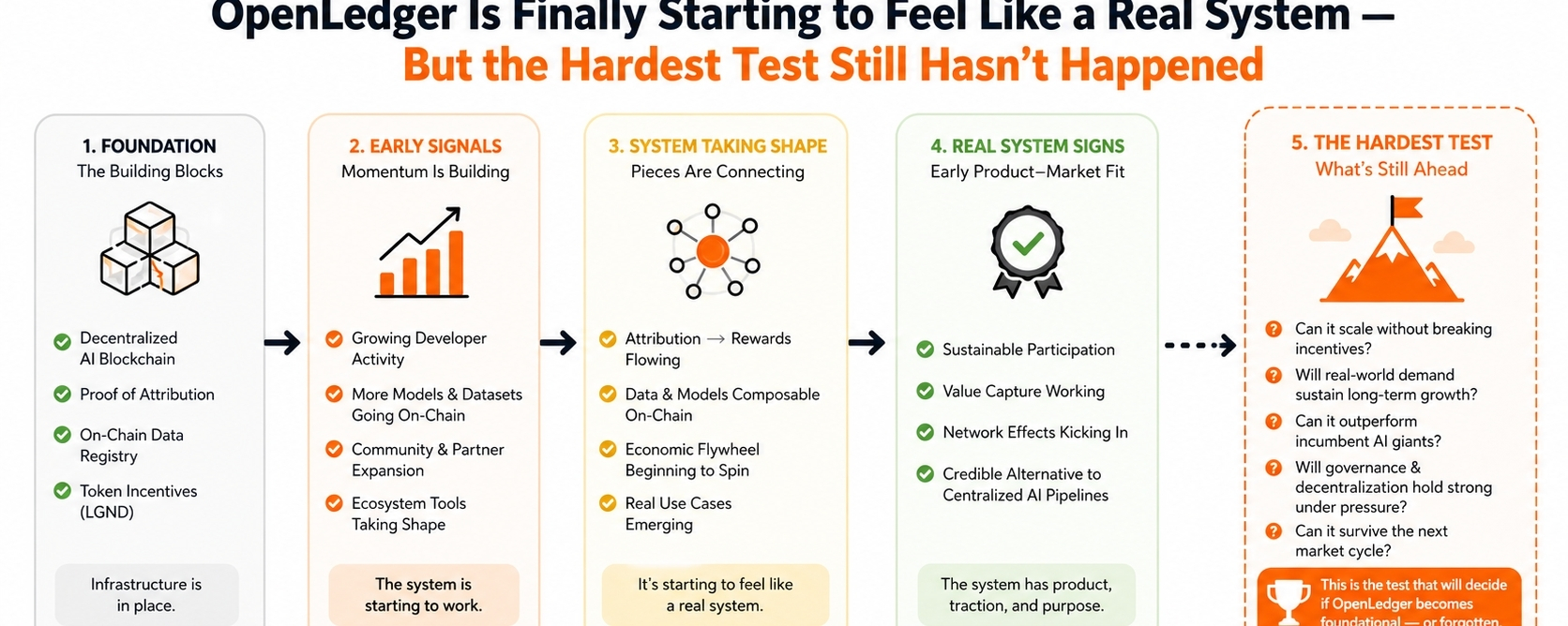
What also changed my perspective slightly is that OpenLedger is no longer presenting itself like disconnected components floating around a narrative. The stack is starting to connect into something more coherent Datanets, model creation, attribution systems, deployment tooling, incentive layers. I can at least see the shape of what they’re trying to build now.
But I still think the hardest part is ahead.
Because architecture is not the same thing as reliability.
A system can sound elegant and still fail once demand becomes unpredictable or incentives become adversarial. Crypto has a long history of platforms looking revolutionary right up until users stress-test them in ways the designers never expected.
That’s why I’m still careful with my optimism here.
I do think OpenLedger has moved meaningfully closer to real-world usefulness compared to where it was a few months ago. The project feels more operational now. More exposed to reality. More accountable to whether the product actually works.
At the same time, I don’t think the important questions have been answered yet.
I still want to see whether usage continues without artificial incentive pressure. I still want proof that builders stay after the announcements fade. And most importantly, I want to know whether Proof of Attribution remains dependable once the system operates under heavier load and more chaotic conditions.
That’s the update to my mental model right now.
Not bullish conviction.
Not dismissal either.
Just a growing sense that OpenLedger is finally approaching the stage where execution matters more than narrative — and honestly, that’s the first time I’ve started paying closer attention again.
Maybe that’s why OpenLedger feels different to me now.
Not because it already proved everything — but because it’s finally entering the phase where failure becomes possible.
And strangely, that makes the progress feel more real.
Narratives survive in comfort. Infrastructure survives under pressure.
The next chapter will not be decided by announcements, hype, or engagement numbers.
It will be decided by whether this system still works when nobody is patient anymore.
And honestly, I think that moment is getting closer than most people realize.