
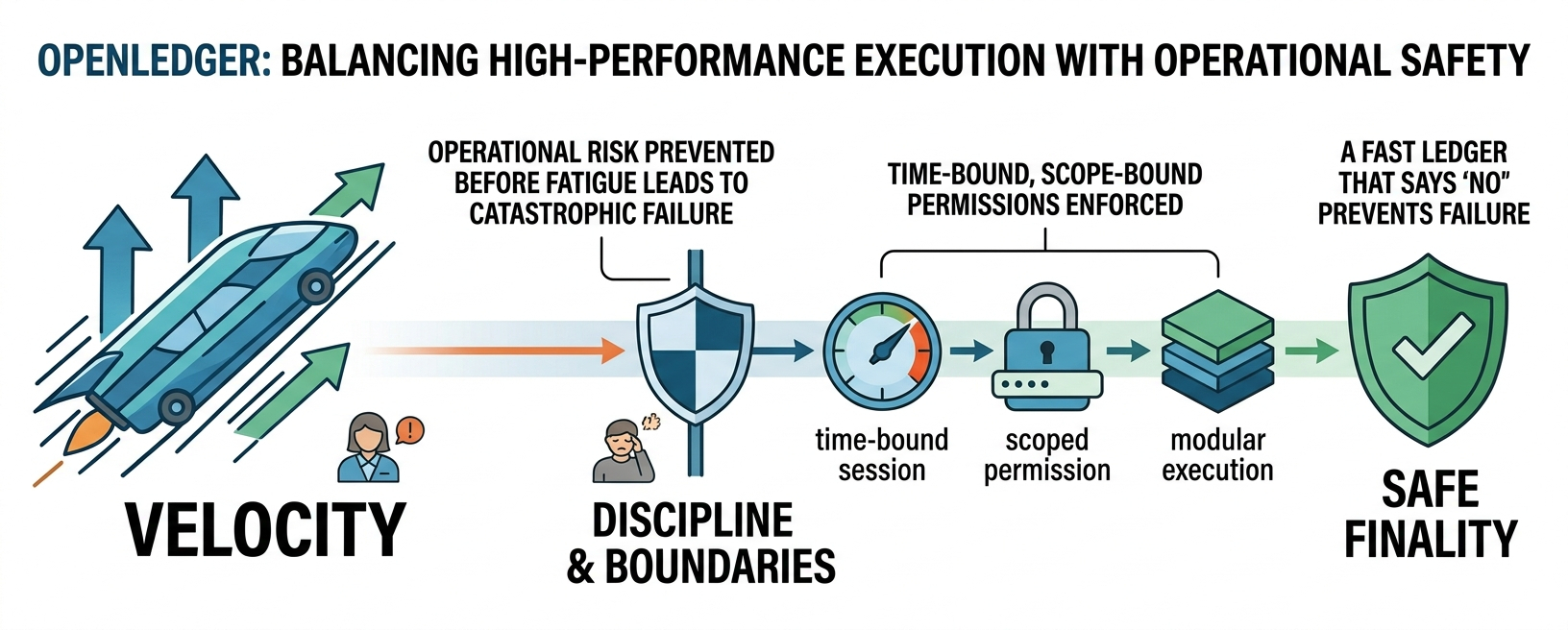
I stopped treating throughput charts as evidence of safety after the third 2 a.m. escalation call in a single quarter.
The dashboards always looked healthy. Finality stayed low. Validators stayed online. TPS numbers climbed high enough for people to confuse velocity with discipline. Then someone opened the permissions log and the room went silent.
That was usually the real incident surface.
Not congestion. Not latency. Not slow blocks.
Permissions granted too broadly. Wallet approvals signed too quickly. Session keys left open longer than anyone remembered. Operators exhausted enough to approve access they would normally challenge twice during daylight hours. Most systems do not fail because computation becomes expensive. They fail because trust becomes invisible.
Risk committees eventually learn this the hard way. Audit teams do too.
The first phase of every infrastructure cycle tends to worship speed. Faster execution becomes the metric everyone understands because it can be measured cleanly and displayed publicly. Lower latency. Higher throughput. Bigger charts. But the operational failures that matter rarely announce themselves through declining performance. They emerge quietly through accumulated exposure.
One approval becomes permanent.
One bridge assumption goes unquestioned.
One delegated permission survives beyond its intended scope.
Then an ordinary Tuesday turns into a forensic investigation.
Trust doesn’t degrade politely—it snaps.
That is partly why OpenLedger caught my attention.
Not because it presents itself as another high-performance chain. The industry already has enough of those. What matters is the design philosophy underneath the performance claims. OpenLedger approaches infrastructure like a system that expects operators, users, and institutions to eventually make mistakes under pressure. That assumption changes architecture.
OpenLedger is built as an SVM-based high-performance L1, but the interesting part is not the execution speed alone. The more important decision is the insistence on guardrails around execution itself. There is a visible recognition that unrestricted velocity eventually becomes operational risk.
The industry spent years pretending security and usability existed on opposite sides of a tradeoff curve. Either users signed constantly and suffered friction, or systems abstracted approvals until accountability disappeared completely. Neither model scaled cleanly.
OPEN Sessions feels like a direct response to that problem.
Instead of forcing perpetual wallet exposure or infinite delegated authority, sessions become enforced boundaries. Time-bound. Scope-bound. Explicitly constrained. Permissions exist for a reason, for a duration, and inside a defined operational perimeter. That matters more than most throughput benchmarks people argue about online.
Scoped delegation + fewer signatures is the next wave of on-chain UX.
Not because convenience is inherently valuable, but because exhausted humans are predictable attack surfaces. The more often systems force users into repetitive approval patterns, the more likely those users become conditioned to ignore risk signals entirely. Eventually every popup looks identical. Every signature request feels routine. That is when operational safety collapses.
OpenLedger appears to understand that trust should expire by default.
The architecture reflects the same philosophy higher in the stack. Modular execution above a conservative settlement layer creates separation between performance experimentation and final state assurance. That separation matters operationally because it prevents every innovation cycle from contaminating the settlement foundation itself. Systems mature when they stop assuming every layer deserves equal freedom.
Even EVM compatibility feels positioned less as ideology and more as friction reduction. Tooling portability matters because operational complexity compounds risk. Every unfamiliar environment increases the chance of human error, rushed deployment, or poorly understood assumptions. Mature infrastructure reduces unnecessary cognitive load where possible.
The native token exists inside that framework less as spectacle and more as security fuel. Staking, in that context, stops looking like passive yield machinery and starts resembling institutional responsibility. Economic participation becomes tied to validation discipline rather than narrative momentum.
None of this removes risk entirely.
Bridges remain difficult. Cross-chain assumptions still introduce exposure. Liquidity moving between environments will always create pressure points because security standards rarely travel evenly across ecosystems. The moment assets leave a controlled settlement domain, inherited assumptions begin to weaken. History already contains enough examples of what happens when interoperability outruns operational caution.
The uncomfortable truth is that most catastrophic failures are rarely technical surprises. Audit logs usually show warning signs long before collapse. The permissions were too broad. The signer topology was fragile. Session exposure lasted too long. Escalation procedures failed quietly until they failed publicly.
People like to imagine infrastructure disasters as dramatic moments of chaos. In reality they often begin with someone clicking “approve” after midnight because the system trained them to stop asking questions.
That is why safety matters more than raw speed.
A ledger that executes instantly but cannot enforce boundaries eventually transfers all responsibility back onto human attention spans. That is not decentralization. That is exhaustion disguised as efficiency.
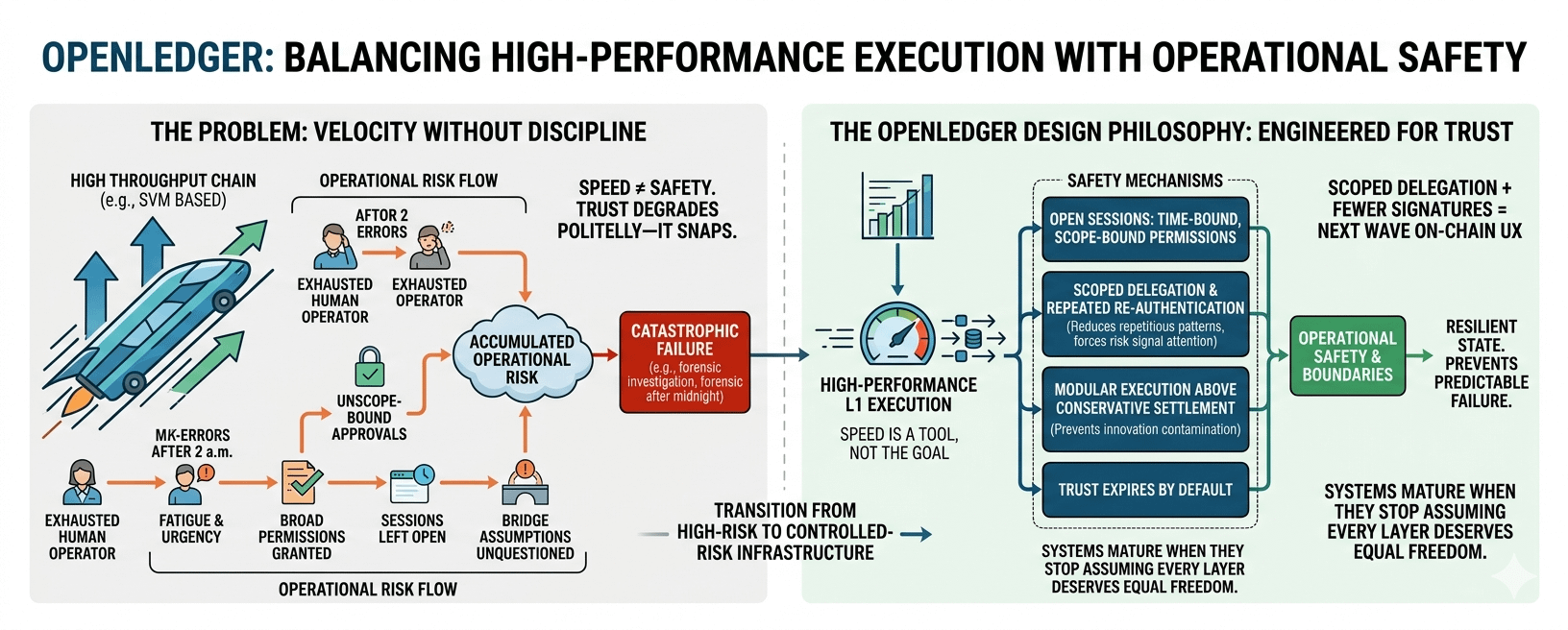
The systems that survive the next decade will probably not be the ones with the most aggressive throughput claims. They will be the ones capable of limiting damage before fatigue, urgency, or misplaced trust turns into irreversible state changes.
OpenLedger feels designed around that quieter understanding.
A fast ledger matters.
But a fast ledger that can say “no” prevents predictable failure.
