
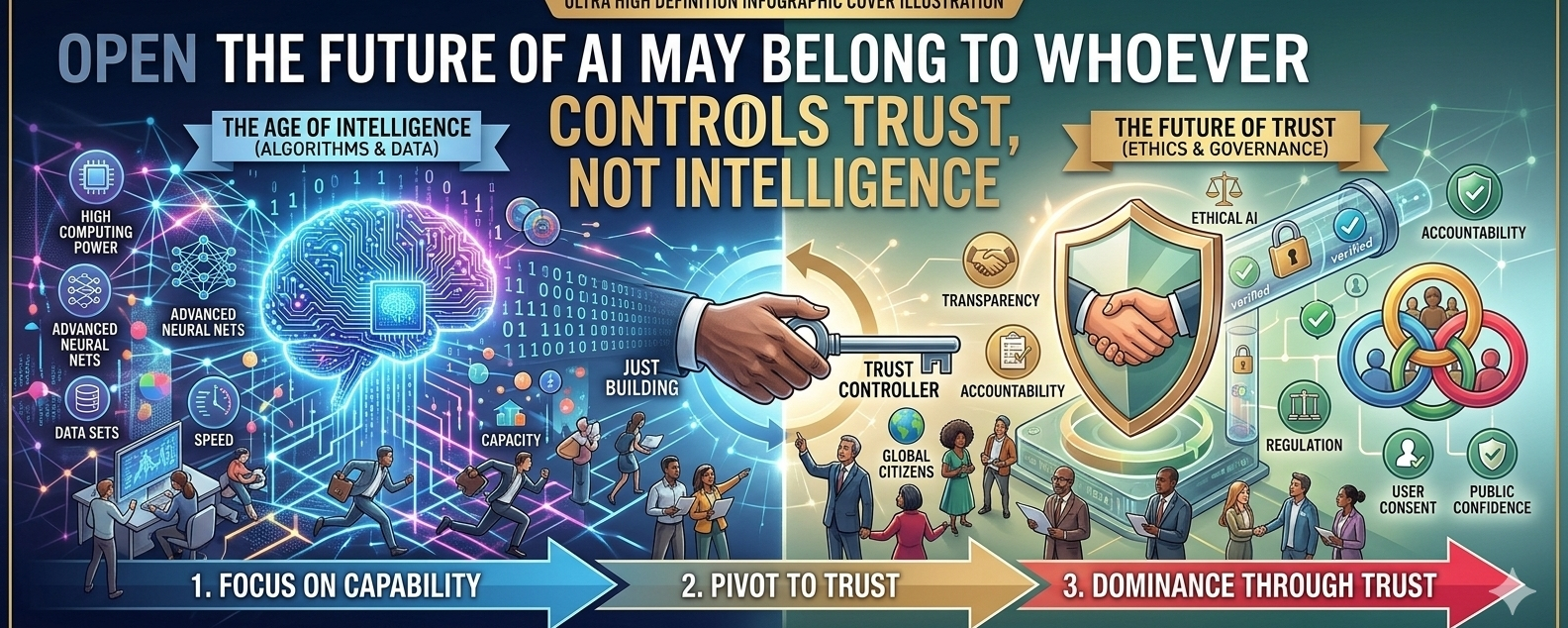
There’s a strange feeling I keep getting lately when I look at AI.
Not fear exactly. And not excitement either. More like the feeling you get when a city changes slowly enough that nobody notices until one night you’re walking home and realize all the stores you used to know are gone.
I think people still talk about AI as if intelligence itself is the scarce thing. As if the main question is who builds the smartest model. Which lab wins. Which benchmark moves two decimal points higher. But I’m not sure that’s where the gravity is anymore. Or at least not where it stays.
Because intelligence is starting to spread out. Diffuse. Leak everywhere.
Every month there are more models. Open models, closed models, fine-tuned models, models pretending to be other models. Small models getting surprisingly good. Cheap models becoming almost good enough. Agents talking to agents. Synthetic voices that no longer sound synthetic unless you listen too carefully. Code generation becoming ordinary in the way calculators became ordinary. Quietly. Then all at once.
And abundance changes human behavior in weird ways.
When something becomes abundant, people stop asking “can this be created?” and start asking “which one do I trust?”
That shift feels small at first. It isn’t.
I keep thinking about how every explosion of abundance in history eventually creates an invisible architecture of filtering around it. Search engines after websites. Record labels after music became recordable. Curators after information overflow. Verification systems after anonymity. Recommendation systems after infinite choice.
Not because humans love control. Though sometimes they do.
Mostly because human attention collapses under excess.
And AI feels headed there very fast.
Maybe faster than we emotionally understand.
Right now people still marvel at generation itself. A model writes a poem, generates an image, drafts a legal memo, writes software, summarizes a meeting. But eventually generation becomes ambient. Expected. Like electricity humming inside walls. Nobody takes a photo of a light switch anymore.
Then what matters?
I don’t think the answer is intelligence alone.
I think the next layer becomes eligibility.
Which outputs are allowed into systems that matter.
Which agents receive permission.
Which models enterprises can legally deploy without risking lawsuits or regulatory damage or reputation collapse.
Which datasets are considered legitimate.
Which outputs can be traced backward.
Which decisions are auditable.
Which identities are trusted enough to transact economically.
That sounds dry when phrased directly. But I don’t think it’s dry at all. I think it’s where power quietly moves.
Because once creation becomes cheap, filtering becomes expensive.
And filtering is never neutral for long.
You can already feel the early shape of it. A company doesn’t just want an intelligent agent. They want an agent whose reasoning can be inspected after something goes wrong. They want provenance. Logs. Attribution trails. Permission structures. They want to know where the training data came from because eventually someone in legal will ask. Or insurance will ask. Or regulators will ask.
A strange thing happens here.
The model itself almost starts becoming secondary.
Not irrelevant. Just… insufficient.
Like raw intelligence without institutional acceptance attached to it.
And maybe this is where projects like OpenLedger become psychologically interesting — not because “AI plus blockchain” is some magical phrase, honestly most of those combinations feel forced — but because there is an emerging anxiety underneath all of this around attribution and economic legitimacy.
Who contributed what.
Who gets paid.
Which model used which data.
Which agent acted with whose permission.
Which outputs can enter financial systems.
Which identities persist across interactions.
Which intelligence can be trusted operationally, not philosophically.
Operational trust might become more valuable than raw capability.
That sentence keeps bothering me.
Because it suggests the future control layer in AI may sit far away from the intelligence itself.
Not inside the model.
Around it.
The systems deciding whether the model is admissible.
There’s a subtle difference between intelligence people admire and intelligence institutions permit. History is full of brilliant things that systems refused to absorb because they were illegible, unaccountable, politically inconvenient, economically threatening, or simply impossible to standardize.
AI agents are running toward that wall now.
Everyone imagines autonomous agents negotiating contracts, managing workflows, executing financial decisions, coordinating logistics. But an autonomous agent inside a laboratory demo is very different from an autonomous agent inside an insurance company or hospital or government procurement system.
The second environment doesn’t primarily care whether the agent is clever.
It cares whether the agent can be audited at 2:13 AM after a compliance incident.
That’s a very human detail. Maybe the most human detail.
Technology people often underestimate how much civilization runs on procedural reassurance rather than pure efficiency. We tolerate inefficient systems constantly because they preserve accountability structures people psychologically depend on.
And AI is beginning to collide with that reality.
I don’t think most people realize how much recommendation systems already govern perception itself. Not in the dramatic conspiracy sense. In the ordinary infrastructural sense. Ranking systems decide visibility. Visibility decides adoption. Adoption creates legitimacy. Legitimacy attracts capital. Capital reinforces visibility again.
A loop.
Quiet loops are usually the ones that matter.
If millions of AI-generated outputs flood networks every hour, then recommendation layers become existential infrastructure. Which means trust scores become infrastructure. Provenance becomes infrastructure. Identity becomes infrastructure. Reputation graphs become infrastructure.
Not glamorous words. But important ones.
Especially once synthetic media becomes impossible to intuitively detect.
I wonder sometimes whether the future internet starts feeling less open not because governments suddenly close it, but because humans become psychologically unable to navigate unlimited synthetic abundance without heavy trust scaffolding wrapped around everything.
Maybe that’s the real shift.
Not artificial intelligence replacing humans.
But artificial abundance forcing civilization to construct enormous systems of verification around machine output.
And whoever controls verification controls economic access.
That part sits strangely with me.
Because we like to imagine technological revolutions as moments where power decentralizes cleanly. But often abundance creates new chokepoints instead. New gatekeepers emerge exactly where overload becomes unbearable.
Too much information created search monopolies.
Too much media created algorithmic feeds.
Too much AI may create legitimacy monopolies.
Or maybe not monopolies exactly. But dense trust layers that function similarly.
The uncomfortable thing is that many of these systems will probably emerge for understandable reasons. Fraud prevention. Safety. Attribution. Liability management. Enterprise reliability. Compliance standards. None of those are evil goals.
Still, standards shape markets even when nobody announces it openly.
Eligibility standards determine who participates.
And the standards themselves often become more powerful than the technology they evaluate.
That’s the part I keep circling back to late at night.
Not whether models become smarter.
They obviously will.
But who gets recognized as real inside the economic systems built around them.
Which agents can access capital.
Which outputs become discoverable.
Which identities remain trusted after synthetic imitation becomes trivial.
Which datasets are considered clean enough to train on.
Which models are allowed into institutional workflows.
Which chains of attribution survive scrutiny.
A civilization drowning in generated intelligence may become obsessed with proof.
Proof of origin.
Proof of permission.
Proof of accountability.
Proof that something belongs somewhere.
And maybe that’s why this moment feels less like a software race and more like the early construction phase of an invisible bureaucracy for machine cognition.
Not a bureaucracy made of paperwork exactly.
A bureaucracy of trust.
The strange thing is I don’t even think this future arrives through malice. Most systems of control rarely announce themselves dramatically while they’re forming. They emerge gradually as solutions to real coordination problems. People ask for safer outputs. Better rankings. Better filtering. Better reliability. Better attribution.
Then one day the filtering layer becomes the economy itself.
And the models underneath compete for admission into it.
That possibility feels more real to me lately than the louder conversations people keep having about AGI timelines or whether models can “think.”
Because intelligence alone does not decide adoption.
Civilizations adopt what they can operationally absorb.
The rest stays outside the gate.
And maybe that gate is becoming the real story.
