
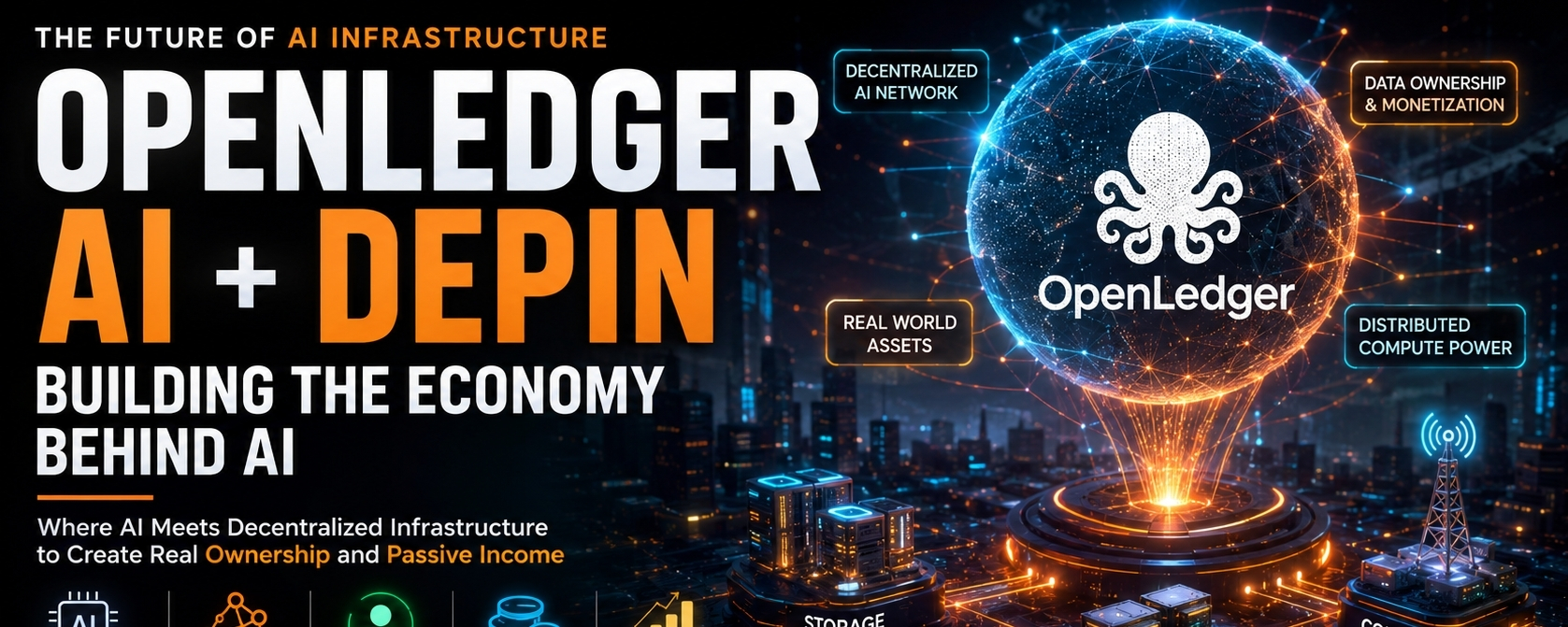
I’ve been in crypto long enough to see the same cycle repeat itself in different disguises.
A new narrative appears.
People rush in.
Everyone talks about the upside.
Almost nobody talks about the structure underneath.
Then a few years later, we realize the real winners weren't always the loudest projects. They were the ones building something the market couldn't function without.
That thought keeps coming back whenever I look at AI.
Right now, the conversation is dominated by models, chatbots, productivity tools, and endless debates about which company is leading the race.
Interesting discussions.
But they all feel a little incomplete.
Because AI doesn't run on hype.
It runs on infrastructure.
The model that answers your question needs data. The data needs storage. The network needs computing power. The computing power needs participants willing to contribute resources. Somewhere beneath every impressive AI demonstration is a giant stack of infrastructure that most people never think about.
And that's where things start getting interesting.
For the last twenty years, the internet has operated on a fairly simple arrangement.
Users create value.
Platforms capture most of it.
We accepted that trade because the services were useful.
Free email.
Free social media.
Free search.
Free everything.
At least on the surface.
The actual payment was hidden in the background through attention, behavior, data, and network effects.
Most people never owned the systems they helped grow.
They simply used them.
Now AI is accelerating this dynamic.
Every interaction teaches systems something. Every piece of data contributes to a larger machine. Every user adds another layer of value.
Yet the ownership question remains largely unanswered.
Who benefits when these systems become exponentially more powerful?
That's not a technical question.
It's an economic one.
And honestly, I think it's the more important question.
This is partly why OpenLedger caught my attention.
Not because it claims to have all the answers.
And definitely not because I'm looking at it through a short-term price lens.
What interests me is the broader thesis behind the project.
The attempt to connect AI and DePIN in a way that turns participation into something more meaningful than passive consumption.
Most people hear "DePIN" and immediately think about hardware, nodes, or resource sharing.
But underneath all the terminology, the idea is surprisingly simple:
Can the infrastructure powering future technologies be owned and supported by a distributed network instead of a handful of centralized entities?
That's a much bigger idea than most people realize.
Because if AI becomes as important as many expect, then the infrastructure layer becomes incredibly valuable.
History tends to reward infrastructure.
The companies that built railroads mattered.
The companies that built internet networks mattered.
The companies that built cloud infrastructure mattered.
People often focus on the products they use every day while overlooking the systems quietly enabling those products to exist.
The weird part is that infrastructure usually looks boring until it becomes indispensable.
Nobody gets excited about roads.
Until they're gone.
Nobody talks about electricity.
Until it stops working.
Nobody pays attention to digital infrastructure.
Until half the economy depends on it.
That pattern shows up again and again.
And maybe that's why the intersection of AI and decentralized infrastructure feels important.
Not because it's guaranteed to succeed.
Nothing in crypto is.
But because it is attempting to address a problem that becomes larger every year: the growing gap between participation and ownership.
Millions contribute.
A few benefit.
That model has worked remarkably well for large corporations.
The question is whether it remains the only model available.
Maybe OpenLedger succeeds.
Maybe it doesn't.
Markets are unpredictable.
Execution matters.
Adoption matters.
Timing matters.
But I think the underlying question survives regardless of what happens to any individual project.
As AI becomes woven into daily life, will ordinary participants simply feed the machine?
Or will they own a piece of it?
I suspect that question will end up being far more important than which AI model wins the current race.
And by the time most people start asking it, the answer may already be taking shape.