
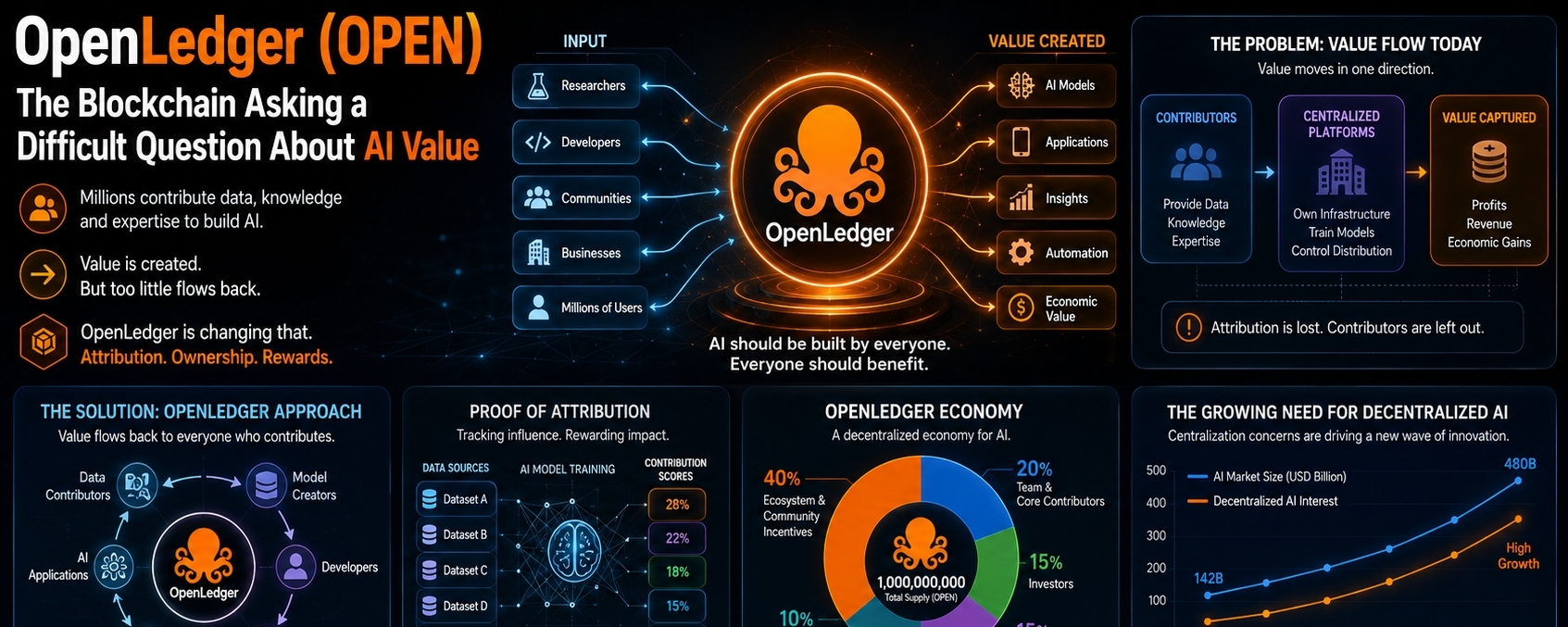
Artificial intelligence has become one of the defining technologies of this decade. Investment continues to pour into new models, infrastructure, and applications, with companies racing to build the next breakthrough.
Yet beneath the excitement lies a quieter reality that rarely receives the same level of attention.
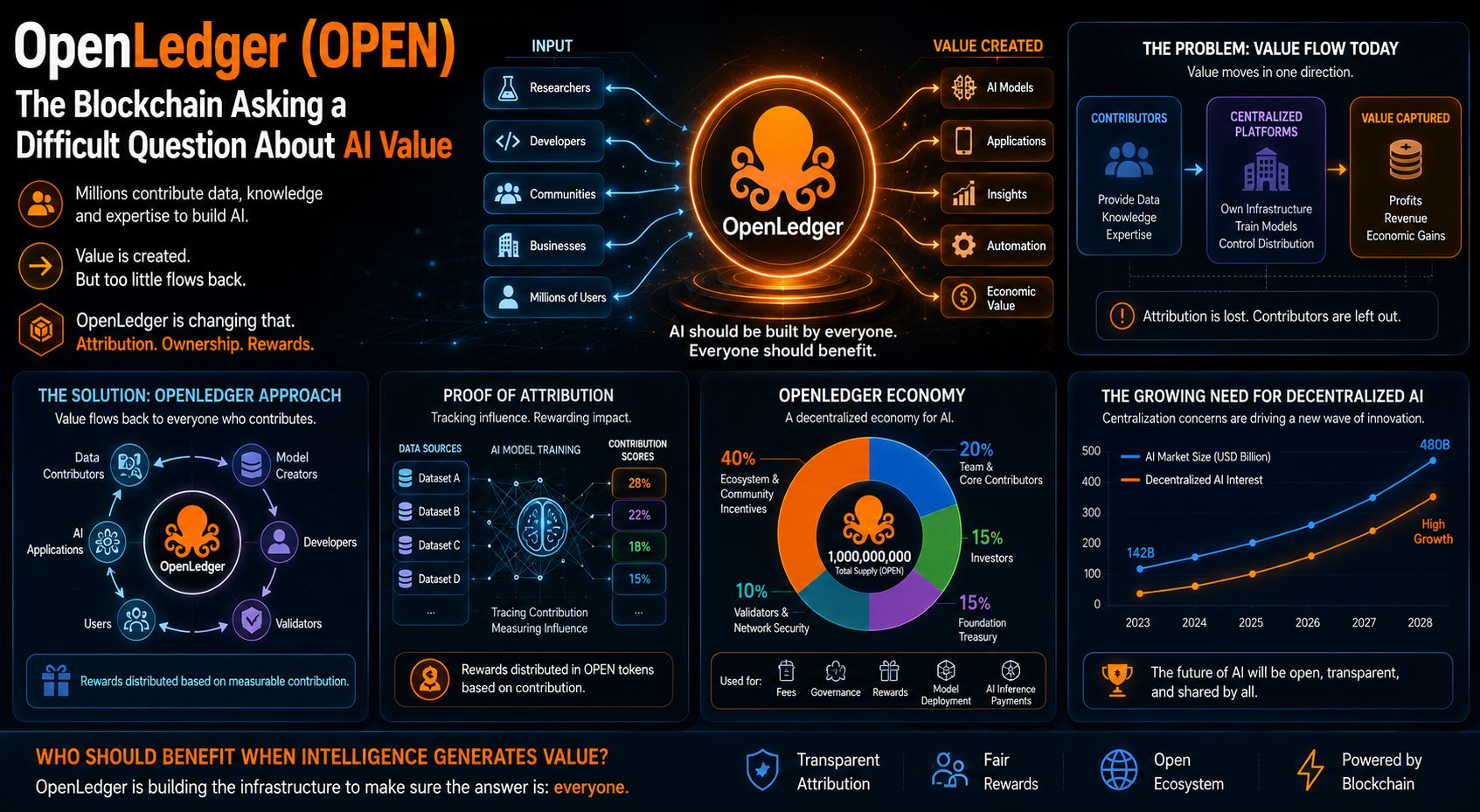
Every AI system is built on an enormous foundation of human contribution. Researchers publish findings. Developers create tools. Communities share knowledge. Businesses generate data. Millions of people produce the information that eventually feeds these systems.
But when value is created, very little of it tends to flow back to the people who helped make it possible.
Most of the economic rewards remain concentrated among the organizations that own the infrastructure, train the models, and control distribution. Everyone else contributes to the process, but their role often disappears once the data enters the system.
That's the gap OpenLedger is trying to address.
OpenLedger (OPEN) is built around a deceptively simple premise: if data contributes to the creation of value, the people behind that data should have a way to participate in the rewards. Rather than treating information as a resource that gets absorbed into centralized platforms, the project aims to make data, models, and AI agents traceable, attributable, and economically valuable.
At first glance, it sounds like another blockchain project attaching itself to the AI narrative. There is certainly no shortage of those.
But here's where things get interesting.
OpenLedger isn't primarily focused on making AI faster, cheaper, or more powerful. Its focus is ownership. Attribution. Economic participation.
In other words, it's asking a question much of the industry still struggles to answer:
Who should benefit when intelligence generates value?
The Economy Beneath the Models
Most AI discussions revolve around what models can do.
People debate reasoning capabilities, autonomous agents, image generation, productivity gains, and performance benchmarks. That's where the spotlight usually lands.
What's easier to overlook is everything underneath.
The datasets.
The training material.
The specialized knowledge.
The countless contributions that shape how a model understands the world.
Without those inputs, even the most sophisticated system would have very little to work with.
Yet once data enters a training process, its origins often become difficult to track. Attribution fades. Ownership becomes blurry. The economic connection between contribution and reward largely disappears.
The result is a system where value tends to move in a single direction.
Companies own the infrastructure. Users generate data. Researchers contribute expertise. Developers improve performance.
But connecting those contributions to financial outcomes remains remarkably difficult.
OpenLedger's argument is that AI is missing a critical layer—one capable of recording contributions and distributing value more transparently.
The important part is that this isn't simply about recognition. It's about economics.
Because once contributions can be identified, they can potentially be rewarded.
And that changes the conversation entirely.
Looking Beyond the Usual AI-Blockchain Narrative
The intersection of AI and blockchain has become increasingly crowded over the last few years.
Nearly every project claims to be building some form of decentralized intelligence. Many promise open ecosystems. Others focus on compute networks or model marketplaces.
OpenLedger takes a different path.
Its primary focus is attribution.
The platform introduces what it calls "Datanets"—community-owned datasets designed to support the development of specialized AI models. Participants can contribute data, improve existing datasets, train models, and deploy applications while those activities are recorded on-chain.
On paper, it sounds technical.
In practice, the idea is fairly straightforward.
Imagine a medical dataset that helps improve healthcare-focused AI. Or a financial knowledge base that contributes to forecasting models. Or a highly specialized collection of industry expertise that becomes valuable for a niche application.
If those resources help create products or services that generate revenue, OpenLedger wants contributors to share in that economic activity.
That represents a meaningful shift from the dominant model today, where valuable datasets are often absorbed into closed ecosystems and largely disappear from public visibility.
Instead of treating data as a one-time input, OpenLedger treats it as an asset that can continue generating value long after it has been contributed.
That's the bigger shift happening underneath.
The Hard Problem: Attribution
At the center of OpenLedger's architecture is a mechanism known as Proof of Attribution.
The idea sounds simple enough.
Which data actually contributed to a particular outcome?
The challenge, of course, is that AI systems are anything but simple.
Modern models process enormous volumes of information across highly complex training environments. Determining which data points influenced a specific output is one of the more difficult technical questions in the field today.
OpenLedger's approach attempts to address that challenge by tracing data influence and distributing rewards based on measurable contributions. When value is generated, contributors whose data played a meaningful role can receive compensation through OPEN tokens.
If it works, the implications could be significant.
One of the most common criticisms of modern AI systems is their opacity. Users receive answers, predictions, and outputs without much visibility into where those results come from or whose contributions helped shape them.
OpenLedger is trying to make those relationships more transparent.
And honestly, that's where both the opportunity and the risk exist.
The concept is compelling.
The execution is considerably harder.
Building attribution systems that are accurate, scalable, and trusted across large networks remains an unsolved challenge. Whether OpenLedger can bridge that gap will likely determine how far the project ultimately goes.
Creating an Economic Layer Around AI
OpenLedger's ambitions extend beyond rewarding data contributors.
The network is also designed to support developers, model creators, validators, and application builders.
Developers can deploy models onto the network and make them accessible through OpenLedger's infrastructure. When those models are used, fees are paid through the OPEN token, creating potential revenue opportunities for creators.
The broader vision resembles an ecosystem where multiple participants contribute and benefit simultaneously.
Data contributors supply information.
Developers build models.
Validators secure the network.
Users access services.
Rewards are distributed according to measurable participation.
It's an attempt to move away from a world where AI value is concentrated in a small number of centralized platforms and toward a model where economic participation is shared more broadly.
Whether that vision achieves meaningful scale remains uncertain.
But the underlying idea reflects a larger trend emerging across the technology sector: the belief that future AI systems may require entirely new approaches to ownership and incentives.
The Role of the OPEN Token
Like most blockchain ecosystems, OpenLedger relies on a native token to coordinate activity.
OPEN serves multiple functions within the network. It is used for transaction fees, governance, model deployment, contributor rewards, and payments tied to AI inference.
The project's tokenomics place considerable emphasis on ecosystem growth and participation. Total supply is capped at one billion tokens, with significant allocations directed toward incentives intended to support contributors and encourage network activity.
For investors, however, token mechanics are only part of the story.
Adoption is what matters.
Many blockchain projects spend years trying to discover practical utility after launch. OpenLedger faces a different challenge. The use case already exists. The real question is whether enough people find it valuable enough to participate.
If contributors, developers, and businesses actively use the network, demand for the token could grow alongside ecosystem activity.
If they don't, OPEN risks becoming another speculative asset disconnected from meaningful usage.
Ultimately, the market tends to be unforgiving about that distinction.
Why Decentralized AI Is Gaining Attention
OpenLedger enters the market at a time when concerns about concentration in AI are becoming harder to dismiss.
A relatively small number of organizations control much of the industry's computing power, proprietary data, and financial resources. Supporters argue that this concentration accelerates progress.
Critics see potential problems.
Questions around transparency, accountability, access, and ownership continue to grow as AI systems become more influential.
As a result, interest in decentralized alternatives has expanded steadily. Researchers and developers are increasingly exploring models that combine blockchain infrastructure with machine learning in an effort to distribute participation more broadly across networks rather than institutions.
OpenLedger sits squarely within that movement.
Its success does not depend on replacing established AI companies. In many ways, that isn't the objective.
Instead, the project offers an alternative framework for those who want greater visibility into how AI systems are built, trained, and monetized.
That distinction matters because the future is unlikely to belong entirely to one model.
The AI ecosystem will probably become a mix of centralized and decentralized approaches, each serving different needs and different users.
OpenLedger is betting that transparency, attribution, and participation will become increasingly important within that landscape.
It's a reasonable thesis.
Whether it's enough to create a sustainable network remains the open question.
Final Thoughts
OpenLedger is attempting something more ambitious than launching another blockchain token.
At its core, the project is challenging one of the fundamental assumptions behind today's AI economy.
Who deserves to benefit from the value that intelligent systems create?
The answer isn't obvious.
What is clear is that data has become one of the most valuable resources in the digital world, while the people who generate, curate, and improve that data often remain disconnected from the rewards.
OpenLedger's attempt to close that gap addresses a real issue.
The challenge, as always, lies in execution.
Building reliable attribution systems is difficult. Creating incentives that attract developers, contributors, and businesses is difficult. Scaling a new economic model around AI may be even more difficult.
Still, the question OpenLedger is asking feels increasingly relevant.
As AI becomes more deeply woven into everyday life, debates around ownership, transparency, and economic participation are only going to grow louder.
Whether OpenLedger ultimately succeeds or not, the conversation it is trying to start is unlikely to disappear anytime soon.