
In today's AI race, most attention goes to what people can immediately see. New chatbots appear every week, AI assistants become more capable, and autonomous agents continue to attract headlines. These products often become the face of artificial intelligence, making it easy to believe that the model itself is the ultimate achievement. Yet when looking deeper, an important question emerges: what happens before an AI model reaches users, and what motivates people to continue improving it after it is launched? This is where OpenLedger introduces a perspective that feels refreshingly different from many projects competing in the same space.
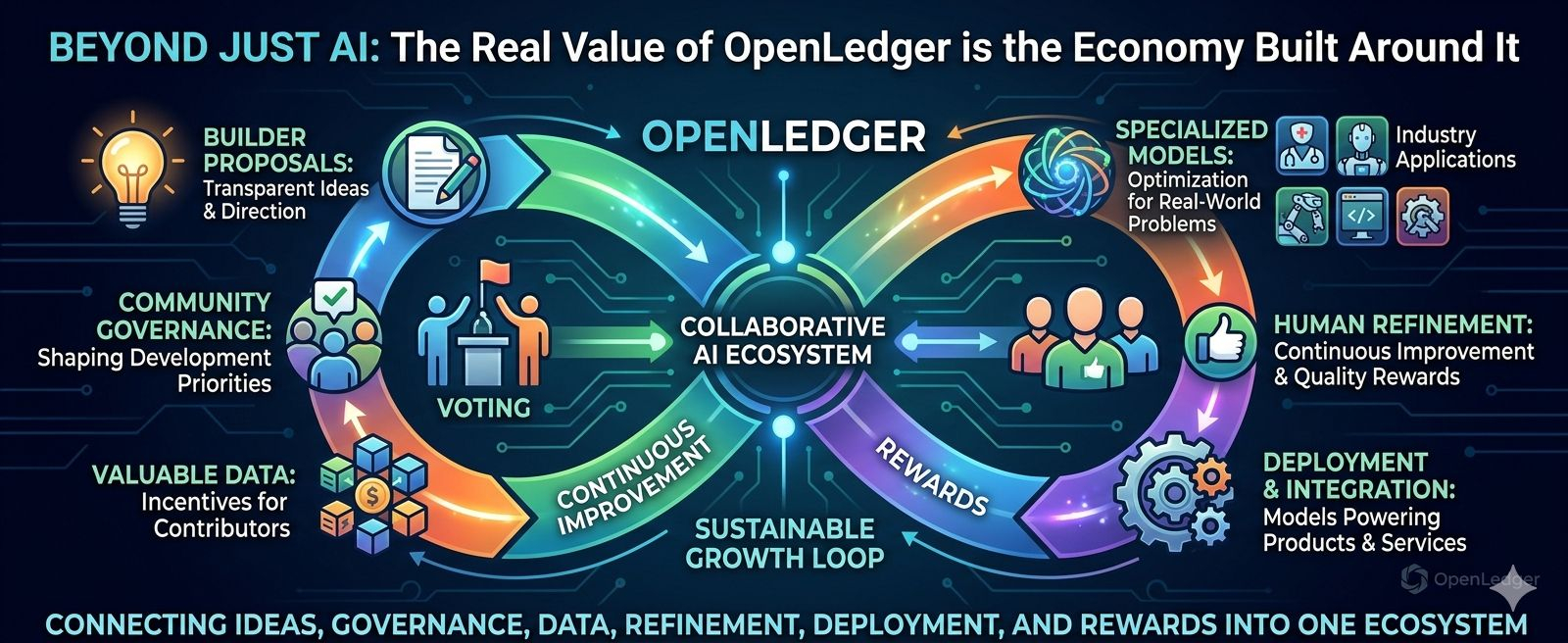
Instead of treating AI as a finished destination, OpenLedger approaches it as a living network powered by participation, incentives, and continuous improvement. Every successful model begins long before training starts. It begins with an idea. Rather than allowing development decisions to happen behind closed doors, builders can present proposals explaining the purpose of their model, the problem it aims to solve, and the value it can create. This early transparency helps establish direction and ensures that resources are allocated toward initiatives that have genuine relevance rather than simply following trends.
What makes this approach particularly interesting is the role of the community. In many traditional systems, a small group decides which projects move forward and which are ignored. OpenLedger introduces a more collaborative structure where governance participants can help influence development priorities. The result is a process that seeks alignment between creators and users, increasing the chances that useful and meaningful AI solutions receive support. It transforms innovation from something controlled by a few into something shaped by collective participation.
Of course, no AI ecosystem can exist without data. Data is often described as the fuel of artificial intelligence, but not all data carries the same value. The difference between an average model and an exceptional one frequently comes down to the quality, relevance, and uniqueness of the information used during training. OpenLedger recognizes this reality by creating incentives that reward contributors for providing valuable datasets. Instead of treating data as something extracted without recognition, the platform turns it into an asset that can generate economic value for those who contribute. This simple shift changes the relationship between creators and the ecosystem itself.
Once valuable data enters the network, the focus moves toward refinement and specialization. Rather than chasing the idea of building one model that attempts to do everything, the ecosystem encourages the development of models optimized for specific needs and real-world applications. This allows AI to move beyond general-purpose functionality and become increasingly effective in solving targeted problems. Specialization often creates more practical value than scale alone, and OpenLedger appears to understand this distinction.
Human contribution remains equally important throughout the process. AI systems improve when people evaluate outputs, provide feedback, identify weaknesses, and guide optimization. OpenLedger incorporates these contributions into its economic framework, rewarding participants who help improve performance while filtering out activity that adds little value. This creates an environment where quality becomes beneficial for both the ecosystem and the contributor. The incentive structure encourages meaningful participation instead of noise, helping models evolve in a more sustainable way over time.
The journey does not stop once a model has been trained. Through integrations, APIs, applications, and AI agents, these models can become part of larger digital infrastructures that businesses and developers rely upon. At this stage, AI transitions from a research project into something far more impactful. It becomes a functional layer of technology capable of powering products, services, and autonomous systems across multiple industries.
What stands out most is that OpenLedger appears focused on the entire lifecycle rather than a single stage of development. It connects ideas, governance, data, refinement, deployment, and rewards into one continuous ecosystem. Many projects are focused on building smarter AI. OpenLedger seems focused on building the environment that allows smarter AI to emerge, improve, and sustain itself over time. In a future where creating AI models becomes increasingly accessible, the projects that successfully align contributors, incentives, and utility may hold the greatest long-term advantage. That is why OpenLedger's biggest innovation may not be the models themselves, but the economic foundation being built around them.
