
Something about the AI economy feels strangely unfinished.
Not because the models are weak.
Not because the technology is slowing down.
Bigger models. Better reasoning. Faster outputs. More automation. The assumption seems simple: whoever builds the smartest system wins.
The more I look at it, the less convinced I become that intelligence is the real battleground.
I think the more interesting question is who owns the value created by intelligence in the first place.
Because AI does not appear from nowhere.
Every model is built on an ocean of human contribution.
Research papers.
Technical discussions.
Images.
Code repositories.
Specialized datasets.
Years of accumulated knowledge from people who may never receive recognition for the role they played.
That creates a strange imbalance.
The internet trained us to believe that creating value and capturing value were connected activities. If your work helped enough people, visibility usually followed. Visibility brought opportunities. Opportunities created economic rewards.
AI quietly changes that relationship.
Knowledge can now disappear into systems.
A useful explanation posted by an anonymous engineer.
A niche dataset assembled by a researcher.
A detailed thread written by someone with almost no audience.
The contribution remains valuable.
The contributor often becomes invisible.
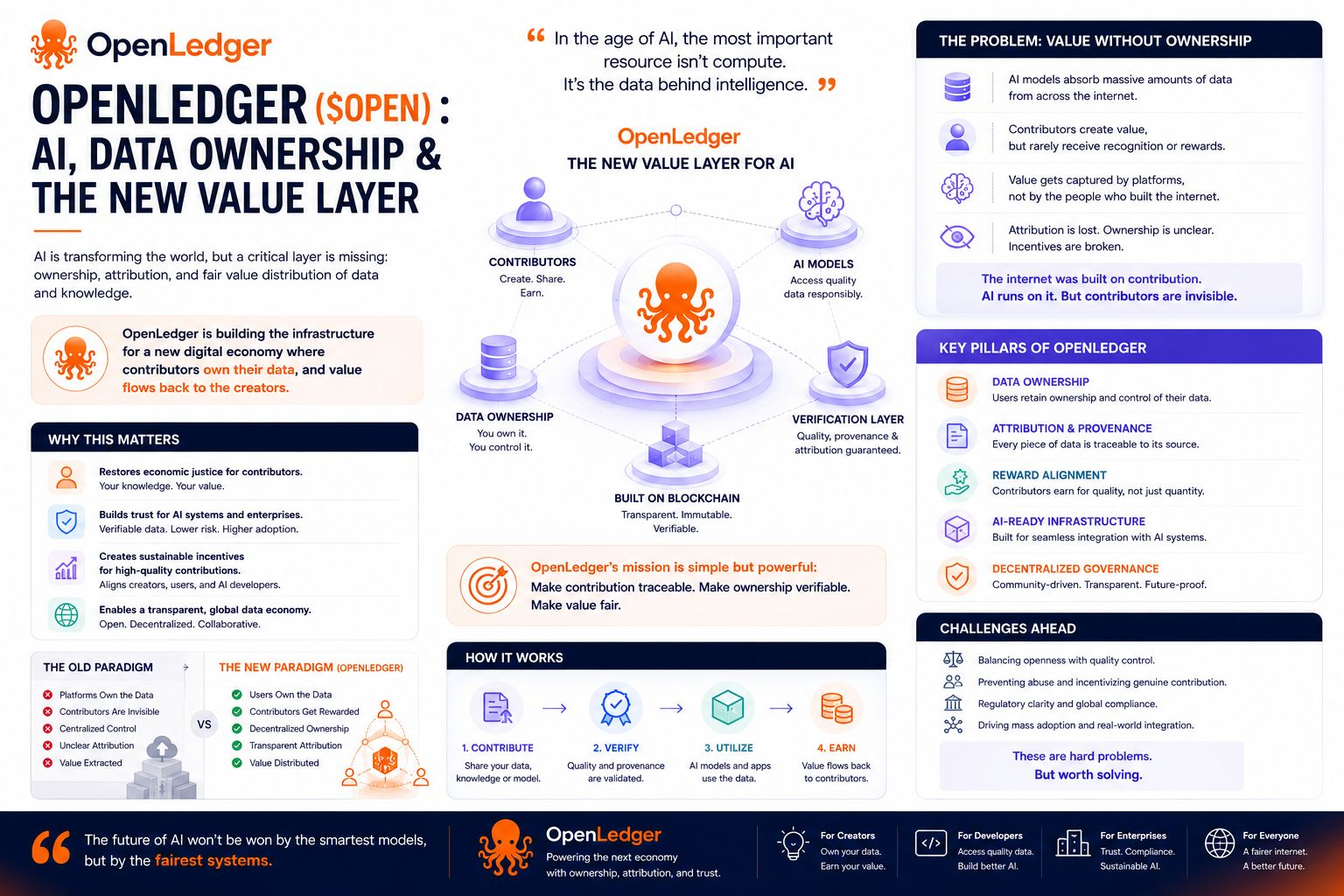
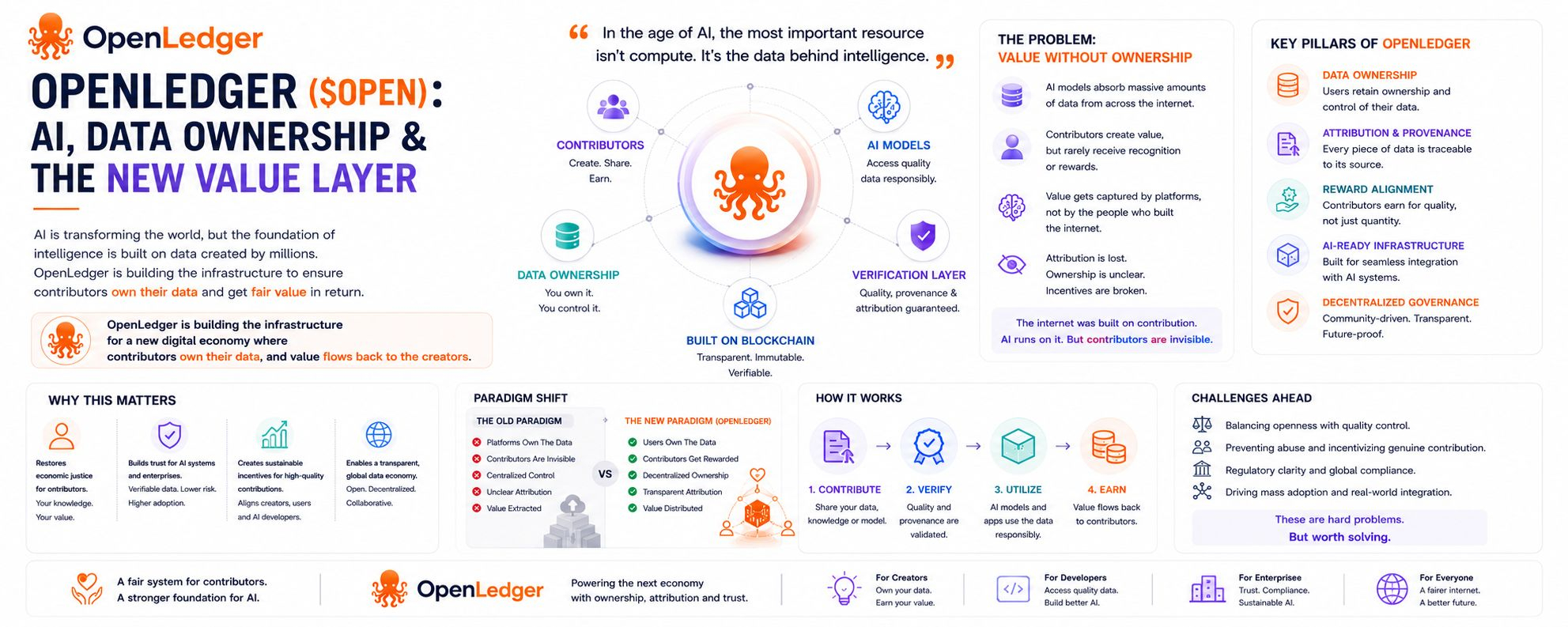
And this is where @OpenLedger started feeling interesting to me.
Not because it promises another AI narrative.
Honestly, the market has plenty of those already.
What caught my attention is that OpenLedger seems focused on something deeper than model performance. It appears to be exploring whether contribution itself can become a traceable economic asset.
That sounds like a small distinction.
I don't think it is.
People describe AI as a technology shift.
But perhaps it is also an ownership shift.
If intelligence increasingly becomes infrastructure, then attribution becomes important. Not only for creators but for institutions as well.
Markets can tolerate uncertainty.
Institutions usually cannot.
Once AI systems begin influencing financial decisions, operational workflows, compliance processes, procurement systems, healthcare environments, or legal frameworks, questions around data provenance stop being philosophical.
They become practical.
Where did the information come from?
Can it be verified?
Can decisions be audited?
Can contributions be traced?
Can incentives remain aligned?
Those questions sound boring compared to AI breakthroughs.
Yet boring infrastructure has a habit of becoming extremely important later.
History repeats this pattern constantly.
People celebrate applications first.
They notice infrastructure afterward.
The internet itself followed this path.
Cloud computing followed this path.
Even decentralized finance followed this path.
Early attention focused on visible outcomes.
Long-term value often accumulated underneath.
That possibility keeps coming back to me when I think about OpenLedger.
Creating a contribution economy sounds elegant in theory.
Reality is harder.
The moment rewards exist, manipulation appears.
People optimize for incentives.
Low-quality submissions flood systems.
Participants search for shortcuts.
Bad actors attempt to extract value without creating it.
This is not a technology problem.
It is a human problem.
Which means any ownership-based data economy must solve two challenges simultaneously.
It must encourage contribution.
And it must protect quality.
Fail either side of that equation and the entire structure weakens.
That is easier said than done.
Perhaps much easier.
The internet itself still struggles with this balance.
Open contribution creates innovation.
Open contribution also creates noise.
Finding the line between openness and reliability may be one of the most difficult coordination problems in digital systems.
Yet that challenge may become increasingly important as AI expands.
Because future economic value might not come only from model intelligence.
It may come from trusted data infrastructure.
Trusted ownership systems.
Trusted attribution frameworks.
Not speed.
Not hype.
Something quieter.
The strange thing is that most people still evaluate AI projects through the lens of capability alone. They ask whether models are faster, smarter, or cheaper.
Those questions matter.
But they may not be the only questions that matter.
The ownership architecture underneath those systems could become equally important over time.
After all, intelligence without trust creates risk.
Intelligence without accountability creates liability.
Intelligence without attribution creates tension.
The larger these systems become, the harder those questions become to ignore.
Maybe OpenLedger succeeds in addressing part of this problem.
Maybe the implementation challenges prove larger than expected.
Maybe institutions move slower than enthusiasts anticipate.
The future AI economy may not simply be a competition between models.
It may become a competition between value systems.
One model asks who creates intelligence.
The other asks who owns the value generated by intelligence.
Those are very different conversations.
And perhaps the second one is still in its earliest stages.
Maybe the real shift is not happening inside the models themselves.
Maybe it is forming underneath them, inside the economic infrastructure that determines how contribution, ownership, and value connect to each other.
That possibility feels easy to overlook today.
But it may matter more than people realize.