
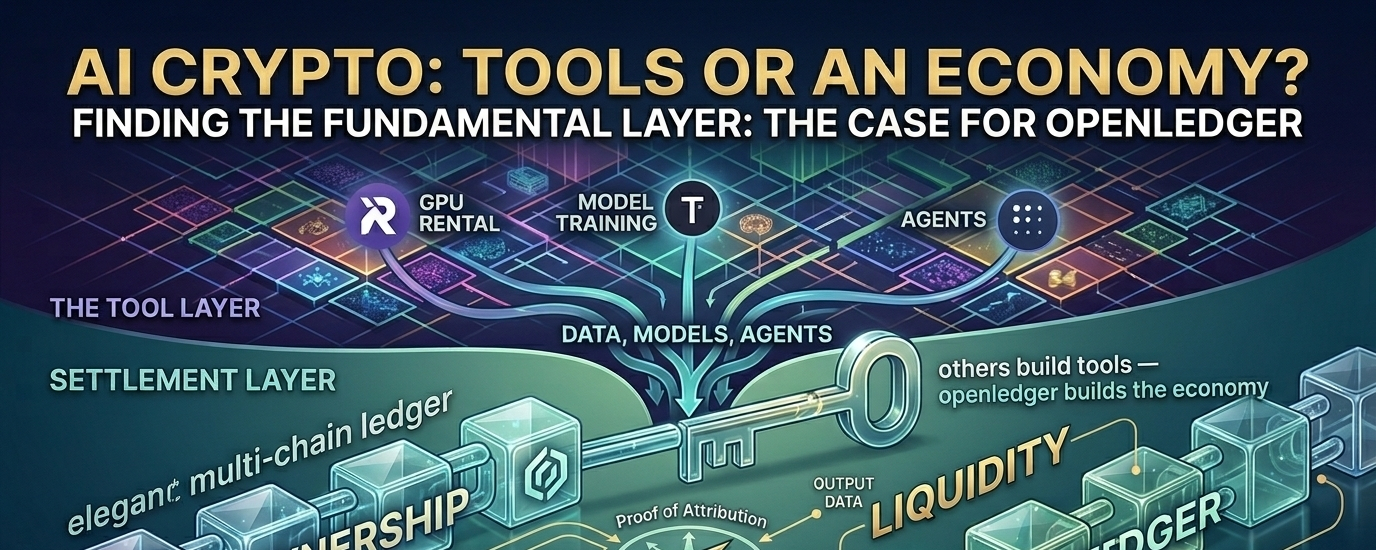
I keep circling back to the same question, and honestly, I can't settle on a clean answer yet…
Everyone's talking about AI crypto right now. The noise is insane. You see GPU networks, model marketplaces, agent platforms—dozens of projects racing to define how data, models, and autonomous agents interact. But when I actually try to pick which one is building real infrastructure, not just hype, I get confused.
Is it Bittensor with its massive subnet network? Fetch.ai pushing all these "autonomous agents"? Render with its GPU rental network? Or is it something quieter like OpenLedger?
This is where things get interesting…
I stop and think here… because almost every AI project in crypto is solving just one slice of the AI stack. It's like everyone's building tools, but nobody's building the economy around those tools.

Render gives you GPU power. Bittensor coordinates model training across nodes. Fetch.ai builds agents that can do tasks. SingularityNET is a marketplace for AI services. All useful, but something's missing underneath all of this…
Who owns the data?
Who gets paid when a model uses your data?
How do you prove where a model's knowledge actually came from?
How does any of this become liquid, tradeable, monetizable?
Most people ignore this. They focus on compute, or models, or agents… but not on the economic layer that makes data, models, and agents actually flow as value. Without that layer, you just have expensive tools sitting around, not an economy.
I've been thinking about how AI works today in the real world, and it's messy. Big companies grab data from everywhere. They train models. They sell access. The original data creators? They see nothing. No clean way to attribute data to its source, no way to track how that data influenced a model, no way to pay the right people automatically, no way to prove to institutions that the data is legitimate and compliant.
Humans can't do this manually at scale. Lawyers, contracts, audits… it's too slow, too expensive, too opaque.

So the real question isn't "who has the best models?"
It's: "Who's building the infrastructure where data, models, and agents can become liquid assets?"
This is where OpenLedger keeps catching my attention…
OpenLedger isn't trying to be another GPU network. It's not just another model marketplace. It's not just about agents. It's positioning itself as the settlement layer for AI value
The core idea is simple, but it's dangerous in a good way: every dataset, model, adapter, and agent becomes a verifiable, attributable, compensable asset on-chain . Through something called Proof of Attribution, it traces how data influences outputs and rewards contributors automatically . The EVM-compatible chain lets trained models and agents be traded, combined, and called easily .
In other words: OpenLedger wants to turn AI into a liquid economy of intelligence, where value flows back to contributors, not just to the people who own the models . By 2026, it's already listed on Binance with a circulating supply of around 215.5M OPEN out of 1 billion total, trading around $0.18 .
When I compare this to the other big players, the differences start to sharpen…
Bittensor is all about decentralized model training and intelligence competition via subnets . It's more about collective training and general compute/intelligence. OpenLedger, on the other hand, is more like the settlement layer for AI value realization . Bittensor asks "How do we train models collectively?" while OpenLedger asks "How do data, models, and agents become tradable, monetizable, attributable assets?" . OpenLedger doesn't try to out-compete Bittensor on raw intelligence. It carves out a different niche: data monetization and enterprise compliance . I'm not fully convinced yet that this will beat Bittensor's network effect… but the angle is different enough that both could coexist.
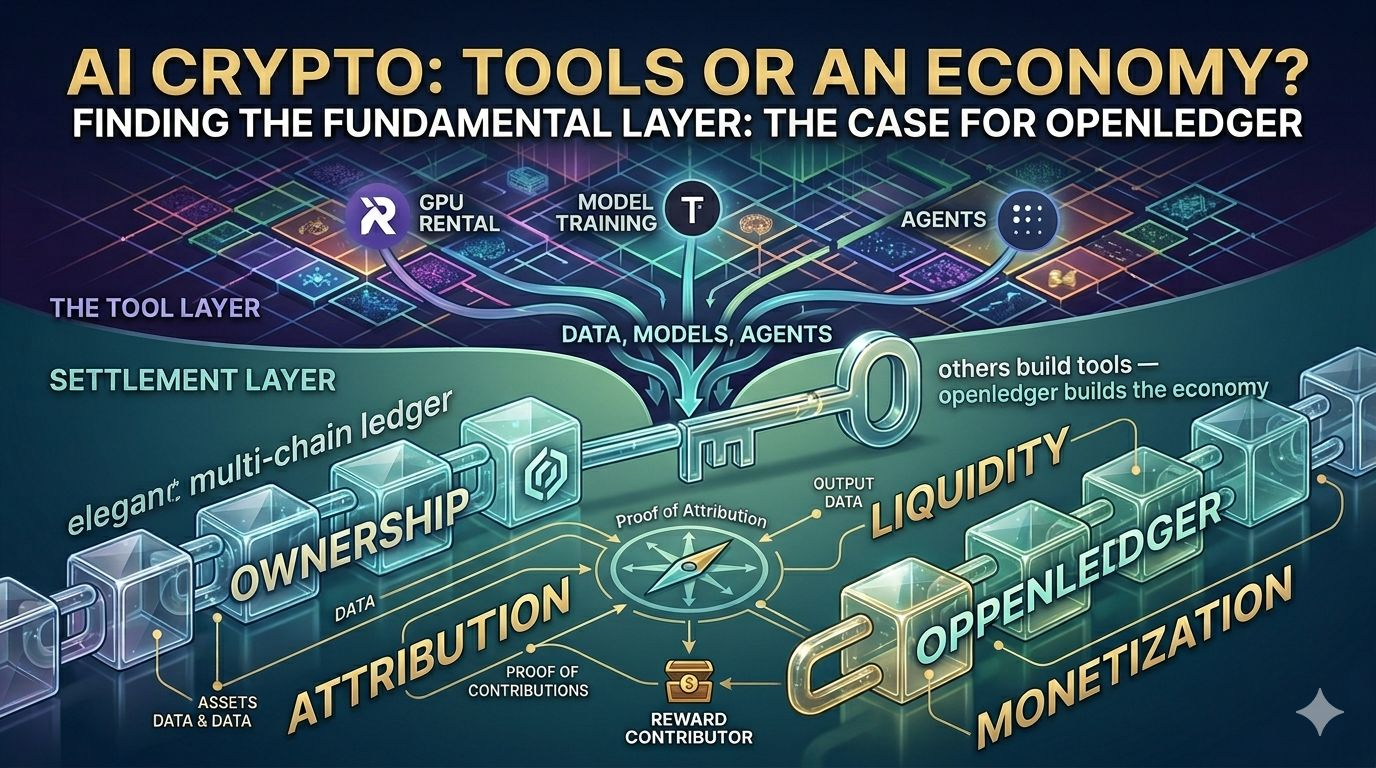
Fetch.ai is strong in autonomous AI agents and multi-agent systems for tasks like supply chain optimization or energy trading . It's more like middleware where agents interact in markets . OpenLedger pushes further: it wants to embed the full lifecycle on-chain, not just agent interaction . Fetch.ai is the "Agent Layer," while OpenLedger is calling itself the Liquidity Layer . If Fetch.ai is about agents interacting in markets, OpenLedger is about models, data, and agents as a liquid economy where everything is attributable and monetizable . That's a bold claim. I'm curious, not sold.
Render is a GPU rental network. It solves raw compute distribution . OpenLedger is not another GPU network. It addresses the accountability layer . Render says "Here's GPU power." OpenLedger says "Here's the layer where contributions are recognized, outputs are verifiable, and value is attributed" . They're not direct competitors. In fact, OpenLedger partners with io.net for GPU compute, which touches Render's space but adds liquidity and attribution on top . So the question becomes: which layer is more fundamental in the long run? Compute, or the economic/attributable layer?
I need to be honest here… there are a lot of moving parts for OpenLedger. You need Proof of Attribution that actually works at scale, a functioning model market where people trade models and adapters, real monetization for data contributors, and enterprise adoption for explainable AI and compliant data sources . That's a lot.
But here's the real point… by 2026, more enterprises are going to need explainable AI and compliant data sources . They can't just grab random data from the internet and train models anymore. They need transparency, auditability, and clear ownership. OpenLedger's transparent + liquid combination could attract real-world applications, not just speculative funds . By building on the OP Stack as an Ethereum Layer 2, it's also EVM-compatible, which means developers can actually build on it without learning a completely new language .
Still, execution is everything. If the team can't deliver a smooth model market, real attribution, and actual liquidity, this becomes another whitepaper dream. I'm watching closely, but I'm not fully convinced yet.
But if OpenLedger actually pulls this off… it would be the financial infrastructure of the AI economy, not just another marketplace . Think about it: data becomes a tradeable asset with clear ownership . Developers can monetize models directly on-chain . Institutions get a compliant, scalable AI deployment layer . Cross-chain liquidity bridges fragmented ecosystems . This is more than a token. It's a gateway to the multi-chain AI economy . If that happens, $OPEN could become a top-tier project in the AI + Web3 sector, similar to how Ocean Protocol and Bittensor defined their niches . The underlying narrative is strong: Others build the tools — OpenLedger builds the economy . And it's backed by Polychain Capital, which at least tells me serious investors are paying attention .
I don't have a clean answer. Bittensor has network effect and a strong training layer. Fetch.ai is pushing agents hard. Render owns the GPU compute niche. OpenLedger is betting on attribution + liquidity as the missing layer .
The question keeps circling back… which layer is more fundamental in the long run? Raw compute? Collective training? Autonomous agents? Or the economic layer that makes data, models, and agents liquid and attributable?
I'm leaning toward the idea that, if the AI economy truly scales, the economic/attribution layer becomes as critical as compute itself. Maybe more so. Because tools become commoditized. But the economy around them? That's where value settles.
But I don't know yet if OpenLedger will be the one to own that layer… or if someone else will out-execute them. All I know is: the projects that focus only on tools, not on the economy around them, might end up as commoditized infrastructure. The ones that solve ownership, attribution, and liquidity… those could be the real winners.
I'm still thinking about this. I'm still watching. And honestly, that's where I'm most comfortable—curious, skeptical, but leaning in.
#bitcoin #crypto #Binance #CryptoExchangeNews $BTC
