


I noticed something odd recently.
Whenever a new AI model appears, the conversation almost immediately shifts toward benchmarks, reasoning ability, context length, or how much smarter it is than the previous generation.
For a long time, that felt completely reasonable.
Then I started paying attention to something else.
Two AI projects can have access to similar models, similar compute resources, and even similar datasets. Yet one ecosystem attracts contributors, retains participation, and continues growing, while another struggles to maintain engagement.
That felt strange to me.
If intelligence is the ultimate advantage, why do systems with comparable intelligence produce such different economic outcomes?
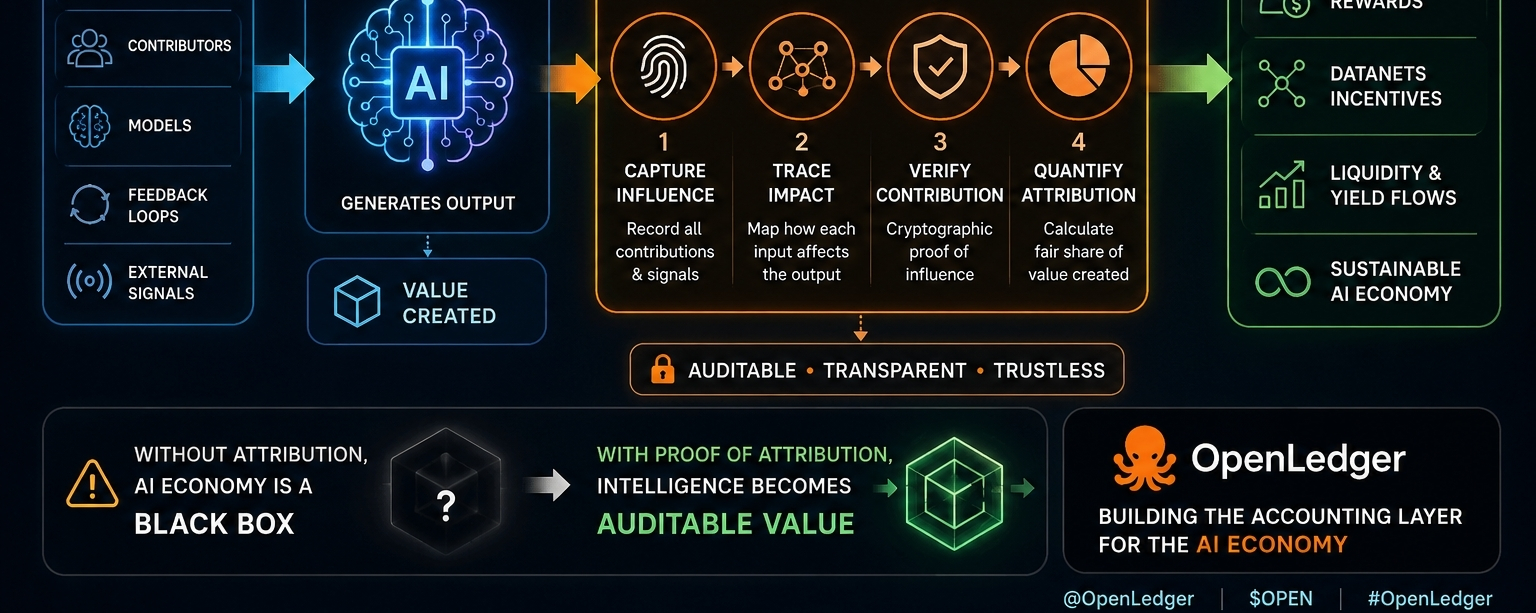
The more I thought about it, the more I found myself focusing on attribution rather than intelligence.$OPEN
A simple example comes to mind.
Imagine two contributors provide data to an AI network. Months later, the model begins generating outputs that companies are willing to pay for.
One contributor's data becomes deeply embedded in the decision-making process. Their signals continue influencing outputs during inference.
The second contributor's data exists inside the system but rarely affects meaningful outcomes.
From the outside, both appear to have contributed.
But did they create the same value?
Probably not.
This is where the conversation starts becoming interesting.
Most AI discussions focus on capability. Better models. Faster inference. More autonomous agents. Those improvements matter, of course.
But capability alone does not explain how value should flow through an ecosystem.
Without attribution, it becomes difficult to understand which contributions actually matter and which merely @OpenLedger exist within the system.
That creates a subtle tension.
Activity versus impact.
Participation versus influence.
Effort versus value creation.
These concepts often look similar, but they are not the same.
What makes this particularly interesting is that crypto has spent years exploring ownership, incentives, and value distribution. Yet many AI narratives still operate as if intelligence itself is the only scarce resource worth measuring.
I am not convinced that assumption will hold forever.
As AI ecosystems become larger and more economically significant, questions around contribution, ownership, and value allocation may become harder to ignore.
Perhaps the next major challenge is not building intelligence that is increasingly powerful.
Perhaps it is building systems capable of explaining where that intelligence came from, who influenced it, and why certain participants deserve a share of the value it creates.
I do not know if attribution will eventually become more important than intelligence itself.
But the longer I observe AI economies evolve, the more it feels like a question worth taking seriously.