
I've been noticing how quickly narratives come and go in crypto. After watching this market for years, it almost feels predictable. A new trend appears, everyone rushes toward it, timelines fill with bold predictions, and for a few months it seems like nothing else matters. Then attention shifts somewhere else. The cycle repeats. I've lost count of how many projects were supposed to change everything, only to disappear once the excitement faded.
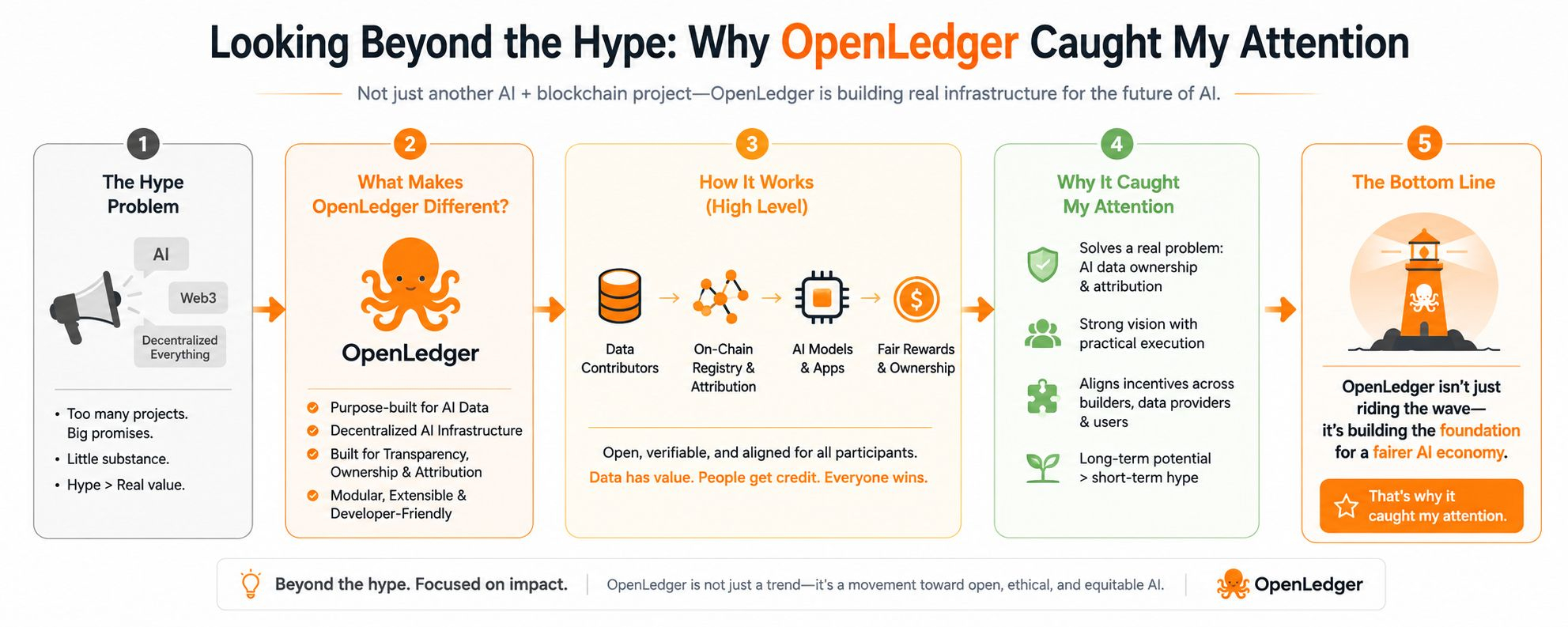
That's probably why I didn't pay much attention when OpenLedger (OPEN) first crossed my radar. At a glance, it looked like another project trying to ride the growing AI wave. There are a lot of those right now. Almost every week a new protocol appears claiming it will connect AI and blockchain in some revolutionary way. Most of the time, the story sounds bigger than the actual product.
But after spending some time reading about OpenLedger, I found myself thinking about it differently. Not because it promises some futuristic world where everything suddenly changes overnight, but because it's trying to address a question that feels increasingly relevant as AI becomes more important.
The idea, at least from my perspective, is fairly simple. AI systems need data. They need models. They need people contributing information and resources that help these systems improve over time. Yet when value gets created, the rewards often flow toward the largest platforms while many contributors remain invisible. OpenLedger seems to be exploring whether there is a better way to recognize and reward the people providing those building blocks.
What interests me is not necessarily the blockchain part. Crypto has produced enough blockchains to last several lifetimes. What caught my attention is the broader problem being discussed. As AI becomes more integrated into daily life, questions around ownership and compensation are becoming harder to ignore. Who benefits when data creates value? Who gets rewarded when an AI model succeeds? Those questions aren't unique to crypto. They're questions the wider technology industry will likely face for years.
At the same time, I've followed this space long enough to know that having an interesting idea is only the beginning. The difficult part is making it work in the real world. That's where many projects run into trouble. Building technology is one thing. Convincing businesses, developers, and everyday users to adopt it is something else entirely.
The reality is that traditional industries move slowly. Companies don't rebuild their systems overnight. Regulations take time. Partnerships take time. Trust takes time. Meanwhile, crypto moves at a pace where people expect results within months. That mismatch has challenged countless projects before, and OpenLedger won't be immune to it.
There's also the question of whether enough people actually need the solution. Crypto often assumes that if something can be tokenized, it should be tokenized. Real adoption is usually more complicated than that. People don't use technology because it's decentralized. They use it because it solves a problem better than existing alternatives.
Still, I think that's why OpenLedger stayed on my mind longer than many projects I've looked at recently. Instead of creating a problem and then inventing a token to solve it, it seems to be starting with a real-world discussion that is already happening around AI. Whether the platform can execute on that vision remains an open question, but at least the starting point feels grounded in something tangible.
For now, I'm watching with cautious curiosity rather than excitement. The crypto market has taught me to be careful about grand promises and sweeping predictions. OpenLedger may succeed, or it may end up joining the long list of ambitious projects that never quite reach their goals. But if nothing else, it's trying to tackle an issue that actually exists, and in a market crowded with temporary narratives, that alone makes it worth paying attention to.