
Value
Artificial intelligence is generating extraordinary amounts of value.
New models are released at a pace that would have seemed impossible just a few years ago. Businesses are pouring resources into AI infrastructure. Autonomous agents are beginning to handle tasks that once required human attention. By almost any measure, the AI economy is expanding rapidly.
Yet beneath all that growth sits an uncomfortable reality.
Many of the people, developers, researchers, and organizations helping build this new ecosystem aren't necessarily sharing in the value being created. Data powers modern AI systems, but the people contributing that data often disappear from the economic picture once it enters the pipeline. Developers build highly specialized models, only to find that monetizing them is often harder than creating them in the first place.
Meanwhile, much of the value continues to flow toward a relatively small group of platforms and infrastructure providers.
That's the problem OpenLedger is attempting to tackle.
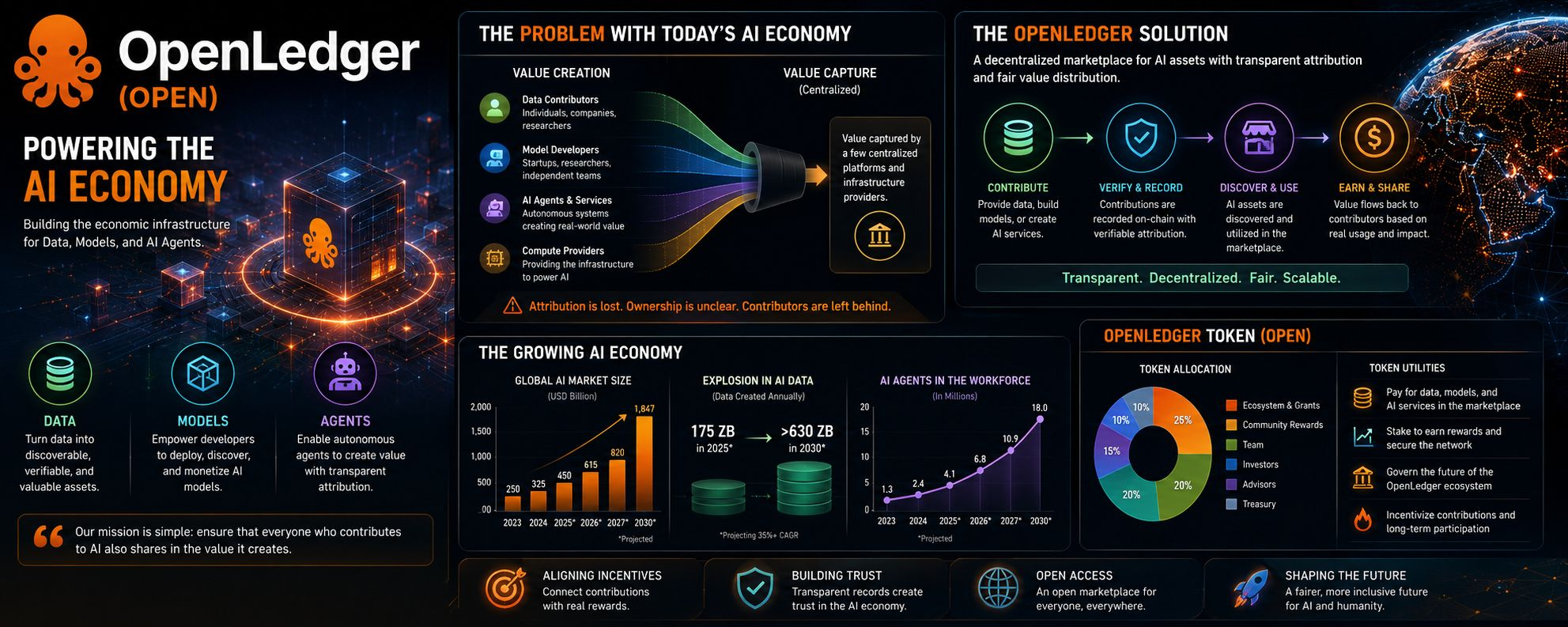
The project is building blockchain infrastructure designed specifically around the economics of AI. Its ambition is straightforward in theory, though considerably more complex in practice: create a system where data, models, and autonomous agents can exist as tradable, monetizable assets rather than remaining locked inside closed networks.
At first glance, it might sound like another attempt to connect two of technology's most talked-about sectors. There have been plenty of those.
But OpenLedger is chasing something more specific. Its focus isn't really on combining AI and blockchain for the sake of it. It's trying to solve a question that is becoming increasingly difficult to ignore.
Who actually gets rewarded when AI creates value?
The Missing Layer in the AI Economy
Most discussions around AI tend to focus on capability.
How powerful are the models? How quickly are they improving? What jobs might they transform? What industries could they reshape?
Those questions matter. But they aren't the whole story.
Every AI system ultimately depends on a few essential ingredients: data, models, and computing power. The industry has invested heavily in the latter two. Massive computing infrastructure continues to expand, while increasingly sophisticated models compete for attention and adoption.
The economics surrounding contributions, however, remain far less mature.
Think about the path data takes through the AI ecosystem. It originates from individuals, companies, researchers, institutions, and countless other sources. Once it enters larger systems, its role often becomes difficult to track. Attribution fades. Ownership becomes less clear. Economic participation becomes even murkier.
A similar challenge exists for smaller developers.
Many niche models solve highly specific problems remarkably well. The issue isn't necessarily quality. It's distribution. Visibility. Access to markets.
Building something useful and getting paid for it are often two very different things.
OpenLedger's core argument is that if contributions can be tracked, verified, and attributed, they can also be rewarded more effectively.
Simple idea.
Complicated execution.
But it speaks directly to a growing gap in the current AI economy.
Building a Marketplace Around AI Assets
Rather than positioning blockchain as the end product, OpenLedger treats it as underlying infrastructure.
The goal is to create a marketplace where datasets, models, and AI services can be discovered, used, and monetized within a transparent framework.
In practical terms, that means contributors could provide data, developers could deploy models, and AI agents could offer services while maintaining a verifiable record of how they participate in the ecosystem.
The blockchain acts as the coordination layer.
That's an important distinction.
Much of the conversation around decentralization tends to focus on ideology. OpenLedger's approach is more economic than philosophical. The project is essentially asking whether blockchain can serve as a neutral accounting system for an increasingly complex AI economy.
If contributions can be recorded transparently, the argument goes, value can potentially flow back to the people responsible for creating it.
Whether that works at scale remains an open question.
But the problem being addressed is difficult to dispute.
Turning Data Into Something More Than Fuel
Data is often described as the fuel of artificial intelligence.
The phrase gets repeated so often that it's almost become background noise.
But here's where things get interesting.
If data is truly one of the most valuable resources in the AI economy, why is it so difficult to treat it like an asset?
Today, data typically follows a familiar path. It's collected, integrated into larger systems, and eventually absorbed into products and services that generate value elsewhere. Along the way, ownership becomes harder to define and opportunities for ongoing participation often disappear.
OpenLedger wants to challenge that model.
Its framework is designed to make datasets discoverable, verifiable, and economically useful within a decentralized marketplace. Contributors could potentially receive compensation when their data helps train models or supports AI-driven services.
The broader idea is data liquidity.
Instead of becoming economically dormant after collection, data could continue generating value through repeated usage and transparent attribution mechanisms.
And honestly, that's one of the more intriguing aspects of the project.
For years, the technology industry has acknowledged the value of data while offering relatively few mechanisms for contributors to benefit from that value over time. OpenLedger is attempting to build exactly that missing layer.
Whether the economics ultimately work is another matter.
But the premise itself addresses a real inefficiency.
Creating Better Economics for AI Models
The same logic extends beyond data.
OpenLedger is also focused on the economic challenges facing AI model developers.
A significant portion of innovation doesn't come from the largest technology companies. Independent teams, startups, and research groups frequently develop highly specialized models capable of solving specific problems with impressive precision.
Yet many struggle to gain meaningful distribution.
Not because the technology isn't useful.
Because marketplaces are hard to build.
Without established channels for discovery and monetization, valuable models can remain largely invisible despite offering genuine utility.
OpenLedger aims to create a framework where models can be deployed, discovered, and monetized based on actual usage.
The appeal is obvious. Developers gain clearer economic pathways. Users gain access to a wider pool of specialized tools. The ecosystem becomes less dependent on a handful of centralized gateways.
At least in theory.
Success ultimately depends on participation. No marketplace functions without network effects. Still, the direction aligns with a broader movement toward more open digital economies.
Why AI Agents May Matter Most
If data and models represent today's AI economy, agents may represent tomorrow's.
That's certainly the assumption behind much of the excitement surrounding autonomous systems.
Unlike traditional software, agents can make decisions, execute tasks, interact with digital environments, and potentially create value with minimal human intervention.
As those capabilities improve, entirely new questions emerge.
Who owns the output generated by an autonomous agent?
How should compensation be distributed when multiple datasets and models contribute to its behavior?
How do users establish trust in systems operating independently?
These aren't just technical challenges.
They're economic ones.
OpenLedger's architecture is built around the belief that attribution and ownership will become increasingly important as agent-based systems mature. The project aims to create transparent mechanisms for tracking participation and distributing value across increasingly complex AI workflows.
The space remains early.
Very early.
But the questions being raised feel increasingly relevant.
Why Blockchain Is Part of the Equation
Mention blockchain in any AI discussion and skepticism usually follows.
That's not necessarily a bad thing.
The technology industry has seen no shortage of solutions searching for problems.
OpenLedger's argument, however, isn't that blockchain somehow improves AI performance. Instead, it treats blockchain as infrastructure for coordination and record-keeping.
When multiple participants contribute data, models, services, and computational resources, questions around attribution become difficult to answer through conventional systems alone.
A decentralized ledger offers one possible approach.
In this context, blockchain functions less like a product and more like an accounting mechanism. A shared system for tracking participation and distributing rewards.
The important part is that the blockchain itself isn't the value proposition.
The value proposition is whether it can help create fairer and more transparent economic relationships.
Everything else is secondary.
Opportunity Meets Reality
Like many projects operating where emerging technologies intersect, OpenLedger sits somewhere between significant opportunity and considerable uncertainty.
The opportunity is easy to see.
Demand for AI continues to accelerate. Concerns around ownership, attribution, and contributor incentives are becoming more visible. Organizations increasingly care about where data comes from and how value is distributed.
If OpenLedger can successfully connect those needs through a functioning marketplace, it could establish a meaningful position within the broader ecosystem.
But reality has a way of testing ambitious ideas.
Adoption remains a major challenge. Building a marketplace requires more than technology. It requires participants, liquidity, incentives, and sustained engagement.
Competition is intensifying as well. Numerous projects are exploring decentralized AI infrastructure, data marketplaces, and tokenized economic models.
Then there's execution.
Tracking contributions across datasets, models, and autonomous agents sounds elegant on paper. Implementing it in a way that is accurate, scalable, and economically viable is considerably harder.
The gap between concept and execution is often where projects succeed or fail.
The Bigger Shift Happening Beneath the Surface
OpenLedger is ultimately part of a much larger conversation.
For years, AI discussions focused almost exclusively on capability. Better models. Faster systems. More impressive outputs.
That's still important.
But increasingly, attention is shifting toward ownership and economics.
Who captures the value generated by intelligent systems?
Who should be compensated?
How do contributors participate in the growth of technologies they help enable?
Those questions stretch far beyond any single blockchain network or AI platform.
That's the bigger shift happening underneath.
OpenLedger's answer is to build economic infrastructure around AI assets and create mechanisms that connect participation with rewards. Whether it becomes a major platform or simply contributes useful ideas to the broader ecosystem remains uncertain.
What seems increasingly clear, however, is that the future of AI won't be defined solely by intelligence.
It will also be defined by incentives.
Conclusion
OpenLedger is pursuing an ambitious vision: turning data, AI models, and autonomous agents into liquid assets within a decentralized economic framework.
The idea is both practical and provocative. Practical because it addresses genuine challenges around attribution and compensation. Provocative because it forces a broader conversation about ownership in the age of intelligent systems.
The road ahead is far from guaranteed. Adoption hurdles, technical complexity, and growing competition will all shape the project's trajectory.
Still, the questions OpenLedger is asking feel increasingly difficult to ignore.
As AI becomes more deeply woven into the global economy, the debate may gradually move beyond what these systems can do and toward who benefits from the value they create.
That conversation is only beginning. And it may end up being one of the defining technology debates of the years ahead.