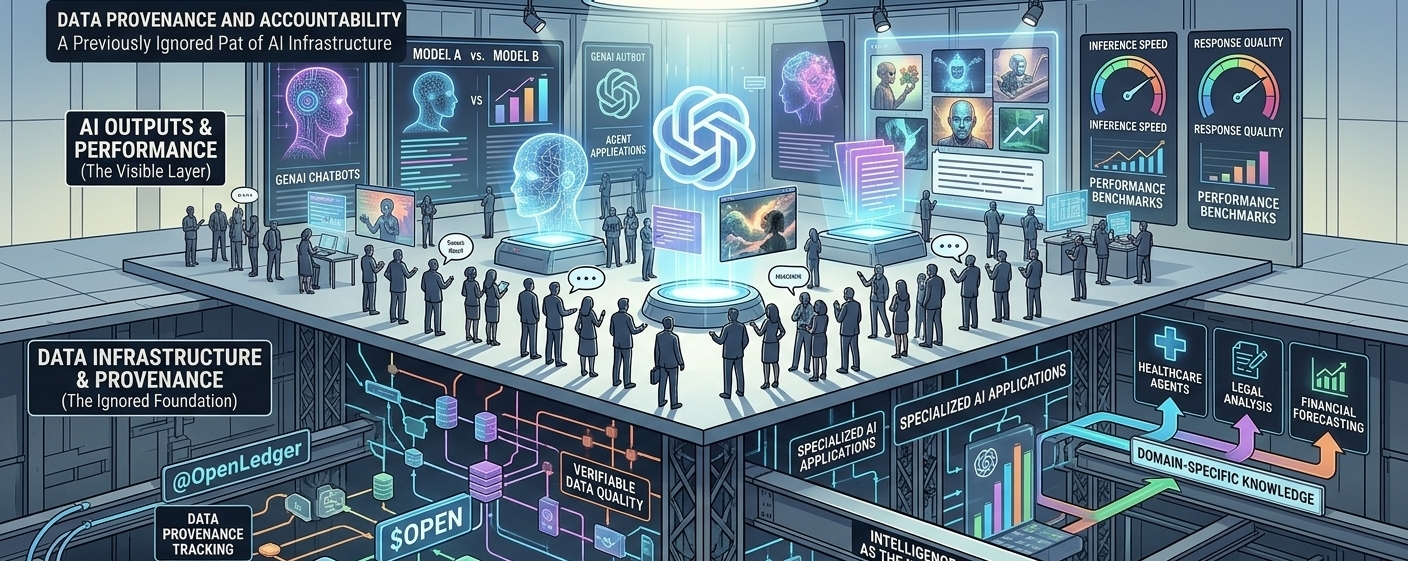
A lot of conversations around AI still revolve around outputs.
People compare models. They compare response quality. They compare speed.
Fair enough.
But there is another layer quietly becoming more important, and it sits underneath the visible product experience.
Data.
Not just having data. Knowing where it came from, understanding who contributed it, tracking how it evolves, and creating systems where contributors are not invisible after the model is trained.
That is one reason I keep paying attention to @OpenLedger.
The discussion around $OPEN often focuses on decentralized AI, but what catches my interest is the attempt to build accountability into the data layer itself. The AI industry has spent years optimizing generation. In 2026, the conversation is slowly shifting toward provenance, attribution, and transparent contribution records.
A small detail stood out to me recently. Many builders now spend more time discussing dataset quality than model size during community calls. That would have sounded unusual a few years ago.
The reason is simple.
Bad data eventually shows up everywhere.
It appears in inaccurate outputs, weak reasoning, unreliable agents, and systems that become harder to trust over time.
OpenLedger's approach feels aligned with a growing realization across the broader ecosystem: intelligence is only as useful as the information supporting it.
Not every project is positioning itself around that challenge.
Some are chasing attention.
Some are chasing narratives.
Some are still pretending bigger automatically means better. It doesn't.
The projects attracting long-term builders increasingly seem focused on creating transparent foundations rather than temporary excitement.
What makes this particularly relevant today is the rise of specialized AI applications. As more industry-specific agents emerge, the demand for verifiable and high-quality data keeps increasing. Generic information helps, but domain-specific knowledge often creates the real advantage.
The community around #OpenLedger appears to understand this shift. Much of the conversation is no longer about AI as a distant concept. It is about practical infrastructure, contributor incentives, and sustainable data ecosystems that can support future applications.
The market may continue paying attention to model launches and benchmark scores.
Meanwhile, some of the most important work is happening much lower in the stack, where data is collected, validated, and connected to the people who helped create it.
That layer is not flashy.
It is also becoming very difficult to ignore.