
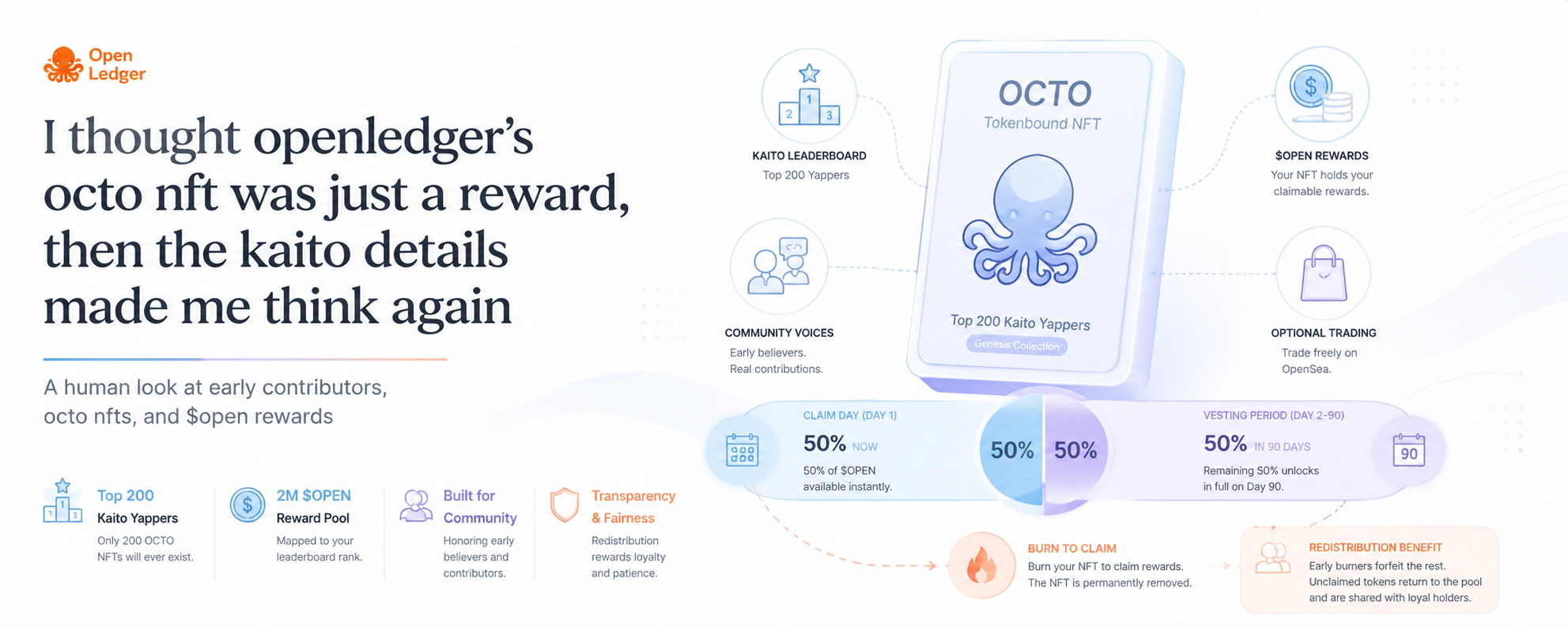
I did not look at openledger’s octo nft update as something serious at first.
Maybe because crypto reward campaigns often sound the same from far away. A leaderboard. A limited nft. A token reward. A claim system. People rush, claim, post screenshots, and then the whole thing becomes another short moment on the timeline.
But this one made me slow down a little.
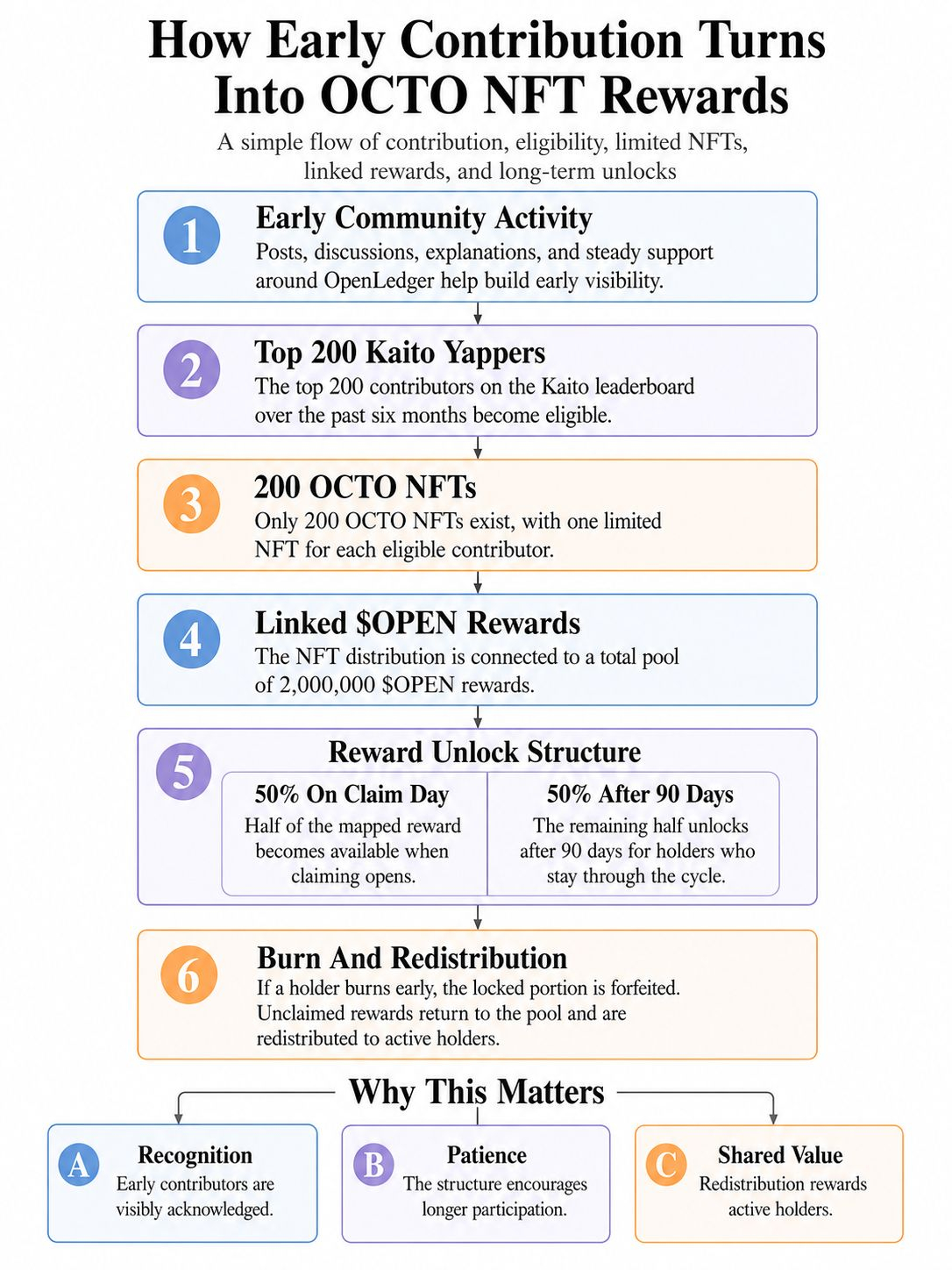
@OpenLedger is rewarding the top 200 yappers from its kaito leaderboard with only 200 octo nfts. These nfts are linked to a total pool of 2 million open rewards. Each nft is connected to the holder’s leaderboard performance, and it works like a claim ticket for the reward.
That is the simple version.
But i do not think the simple version is the most interesting part.
The part that caught me is what openledger is actually counting here.
It is not only counting wallets.
It is not only looking at who came with money.
It is looking at people who kept the conversation alive around the project.
People who wrote, posted, explained, replied, and made openledger visible before the attention became easier.
That feels important to me as a creator.
In this market, attention is everywhere, but useful attention is rare. Anyone can post noise. Anyone can repeat big words. But it takes effort to explain a project in normal language. It takes time to read, understand, and turn complex things into something a wider audience can follow.
That kind of work usually disappears fast.
A good post gets buried. A clear explanation gets copied by others. A helpful comment becomes part of the background. Most of the time, the person who helped shape early understanding does not get remembered properly.
This is why the octo nft feels less like a normal nft and more like a record.
It says that early social effort can have a place in the reward system. It gives that effort a form. It turns public contribution into something visible, limited, and connected to open rewards.
I know that sounds simple, but the idea is bigger than it looks.
Crypto communities are not built only through code or funding. They are also built through people who help others understand why something matters. A project can have strong technology, but if nobody explains it clearly, the message stays locked inside documents and dashboards.
Creators help open that door.
That is why i think the kaito part matters. The leaderboard gives openledger a way to recognize social activity over time. The top 200 yappers are not random names pulled from a crowd. They are people whose public activity helped create discussion around openledger during an early period.
This is not perfect, of course.
No leaderboard can measure every useful contribution. Some people help quietly. Some people add value in private groups. Some people explain things without getting huge reach. But still, this system is a real attempt to connect social contribution with a visible reward path.
That is already better than pretending community work has no value.
The reward mechanics also make the topic more interesting. On claim day, 50% of the linked $open reward becomes available. The remaining 50% unlocks after 90 days. So the system gives early access, but it does not give everything at once.
This is where the design starts to feel more thoughtful.
Many campaigns bring people in for a short visit. They complete tasks, claim rewards, sell if they want, and move on. Openledger’s octo nft adds a timing decision. A holder has to think about whether they want fast access or whether they want to stay connected until the full unlock.
Then comes the burn mechanism.
If a holder wants to claim the reward, the nft can be burned. Burning means the nft is destroyed, and the available tokens linked to it can be claimed. But if someone burns early, before the remaining 50% unlocks, that locked part can be lost. The unclaimed amount can then be redistributed to active holders who stay through the full cycle.
This part is very important.
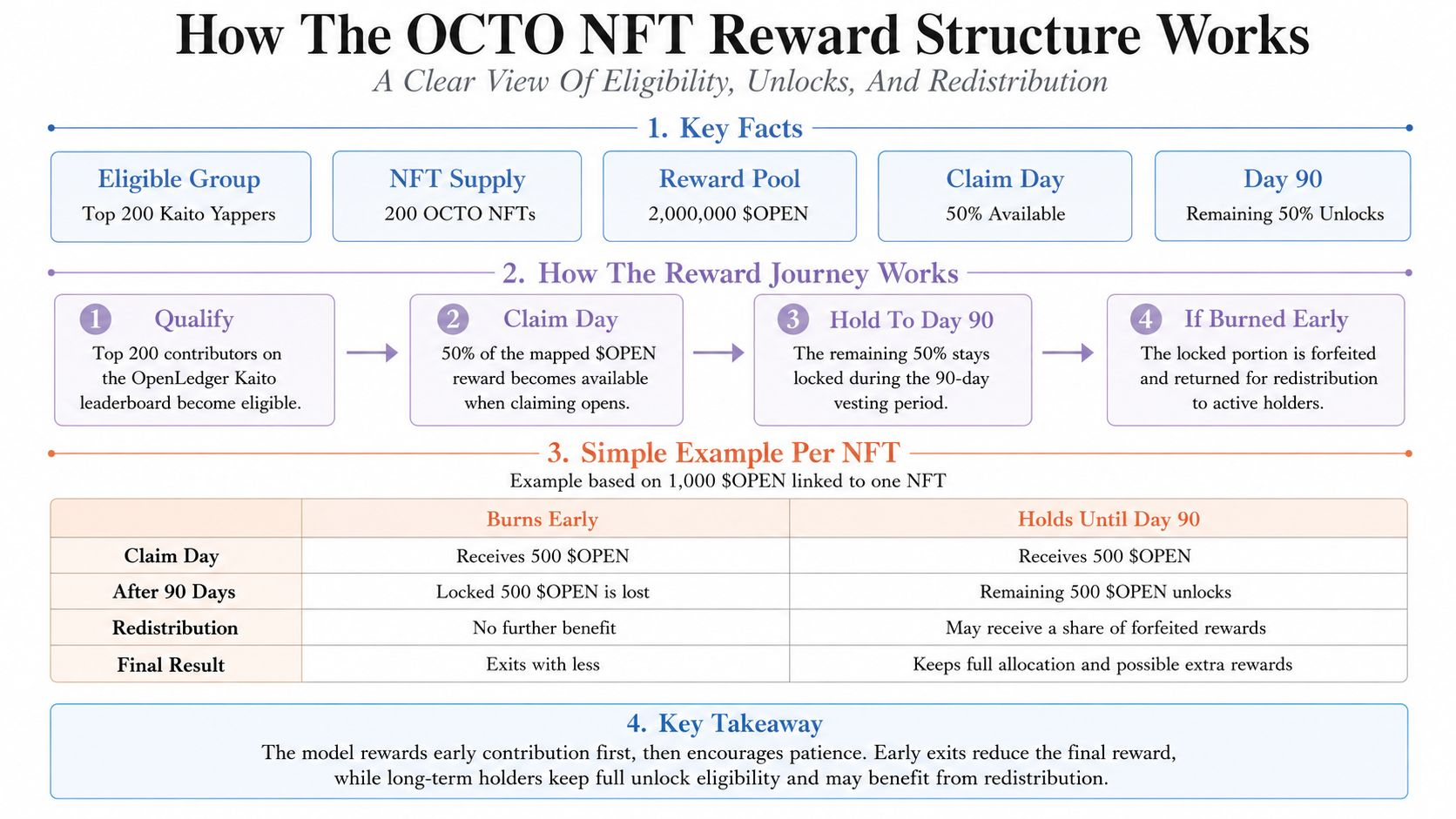
It creates a small economy around patience. Early exit gives faster access, but it can reduce the final reward. Holding longer keeps the nft connected to the full unlock and possible redistribution. So the reward is not only about being eligible. It is also about behavior after eligibility.
I like this because it gives the nft a real function.
It is not just sitting in a wallet as a picture. It carries reward access. It carries a time condition. It carries a choice. It can also be traded on opensea, which means the reward ticket itself can move between users.
That trading part adds flexibility, but it also adds responsibility.
A buyer has to understand what the nft represents.
Is the reward already claimed?
Is part of it still locked?
What happens if it is burned?
What does the holder lose by acting early?
These questions matter because the nft is connected to real reward mechanics, not only visual ownership.
This is also why i would not write about this like a hype post.
There is no need to turn it into a loud promise. $OPEN is a market-traded token, so its value can move. Nft markets can change quickly. Burning is permanent. Early burning can forfeit locked rewards. Anyone involved needs to understand the rules before making any decision.
To me, that makes the system more serious, not less interesting.
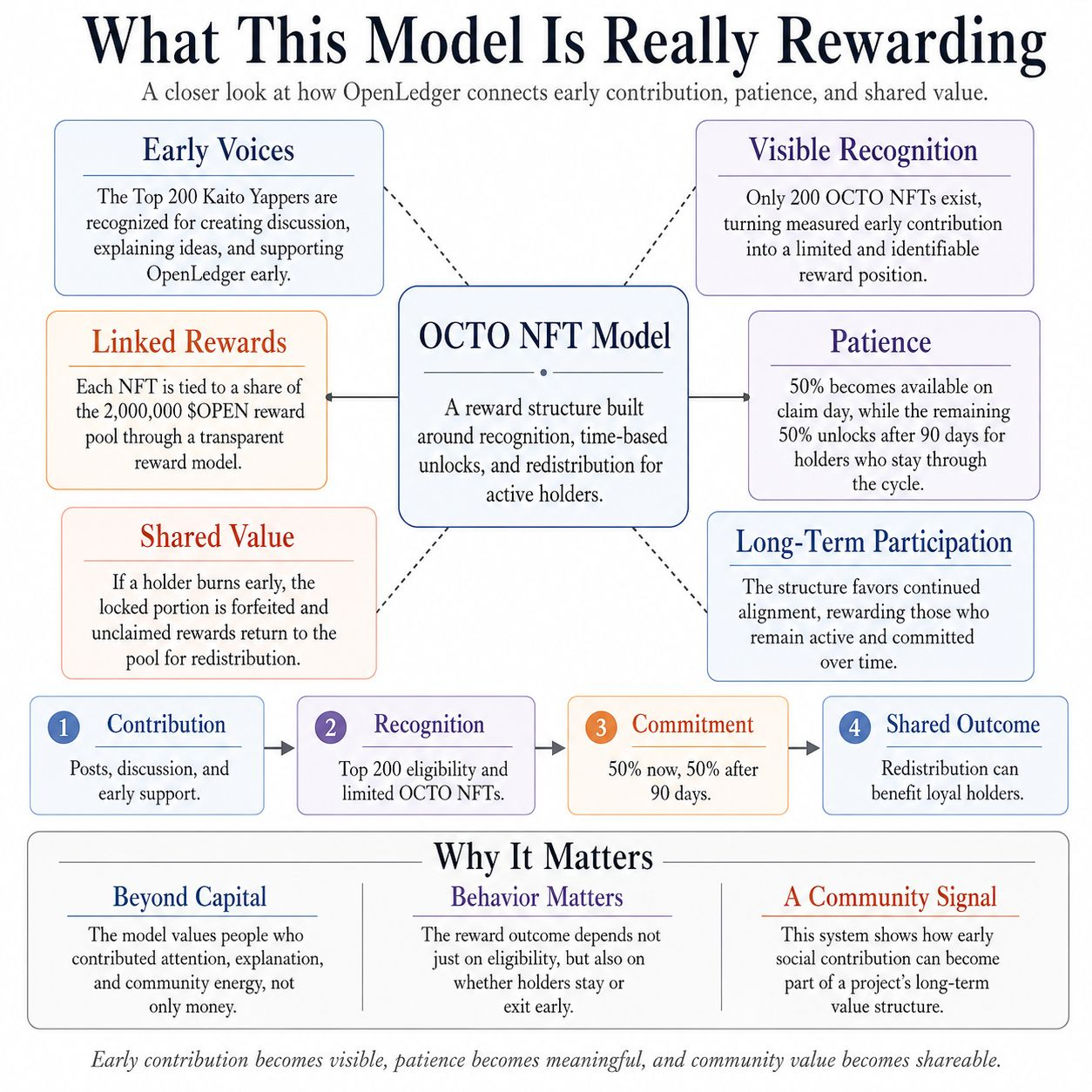
The social impact is the part i keep returning to. OpenLedger is giving recognition to people who helped before the wider crowd arrived. That sends a signal to creators. It says that useful public work can matter. It says that explaining, discussing, and building early awareness can become part of the value map of a project.
That could push creators in a better direction.
Instead of posting empty excitement, creators may try to write with more care. Instead of chasing quick attention, they may focus on clear analysis. If projects start rewarding real contribution more often, then content quality can improve across the space.
Of course, one nft reward system will not fix everything.
But it does show a useful direction. It shows that a project can reward more than capital. It can also reward early belief, steady presence, and social effort. That matters because web3 is supposed to be about participation, not only speculation.
For me, the octo nft is interesting because it sits between three things.
It is a community badge. It is a reward ticket. It is also a small economic object with timing, scarcity, and choice built into it.
Only 200 exist. They are linked to 2 million open rewards. Half unlocks first. Half unlocks after 90 days. Early burning can reduce the reward and send the locked part back for redistribution. These are not random details. They shape how people act.
That is the real story here.
Openledger is not only saying that community matters. It is trying to place community contribution inside a working reward structure.
I think that is worth paying attention to.
Because sometimes the most important people in an early ecosystem are not the loudest buyers or the biggest accounts. Sometimes they are the ones who explain the idea before it becomes obvious.
And with octo nfts, openledger seems to be saying that those early voices should not be forgotten.