
For a long time, I thought AI systems worked in a surprisingly simple way.
A question goes in. An answer comes out.
Everything in between felt like infrastructure. Necessary, sure, but mostly invisible. As long as the final result was useful, I assumed the process itself wasn't where the real value existed.
Lately, I've started questioning that assumption.
The more I look at systems like OpenLedger, the more I think the most important part of AI is not the answer at all. It's the sequence of decisions that happen before the answer ever appears.
A few months ago, something happened that made this idea click for me.
I was traveling and needed to get back to my hotel before a meeting. I opened a navigation app and entered the destination. The route looked straightforward. Twenty minutes later, I arrived exactly on time.
Nothing unusual.
But later I checked the trip history out of curiosity.
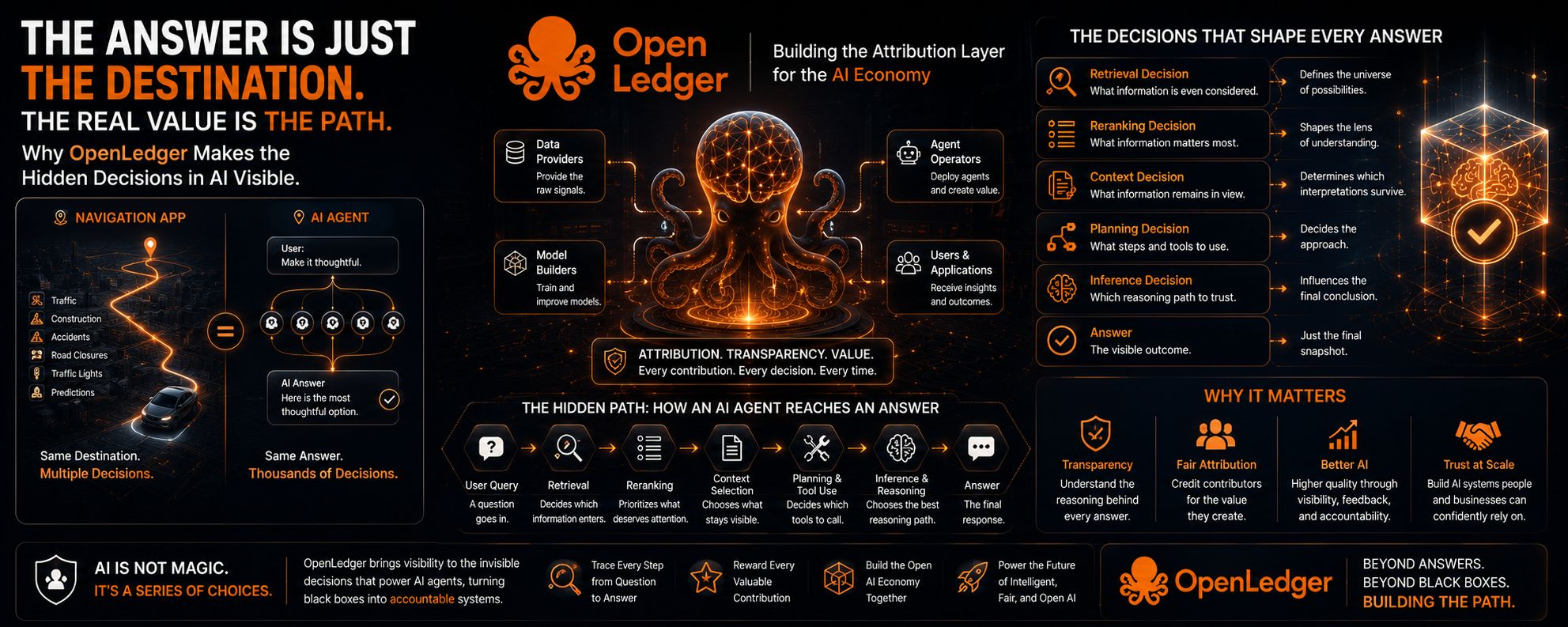
The app had evaluated traffic density, construction zones, traffic lights, accident reports, road closures, and predicted congestion patterns. It had continuously adjusted the route while I was driving.
The destination never changed.
The path changed multiple times.
That realization stuck with me because AI agents operate in a surprisingly similar way.
People often describe AI as a black box, but I think that's an incomplete description.
The darkness isn't that nothing can be seen.
The darkness comes from the sheer number of tiny decisions happening between the question and the answer.
Retrieval decides which information enters the system.
Reranking decides which information deserves attention.
Context selection determines what remains visible.
Planning systems choose which tools to call.
Inference layers decide which reasoning path receives priority.
Individually, none of these decisions seem dramatic.
Together, they fundamentally reshape the original question.
Imagine asking a friend to buy a birthday gift for someone.
You only provide one instruction:
"Make it thoughtful."
Simple enough.
But your friend immediately starts interpreting. They think about budget, age, hobbies, practicality, trends, availability, shipping speed, and presentation.
By the time the gift arrives, it may absolutely be thoughtful.
Yet the meaning of "thoughtful" has quietly evolved through dozens of decisions you never participated in.
AI agents do something remarkably similar.
One thing I noticed while examining agent traces is that the same answer can emerge from entirely different internal paths.
That's what makes this topic so interesting.
In traditional evaluation, we focus almost entirely on outputs.
Was the answer correct?
Did the task complete successfully?
Did the user receive value?
Those are important questions.
But they don't tell the whole story.
Two AI systems can generate nearly identical outputs while arriving there through completely different processes.
One system may explore multiple information sources, compare alternatives, and carefully validate assumptions.
Another may latch onto a strong signal early and converge rapidly.
The result might look identical.
The underlying behavior is not.
That distinction becomes increasingly important as AI systems become more autonomous.
Recent developments across the AI industry show a growing emphasis on agents, multi-step workflows, retrieval systems, tool usage, and reasoning frameworks. The conversation is gradually moving beyond model size and toward process quality.
This is where OpenLedger caught my attention.
What interests me is not simply transparency as a buzzword.
It's the idea that intermediate decisions might deserve recognition instead of being treated as disposable computation.
Think about retrieval for a moment.
Retrieval doesn't merely fetch information.
It determines perspective.
The documents selected become the universe from which understanding emerges.
Reranking works the same way.
Most people view it as a sorting mechanism.
In reality, it's a prioritization engine.
It decides which signals matter most.
Then comes context compression.
This step is often overlooked, but it may be one of the most influential.
Every time information is removed to fit a context window, alternative interpretations disappear as well.
The system isn't only reducing tokens.
It's reducing possibilities.
That's a subtle difference, but an important one.
What makes this difficult is that we rarely measure these effects directly.
The industry has become extremely good at evaluating outputs.
We have benchmarks, leaderboards, accuracy scores, and performance metrics.
Yet there is far less visibility into whether the system followed a robust understanding path to reach that answer.
I sometimes think investors overlook this too.
Markets tend to reward visible outcomes.
The answer.
The application.
The user growth.
The headline metrics.
But if AI increasingly becomes an economy built on data, models, agents, and workflows, then the invisible decisions may become just as valuable as the visible outputs.
That's part of the reason I keep revisiting OpenLedger.
Not because it promises perfect transparency.
Not because every challenge has been solved.
Mostly because it raises a question I don't hear often enough:
What if the most important part of AI isn't the answer, but the chain of choices that created it?
Every retrieval decision.
Every ranking adjustment.
Every context selection.
Every routing choice.
Individually, they look small.
Collectively, they define how the system understands the world.
And once I started looking at AI through that lens, it became difficult to return to the old input-output view.
The answer is still important.
Of course it is.
But increasingly, I think the answer is simply the final snapshot of a much larger process.
The real story exists in the path.
The route chosen.
The possibilities discarded.
The interpretations prioritized.
The signals amplified.
The countless small decisions that quietly reshape the original question before anyone ever sees the response.
If AI continues moving toward agent-driven systems, understanding those hidden paths may become far more valuable than we currently realize.
Because by the time we evaluate the final answer, the system has already made hundreds of decisions on our behalf.
And those decisions may tell us far more about intelligence than the answer itself.
$OPEN @OpenLedger #OpenLedger $STG $PORTAL