
I've researched dozens of AI projects over the past year, and honestly, I've noticed something that keeps repeating.
Most projects spend their time talking about what AI could become.
Very few are building the infrastructure that AI will actually need.
That's exactly why OpenLedger keeps standing out to me.
The more I explore the ecosystem, the more I feel that OpenLedger isn't trying to win the AI narrative for a few months. Instead, it seems focused on building the foundations that could support AI agents, automation, and developer innovation for years.
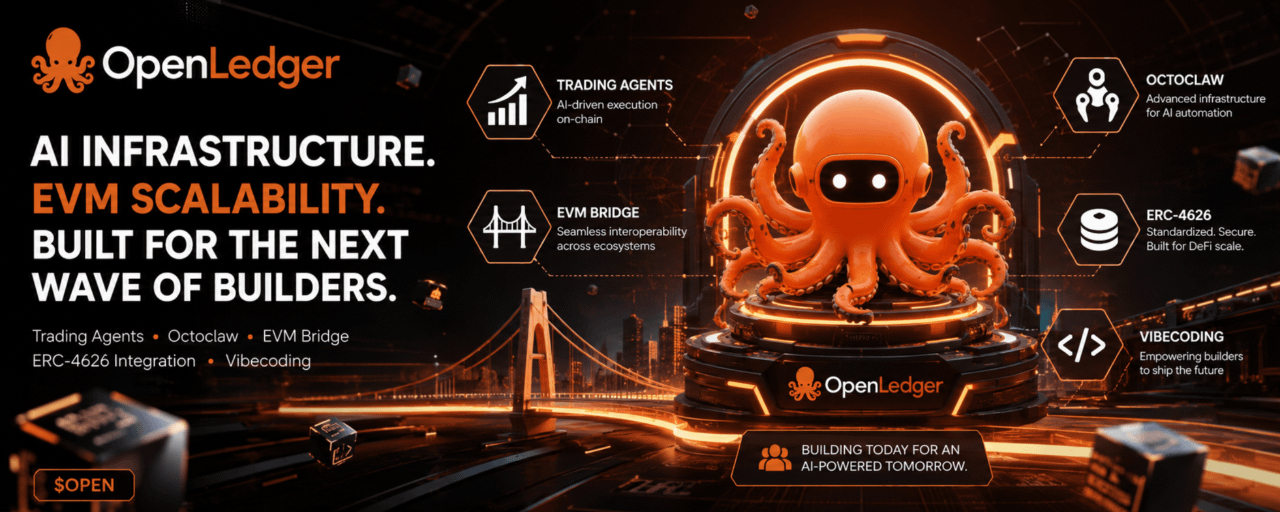
And when I connect the dots between the EVM Bridge, Trading Agents, Octoclaw, ERC-4626 integration, and Vibecoding, the ecosystem starts making much more sense.
To me, these aren't separate announcements.
They're pieces of the same strategy.
A strategy focused on helping AI move from theory into real blockchain utility.
One thing I constantly ask when researching AI projects is:
"What happens after the AI agent is created?"
Most discussions stop there.
The agent gets built.
The demo works.
The marketing starts.
But real-world adoption requires much more than that.
AI agents need infrastructure.
They need access to blockchain ecosystems.
They need interoperability.
They need execution environments.
They need automation layers.
And they need developers continuously building new applications around them.
Without those elements, AI remains a narrative.
With those elements, AI becomes useful.
That's where OpenLedger caught my attention.
The Trading Agent vision is probably the clearest example.
Most AI projects focus on information.
OpenLedger appears focused on action.
And I think that's a massive difference.
Information is everywhere.
Execution is rare.
When I look at Trading Agents, I don't see another AI chatbot.
I see the possibility of systems that can eventually interact with blockchain environments, automate workflows, process opportunities, and perform tasks inside decentralized ecosystems.
Whether that future arrives quickly or gradually, one thing is certain:
Those systems will need infrastructure.
And OpenLedger appears to be building exactly that.
Then there's Octoclaw.
Initially, I thought it was simply another ecosystem update.
But after researching it more deeply, I started seeing it differently.
To me, Octoclaw feels like infrastructure expansion.
Not something designed purely for attention.
Something designed to strengthen the ecosystem's operational capabilities.
That's important because infrastructure rarely receives immediate recognition.
Most people notice applications first.
They notice infrastructure later.
But without infrastructure, applications can't scale.
Without infrastructure, automation remains limited.
And without infrastructure, AI agents struggle to create meaningful utility.
That's why I think Octoclaw deserves more attention than it's currently getting.
The EVM Bridge is another piece that made the ecosystem click for me.
Honestly, I think many people underestimate how important interoperability is becoming.
Crypto is no longer operating in isolated ecosystems.
Liquidity moves across chains.
Developers build across chains.
Users interact across chains.
Future AI-powered applications will need to operate across chains too.
That reality makes the EVM Bridge incredibly important.
Because if OpenLedger wants to support the next generation of AI-powered blockchain applications, those applications can't remain locked inside a single environment.
They need access.
They need connectivity.
They need scalability.
And that's exactly what bridge infrastructure helps provide.
When I see OpenLedger investing in interoperability, it tells me the ecosystem is preparing for where the industry is going, not where it has been.
The ERC-4626 integration reinforces that idea.
I know standards aren't the most exciting topic in crypto.
They don't create huge headlines.
They don't generate instant hype.
But personally, I pay close attention to them.
Because standards reveal how a project thinks.
Projects focused only on attention usually ignore infrastructure standards.
Projects focused on long-term growth embrace them.
ERC-4626 improves compatibility across DeFi environments and helps create a stronger foundation for future integrations.
To me, that's a sign of maturity.
It's a sign that OpenLedger is building for sustainability rather than short-term visibility.
Then we have Vibecoding.
And honestly, this might be one of the most underrated parts of the entire ecosystem.
Because technology alone doesn't build ecosystems.
Builders do.
Developers do.
Communities that create do.
I've seen many projects with impressive technology fail because they couldn't attract developers.
I've also seen ecosystems grow rapidly because builders felt empowered to experiment inside them.
That's why Vibecoding stands out to me.
It signals that OpenLedger understands a simple truth:
The future of AI won't be built by a single team.
It will be built by thousands of developers creating applications, tools, automations, and new use cases.
The easier an ecosystem makes that process, the stronger it can become.
And when I combine Vibecoding with Trading Agents, Octoclaw, the EVM Bridge, and ERC-4626 integration, I start seeing a much bigger picture.
I see an ecosystem designed around enabling builders.
I see infrastructure being created for AI deployment.
I see interoperability being prioritized.
I see automation becoming a core focus.
Most importantly, I see multiple developments reinforcing each other instead of competing for attention.
That's rare.
And honestly, it's one of the main reasons I keep researching OpenLedger.
Of course, execution remains critical.
Every project faces challenges.
The AI sector is crowded.
Competition is intense.
Adoption takes time.
But I think OpenLedger is focused on the right priorities.
Instead of asking how to create the most hype, the ecosystem appears focused on asking a much more important question:
How do we make AI useful inside blockchain ecosystems?
The more I study the project, the more I believe that's the real story.
Not just AI.
Not just blockchain.
Not just automation.
But the infrastructure connecting all three together.
And if the next generation of builders starts creating AI-powered applications at scale, I think ecosystems that invested early in interoperability, deployment, automation, and developer tooling will have a significant advantage.
That's exactly why I'm watching @OpenLedgerso closely.
Because the more I research it, the more it feels like the ecosystem is building for the future rather than simply talking about it.
