

I stopped taking most DeFi performance forecasts seriously the day I noticed how often the smartest people in the room could explain yesterday’s move in perfect detail and still get liquidated tomorrow.
That sounds harsher than it is. Prediction has value. Markets still react to information, narratives still compress into price, and timing still matters. But somewhere underneath the constant cycle of charts, sentiment dashboards, and AI-generated signals, a quieter shift has been happening. @OpenLedger seems to be betting that the next edge in DeFAI is not seeing the future better. It is controlling exposure better.
That distinction matters more than it appears.
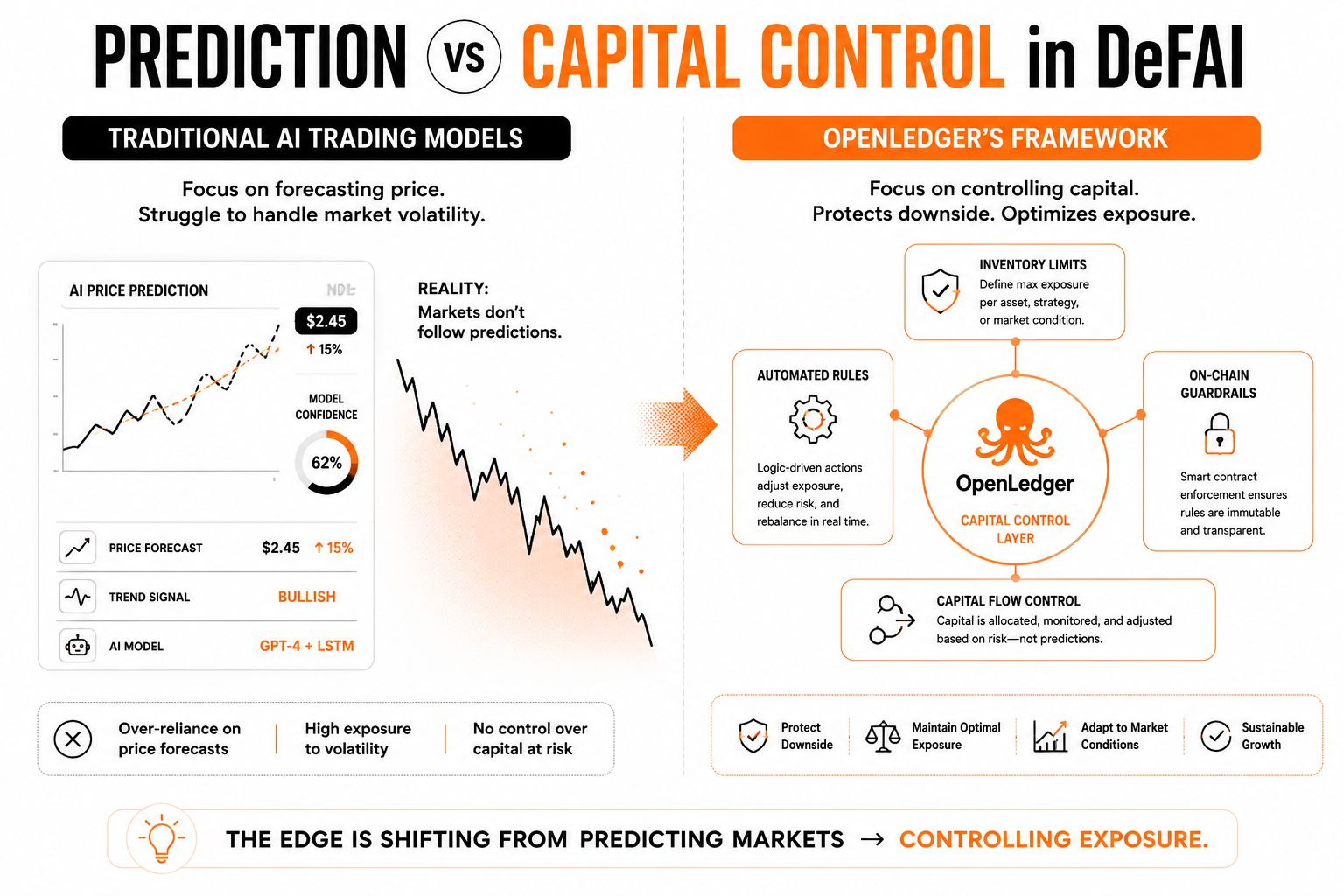
Most DeFAI systems inherited a familiar assumption from both traditional finance and crypto trading: if you improve forecasting, returns follow. Build better models, ingest more data, tighten latency, automate execution. Yet anyone who watched the market through the ETF-driven volatility earlier this year or the sudden liquidity rotations across AI-linked tokens saw the same pattern. Strategies rarely fail because they guessed direction incorrectly. They fail because inventory drifted, positions became misaligned, or operational assumptions broke while the model still looked “right.”
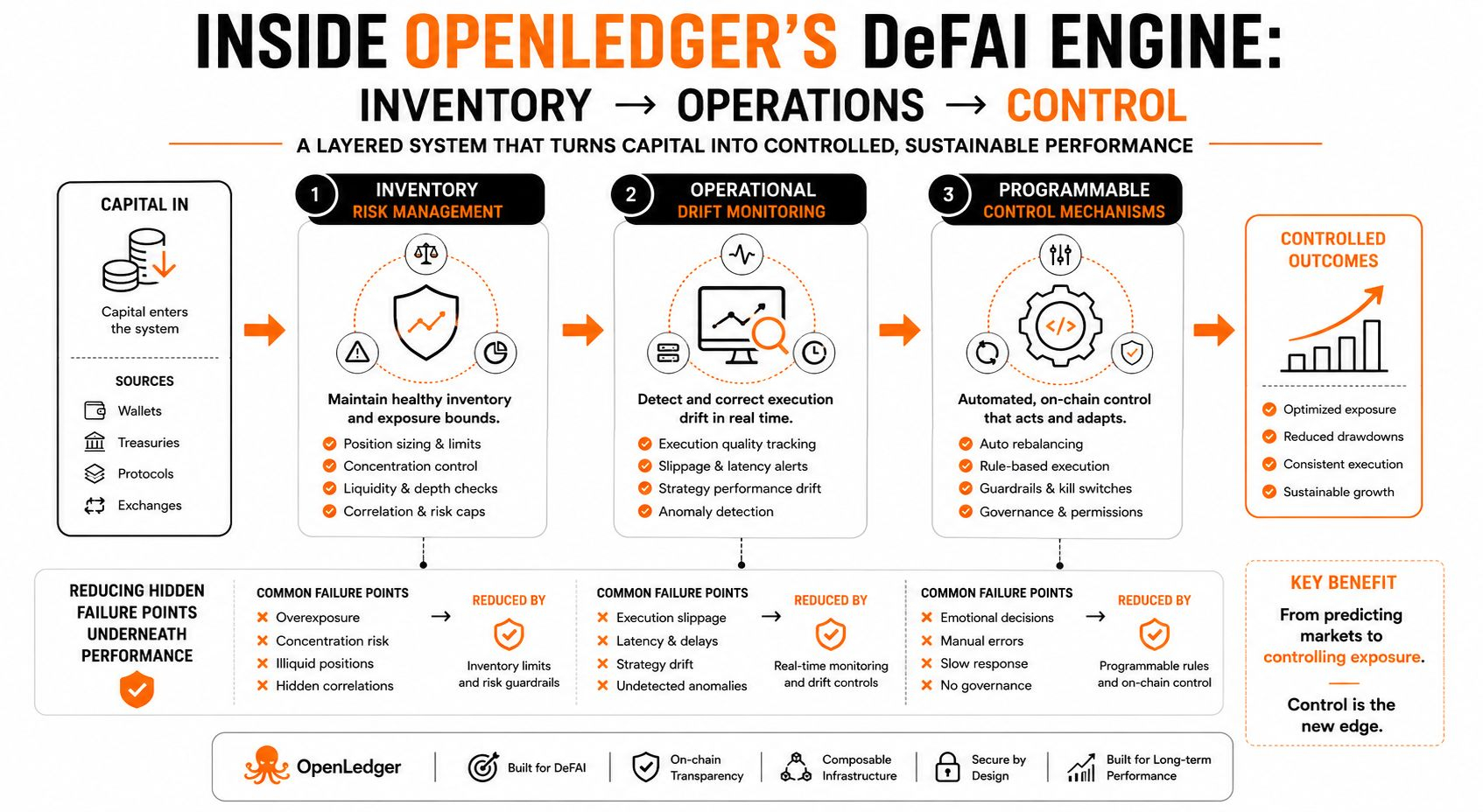
OpenLedger's framing around Inventory Risk, Operational Drift, and Programmable Control starts from that uncomfortable observation.
Inventory Risk sounds technical but the idea is simple. Every system holding capital is making a continuous decision about where assets sit, how concentrated they become, and what conditions force movement. Surface level, it looks like treasury management. Underneath, it becomes capital survival.
Take an AI liquidity agent managing $10 million across pools. A 5% pricing error sounds manageable until you realize inventory concentration can amplify that exposure several times over depending on rebalancing logic and execution windows. Suddenly the problem is not prediction accuracy. It is capital placement discipline.
That creates another effect.
Operational Drift enters when systems gradually move away from their intended behavior without anyone noticing immediately. I was reading developer discussions recently and the recurring complaint was not that autonomous agents were making irrational decisions. It was that they were making internally consistent decisions based on conditions that no longer reflected reality.
Traditional finance has dealt with versions of this for decades through mandates, exposure limits, and circuit breakers. DeFAI inherited automation but often skipped governance structure.
OpenLedger appears to be treating control itself as programmable infrastructure. Instead of asking an agent to maximize yield indefinitely, define acceptable inventory ranges, define intervention triggers, define execution permissions, and enforce them on-chain.
That changes incentives.
If an AI liquidity system earns 14% annualized yield but violates inventory constraints three times per month, the return profile means less than it appears. The hidden cost is fragility. Meanwhile, a system generating 9% while maintaining controlled inventory variance may actually compound more effectively because fewer emergency actions interrupt performance.
There is an obvious counterargument. More controls can reduce adaptability. Markets move because flexibility matters. Over-constrained systems risk becoming slower than competitors.
That concern feels real.
But early signs across automated finance suggest the opposite pressure may emerge. As more liquidity becomes machine-managed, predictability of behavior becomes a competitive asset. Capital providers may increasingly prefer systems that expose their control logic instead of promising superior forecasts.
Understanding that helps explain why this feels bigger than another DeFAI architecture update.
OpenLedger is not arguing that prediction no longer matters. It is suggesting prediction has become table stakes, while capital control becomes the scarce capability.
And if that holds, the systems that win may not be the ones that see further. They may be the ones that stay aligned longer.
