
I keep coming back to the same question whenever I look at AI projects: who actually deserves the value that AI creates?
A few weeks ago, I was using an AI tool to help summarize research papers. It worked well, but it made me wonder. The model had learned from countless datasets, articles, and human contributions. Somewhere behind that simple answer were thousands of people whose data, knowledge, or work helped shape the result. Yet most of them would never know their contribution was used, let alone receive any benefit from it.
That thought led me back to OpenLedger.
Most conversations around AI today focus on how powerful models are becoming. Every week there's a new benchmark, a faster model, or a bigger training dataset. The assumption is that better intelligence automatically creates a better ecosystem.
I'm not sure that's true.
Think about YouTube. Creating videos isn't the hard part anymore. The real challenge is making sure creators are credited, protected, and rewarded fairly. The same thing is happening with AI. Generating outputs is becoming easier. Tracking where value comes from and where it should go is becoming harder.
That's where OpenLedger feels different.
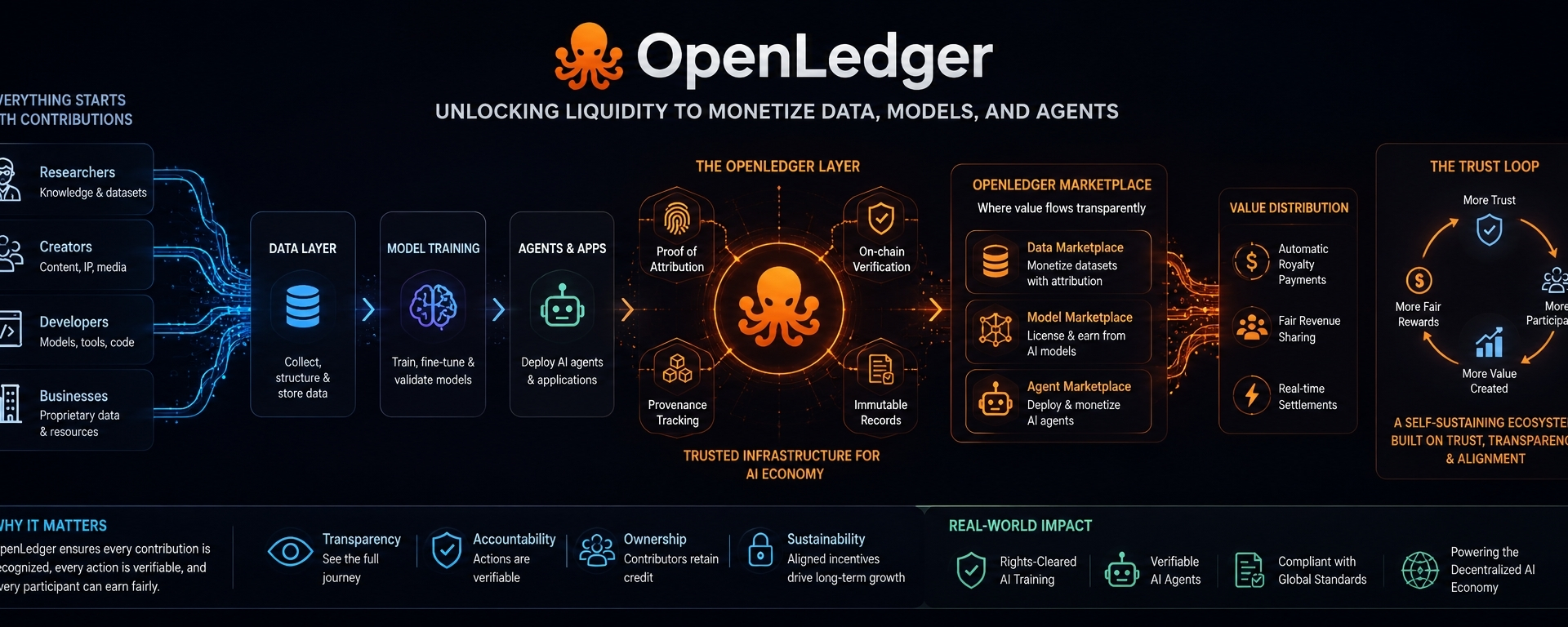
Instead of treating AI as a mysterious black box, OpenLedger is trying to build an economy around attribution. The idea is simple: if data, models, and AI agents create value, the people and resources behind them should be visible and potentially rewarded.
On paper, that sounds obvious.
In reality, it's incredibly difficult.
Imagine an AI model trained on millions of data points. Some data came from researchers, some from developers, some from businesses, and some from everyday users. When that model generates revenue, how do you determine who contributed what? How do you verify ownership? How do you prevent manipulation?
These questions are becoming more important as AI moves from experimentation into real economic activity.
We're already seeing signs of this shift. Lawsuits over training data continue to emerge. Content creators want compensation. Businesses want proof that AI-generated outputs are based on legally sourced information. Regulators increasingly ask for transparency rather than blind trust.
In other words, the conversation is moving beyond intelligence.
It's moving toward accountability.
And accountability is where many systems start to struggle.
A blockchain can verify that a transaction happened. That's useful. But verification alone doesn't solve everything. A system can be transparent and still create unfair outcomes. It can be decentralized and still concentrate value among a small group of participants.
The real test comes when pressure arrives.
What happens when incentives change?
What happens when money is involved?
What happens when thousands of users compete for rewards?
History shows that systems rarely fail during good times. They fail when growth creates stress and hidden weaknesses become impossible to ignore.
That's why I find OpenLedger's focus on attribution and AI ownership more interesting than discussions about model performance alone.
The project appears to be asking a deeper question:
Can AI become part of an economy where contributions remain visible instead of disappearing into a black box?
That's not just a technical challenge. It's a human challenge.
Because trust has always been difficult to scale.
The internet solved information distribution.
Blockchains helped solve digital verification.
AI is helping automate intelligence.
But we're still trying to solve fair value distribution.
Maybe that's the bigger opportunity.
When I look at OpenLedger today, I don't see a project competing to build the smartest model. I see a project exploring how trust, ownership, and incentives might work in an AI-driven world.
Whether that vision succeeds remains to be seen.
But I think it's pointing toward a real problem.
As AI becomes more capable, the winners may not simply be the systems that generate the most intelligence. They may be the systems that can clearly answer a much harder question:
Who contributed, who benefited, and why should anyone trust the process?
That question feels increasingly important every day, and it's one I suspect the entire AI industry will have to answer sooner or later.
