
I still remember the exact moment I closed my short position too early on that 2022 DeFi infrastructure play. The charts looked unstoppable—TVL climbing daily, partnerships announced left and right, and my trading group chat lighting up with screenshots of green candles. I had gone long initially, convinced the tech would drive real adoption. Then the liquidity mining rewards tapered off. Within weeks, the Discord channels that once buzzed with builder talk went eerily silent. On-chain transactions dropped to mostly internal wallet shuffles. I watched my gains evaporate and learned a hard lesson: hype metrics measure momentum, not staying power. That experience is exactly why I’m watching OpenLedger and its OPEN token with cautious optimism right now.
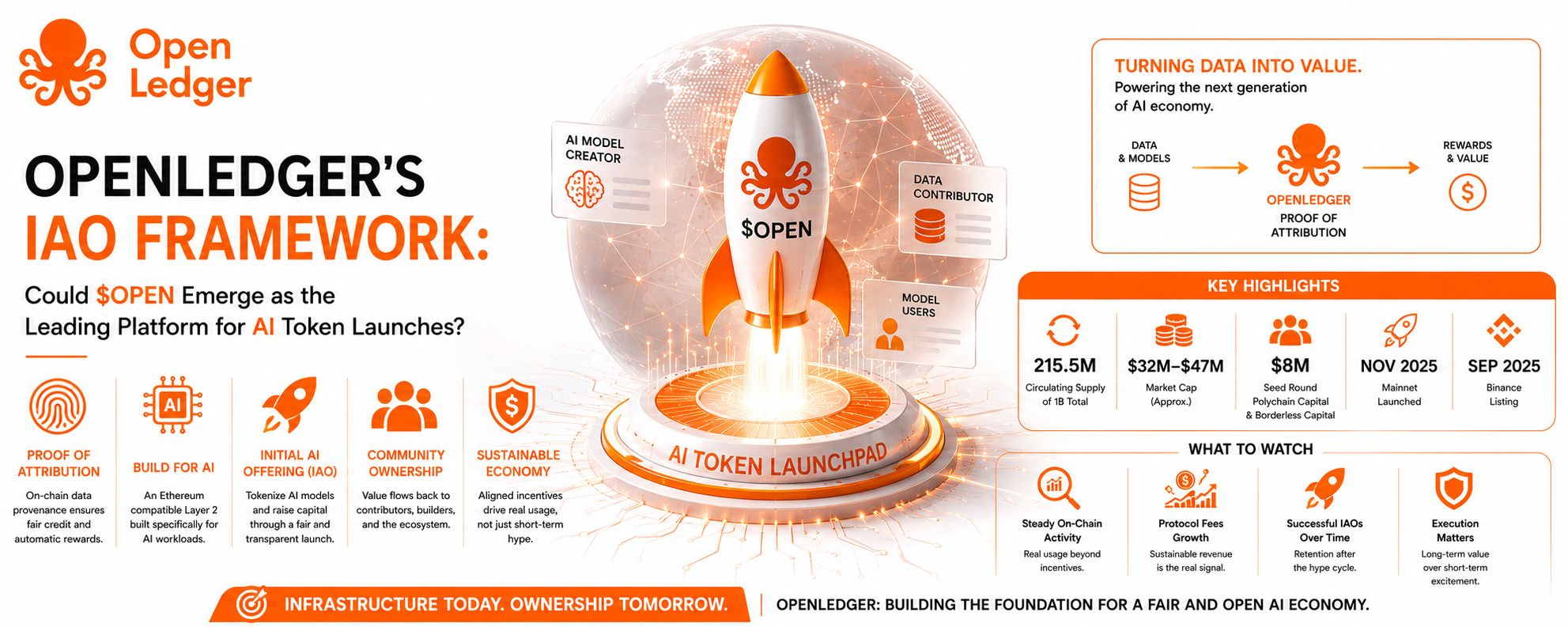
The core concept here genuinely stands out in a crowded crypto landscape. OpenLedger operates as an Ethereum-compatible Layer 2 designed specifically for AI workloads. At its heart is the Proof of Attribution system—a mechanism that records data provenance directly on-chain. When an AI model pulls from your contributed dataset or fine-tuned weights to create outputs, you automatically receive compensation. It turns what’s usually a closed-door process at big labs into something more open and participatory.
This flows naturally into their Initial AI Offering (IAO) model. Instead of traditional fundraising, creators can tokenize their AI models and launch them on the platform, raising capital much like a DeFi protocol does with liquidity pools or fair launches. I’ve been thinking about this a lot. It’s like giving independent developers the same rails that established teams use, but with built-in attribution so value flows back to contributors. Whether this scales beyond the whitepaper is the real test.
Right now, OPEN sits with roughly 215.5 million tokens in circulation out of a 1 billion total supply, giving it a market cap hovering between $32 million and $47 million. That’s modest for the ambition. The project secured an $8 million seed round from Polychain Capital and Borderless Capital. Mainnet went live in November 2025, followed by a Binance listing in September 2025 that pushed the price to an all-time high of $1.85. We’ve since seen a sharp 90%+ pullback to around $0.15. Classic post-hype reality check.
What caught my attention wasn’t the price action itself, but how it mirrored my earlier trading mistake. I opened a small exploratory long position on OPEN shortly after mainnet, mostly to test the waters. The Trust Wallet integration looked promising for broader accessibility. Yet I kept position sizing tiny—maybe 2% of my active portfolio—because I kept remembering how fast those 2022 metrics faded once incentives dried up.
The retention challenge is the make-or-break factor for any launchpad thesis. Exciting roadmaps and strong backers get you initial traction. Sustainable usage comes from developers returning because the tools solve painful problems, not because of airdrop farming. I’ve started checking block explorers during quiet periods, looking past headline numbers. What matters are steady transaction counts when no campaigns are running, protocol revenue trends, and wallets that keep interacting months later.
There are clear risks worth highlighting honestly. Over 51.7% of the total supply sits in community and ecosystem pools, vesting over 48 months. That creates ongoing distribution pressure that could weigh on price if conviction isn’t there. Competition for AI project launches is fierce—established platforms aren’t standing still. The Proof of Attribution idea sounds elegant, but real-world AI supply chains involve messy data licensing issues that haven’t faced large-scale testing yet. Regulatory uncertainty around tokenized models adds another layer; one major jurisdiction cracking down could complicate everything.
I’ve been cross-referencing this with other narratives I’ve traded through. Remember when several NFT marketplaces promised creator royalties forever? The technical implementation worked until market conditions shifted and enforcement weakened. OpenLedger faces a similar test: will IAOs actually deliver active user bases six months post-launch?
Actionable signals to track are deliberately unglamorous. I set calendar reminders to review weekly transaction data during non-event periods. Protocol fee generation in $OPEN—especially quarter-over-quarter growth without marketing pushes—tells you more than holder counts, which inflate during distributions. The number of IAOs that maintain engagement long after their initial hype cycle matters most.
From a fundamental angle, if OpenLedger delivers, the network effects could be powerful. Every serious AI project needing reliable attribution and monetization rails might naturally gravitate toward a specialized Layer 2 built for this. It’s less about narrative momentum and more about infrastructure bets. Think of it like early decentralized exchanges: the ones that survived built habits, not just volume.
My current approach is straightforward: small position, extended time horizon through at least Q3 2026. I review on-chain metrics monthly, independent of price. If organic activity—repeat usage, growing IAO completions, consistent fees—doesn’t show up after incentives fade, I’ll exit without hesitation. No emotional attachment.
This isn’t financial advice, just how I’m thinking through it based on past cycles. The setup rhymes with previous opportunities that worked and others that didn’t. The team has execution ahead to close the gap between current pricing and those optimistic $40 projections some analysts floated earlier.
Two questions I keep returning to before adding to any position: If all incentive programs vanished tomorrow, how many AI builders would continue using OpenLedger because the infrastructure genuinely fits their workflow? And looking across crypto history, how many launchpads have maintained meaningful activity two years after their token generation event?
The answers will come from on-chain data, not marketing materials. For now, I’m staying engaged but disciplined—watching, learning, and sizing risk accordingly. The potential for a true AI-native launchpad is compelling enough to study closely, but only execution over the next year will separate the signal from the noise.
$OPEN @OpenLedger #OpenLedger $LAB