
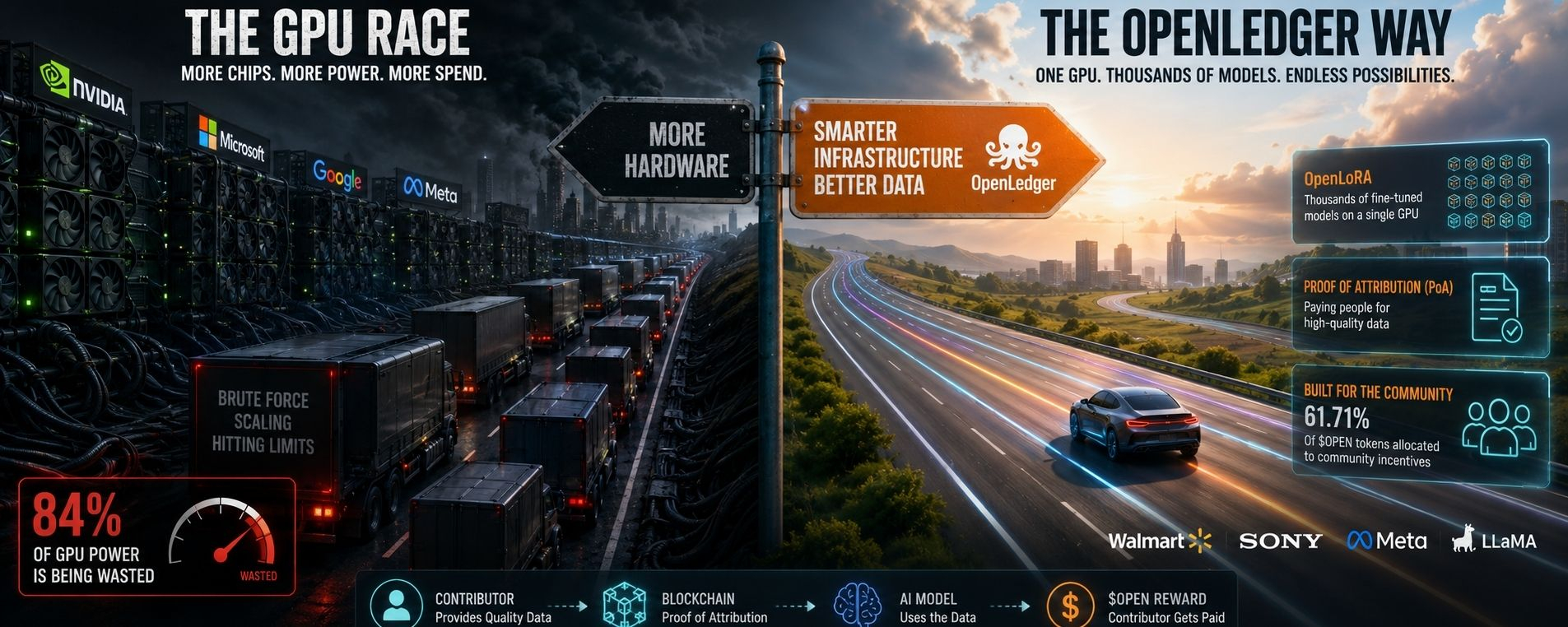
#Openledger Right now, the entire AI industry is obsessed with one thing: GPU hoarding. Big tech companies have turned the world into a frantic horse race for the most expensive graphics cards, trying to build bigger and bigger servers. NVIDIA's H100 and B200 chips have become the oil of the 21st century, with giants like Microsoft, Google, and Meta fighting tooth and nail to get their hands on them, spending billions on clusters that can require hundreds of thousands or even millions of chips for a single model. The loudest voices in crypto have followed the same script. Every day, a new "AI blockchain" launches, promising it's the fastest, most compute-heavy network ever built. It's a one-track race to feed the beast more hardware.
This GPU-centric thinking assumes the only way forward is to pile on more compute. But the results are getting bleak. A recent MIT study found that returns from brute-force scaling are approaching a hard limit—adding more computational steps no longer delivers proportional improvements. Meanwhile, a staggering **84% of GPU power is being wasted** in complex AI environments. We're pouring billions into a system that's increasingly inefficient. It's like trying to solve a city's traffic jams by buying everyone a faster sports car—the real problem isn't the engine, it's the clogged road.
That's why OpenLedger's approach is so refreshingly different. They looked at AI's expensive hardware problem and asked a smarter question: What if we didn't need a separate GPU for every single AI model? Their answer is **OpenLoRA**, a technical framework that allows thousands of fine-tuned models to run on a single GPU at the same time. They compress the models so efficiently that a single graphics card can run thousands of customized AI models with minimal memory usage. Instead of buying new hardware for every new task, OpenLedger sweeps the "clogged road" clean, letting a single, powerful chip do the work of thousands. It's not about building bigger cars; it's about making the existing road handle a hundred lanes of traffic at once.
But OpenLedger's real secret weapon is its focus on what goes into the AI engine, not just the engine itself. The GPU narrative is obsessed with the *how* of computation. OpenLedger is obsessed with the *what*: the data. They argue that high-quality data is the scarcest resource in AI, a sentiment echoed by their co-founder who left his former job precisely because high-quality training data was so hard to find. And while 99% of datasets on platforms like HuggingFace are "useless" noise, OpenLedger has built a **Proof of Attribution (PoA)** system that pays people for good data. It uses a blockchain to create a permanent, unchangeable "receipt" for every piece of contributed data, and when an AI model uses that data to do its thinking, the contributor gets paid in $OPEN tokens.
This isn't some vague promise of future riches. Since its mainnet launch in 2025, OpenLedger has already signed major partnerships with companies like Walmart, Sony, and Meta LLaMA, helping them build specialized models. Their network is processing millions of transactions. And their tokenomics are refreshingly grounded. Of the 10 billion total supply of $OPEN tokens, the single biggest chunk—**61.71%** —is set aside for the community to reward actual contributors with real data and compute power. They've also partnered with Injective to run autonomous AI agents that can track their own reasoning, making the whole process traceable from decision to settlement.
But let's be honest: this isn't a frictionless dream. The biggest challenge isn't tech—it's human nature. The data that's *really* valuable is often the stuff people don't want to share. Is an elite medical imaging lab going to give away its crown jewels for a few $OPEN tokens? Probably not. OpenLedger could end up as a well-organized marketplace for cheap, public data, which doesn't solve the core problem it claims to fix. And the GPU-bottleneck isn't going away either. Eventually, if too many people are running AI agents on OpenLedger, we'll be back to fighting for GPU time, just with a new crypto-powered scheduling system. Even the world's most efficient traffic system can't prevent a traffic jam if too many cars show up.
So who wins? I don't think it's an either/or question. The "brute force" GPU narrative isn't wrong, but it's going to hit a wall. OpenLedger isn't trying to compete on raw speed; it's trying to build an AI world that is more efficient and a little more fair to the people who actually train the models. They're betting that in the long run, the AI models that win won't be the ones with the most chips. They'll be the ones with the best data, running on the smartest systems. And that's a bet I'm watching closely. @OpenLedger