
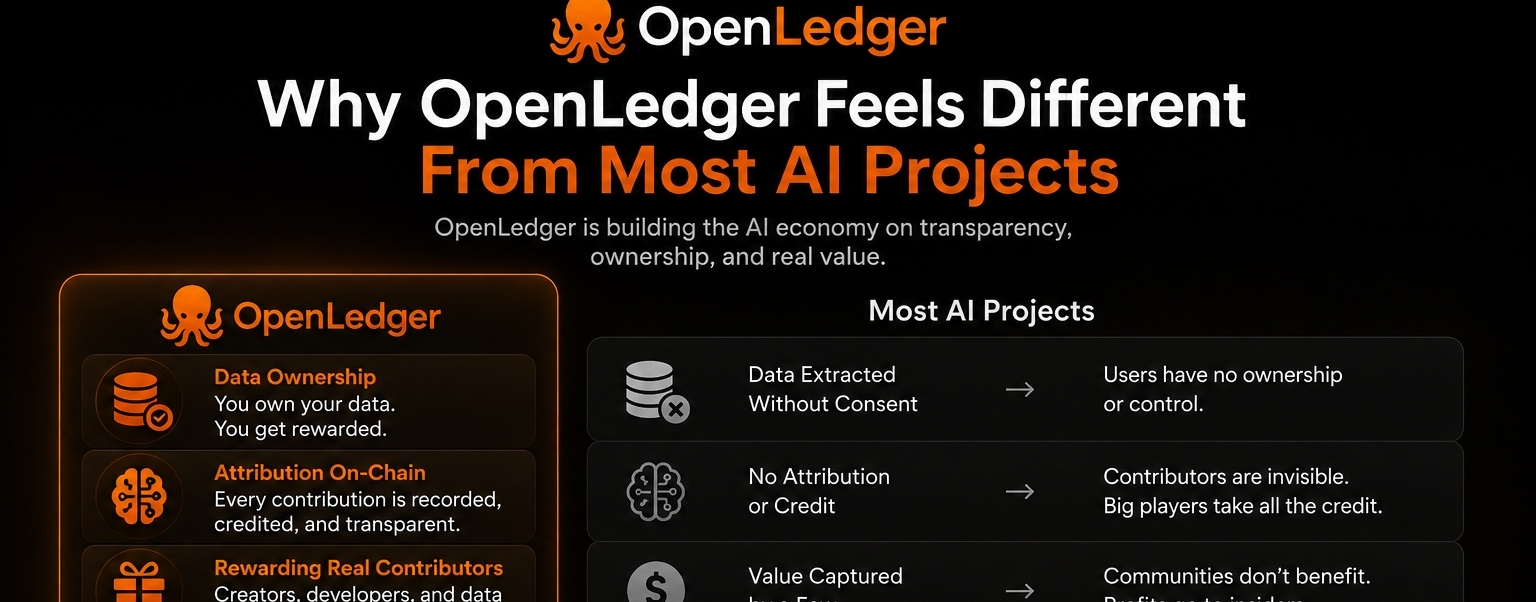
OpenLedger Slowly Changed The Question I Was Asking About AI
A few weeks ago, I couldn't sleep.
Nothing unusual. Just one of those nights where your mind keeps wandering even though you're tired.
So I did what most people probably do. I grabbed my phone and started scrolling.
Markets were moving. People were debating narratives. AI was everywhere again.
Every other post seemed to be about bigger models, smarter agents, faster systems, or some new breakthrough that was supposedly going to change everything.
I kept scrolling for almost an hour before realizing something.
Everyone was talking about what AI can do.
Almost nobody was talking about who makes AI valuable in the first place.
That thought stayed with me longer than I expected.
And without really planning to, I ended up spending the next few weeks digging into OpenLedger.
Not intensely. Not like a researcher trying to write a report.
More like someone following a trail of questions.
I'd read a document while drinking tea in the morning. Check a community update during lunch. Revisit a note late at night. Then forget about it for a day before coming back again.
The more time I spent with it, the more I felt like I was looking at something different from the usual AI conversation.
One afternoon I was sitting with my younger brother after dinner.
The conversation drifted toward technology, as it often does.
At some point he asked a question that sounded simple but wasn't.
"If AI learns from millions of people, shouldn't millions of people benefit from it too?"
I remember laughing because it felt obvious.
Then I realized I didn't actually have an answer.
Because when you think about modern AI, value flows in a strange direction.
The data comes from somewhere.
The knowledge comes from somewhere.
The feedback comes from somewhere.
The creativity comes from somewhere.
Yet most of the economic value eventually concentrates elsewhere.
That imbalance is what kept pulling me back toward OpenLedger.
Not because it claims to solve everything.
But because it seems focused on a question most projects barely discuss.
How do you track contribution inside an AI economy?
The thing that surprised me is that OpenLedger doesn't feel obsessed with intelligence itself.
Most AI projects talk endlessly about making models smarter.
OpenLedger appears more interested in understanding where intelligence comes from and where its value should go afterward.
At first I thought that sounded like a subtle difference.
Now I think it's a massive one.
Because intelligence isn't created in isolation.
Every useful AI output sits on top of countless invisible contributions.
People write articles.
People create datasets.
People provide feedback.
People build tools.
People train models.
People improve systems.
The final result often gets attention.
The contributors underneath it rarely do.
As I followed OpenLedger's recent progress—the mainnet launch, ecosystem growth, new partnerships, and expansion around its Payable AI vision—I kept noticing the same theme repeating itself.
Attribution.
Ownership.
Compensation.
Not as side features.
As the foundation.
A few days later I was walking through a crowded market.
Shopkeepers were calling customers over. Delivery riders were weaving through traffic. Vendors were negotiating prices.
Everything felt chaotic.
Yet there was one thing nobody questioned.
Who created value.
The seller sells.
The buyer buys.
The transaction happens.
Everyone understands their role.
Human economies work because ownership is relatively clear.
AI economies don't.
That's where things become interesting.
When an AI system produces something useful, where exactly did that value originate?
Who deserves recognition?
Who deserves payment?
Who deserves ownership?
The deeper AI becomes embedded into everyday life, the harder those questions become.
And honestly, I think the industry is only beginning to realize that.
Something else started standing out during my research.
OpenLedger talks a lot about agents.
Not just models.
Agents.
At first that distinction didn't seem important.
Then I thought about where AI is heading.
Models answer questions.
Agents take action.
Future AI systems won't simply generate text.
They'll make decisions.
Execute tasks.
Coordinate resources.
Interact with financial systems.
Negotiate with other agents.
Operate continuously.
Once that happens, attribution becomes even more important.
Not less.
Because if autonomous systems create economic value, people will eventually want to know where that value came from.
History suggests they always do.
One evening while having tea, I went back through weeks of notes I'd collected.
What struck me wasn't any specific announcement.
It was the consistency.
A lot of crypto projects evolve by chasing whatever narrative is popular at the moment.
AI one month.
Gaming the next.
DeFi after that.
OpenLedger feels different.
Whether you're looking at partnerships, ecosystem expansion, infrastructure development, or governance discussions, everything seems connected to the same underlying belief.
That intelligence should be accountable.
That contributors should be visible.
That value should be traceable.
Maybe that's harder than building another AI model.
But it also feels more necessary.
The older I get, the more I think technology succeeds because of incentives rather than innovation alone.
Innovation attracts attention.
Incentives determine what survives.
The internet grew because people had reasons to participate.
Open-source software grew because contributors found value.
Markets grow because ownership is understood.
AI will probably be no different.
The systems that last won't simply generate intelligence.
They'll create fair relationships between contribution and reward.
At least that's where my thinking has started to drift.
$
If you'd asked me a month ago what OpenLedger was, I probably would have called it an AI blockchain and moved on.
Now I don't think that's the most interesting way to describe it.
After spending weeks reading, observing, questioning, and occasionally overthinking it, I see something else.
I see a project trying to answer an uncomfortable question that the AI industry still hasn't fully solved.
Who gets recognized when intelligence becomes a network effort?
I don't know whether OpenLedger ultimately succeeds.
I don't know whether its vision becomes the standard.
There are still plenty of unknowns ahead.
But I do know this.
The longer I followed the project, the less interested I became in the technology itself.
And the more interested I became in the people hidden behind it.
Because AI isn't really built by machines.
It's built by countless human contributions layered together over time.
And maybe the next chapter of AI won't be about making intelligence smarter.
Maybe it'll be about finally deciding who intelligence belongs to.
