
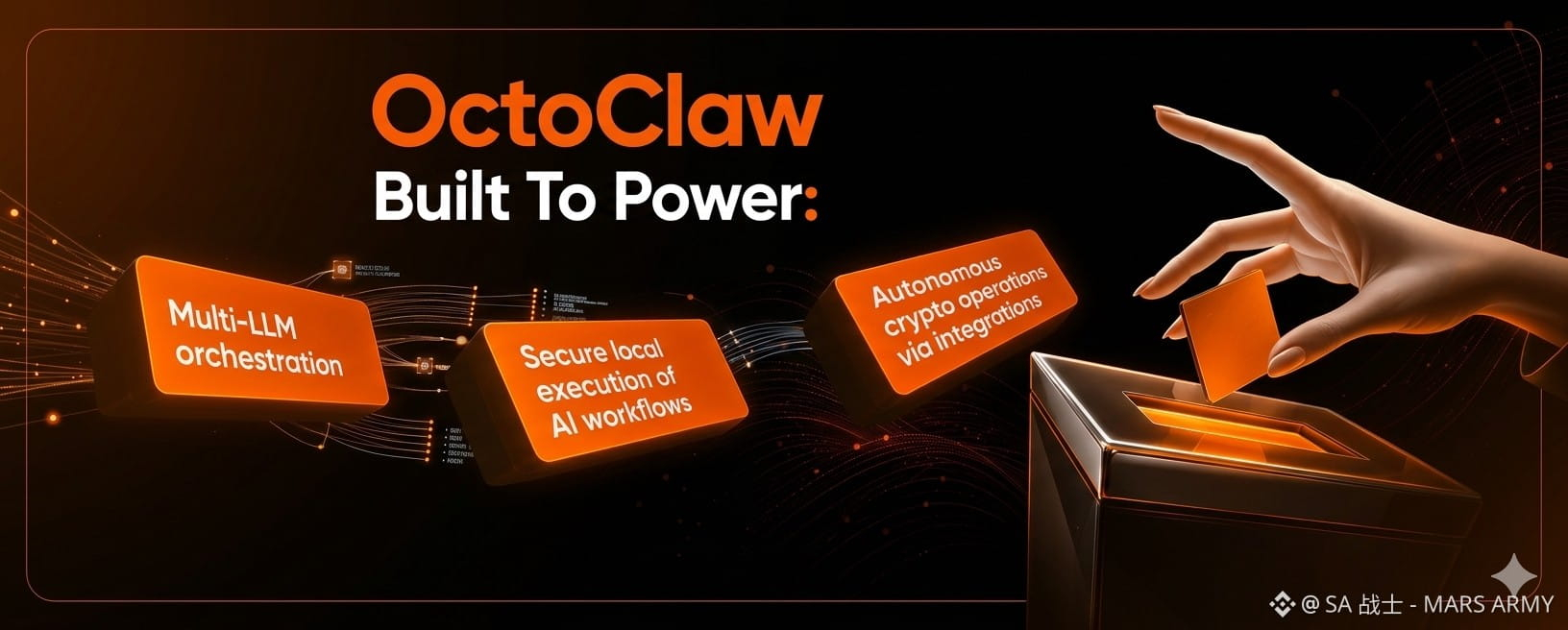
The most important AI story right now might not be a new model. It might be the infrastructure quietly forming underneath them.
When I first looked at @OpenLedger OctoClaw’s latest evolution, what struck me wasn't the idea of adding more agents. Everyone is talking about agents. The interesting part is what happens when those agents have to coexist in the same environment, touch the same resources, and make decisions that can have financial consequences in real time.
That's where most conversations around agentic AI still feel incomplete.
The industry has spent the last two years competing on intelligence. Larger models. Better reasoning. Longer context windows. Meanwhile, a different problem has been growing underneath the surface. What happens when multiple AI systems need to work together instead of simply answering a prompt?
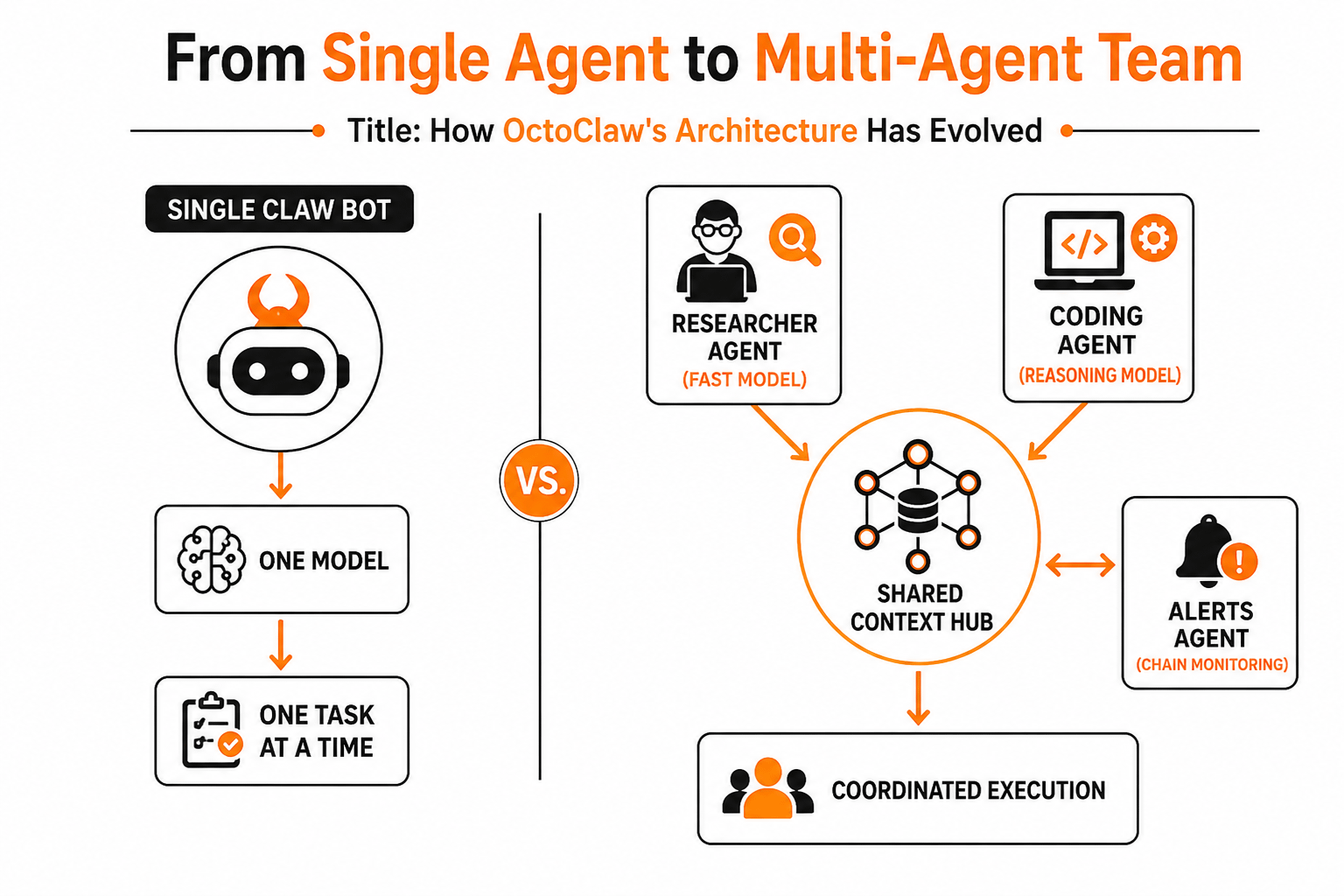
OctoClaw's move from a single Claw Bot tool into a multi-agent orchestration framework is really an attempt to answer that question.
On the surface, the concept is straightforward. Different agents specialize in different tasks. A Researcher Agent can run on a smaller, cheaper model optimized for speed. A Coding Agent can use a larger reasoning model when complexity matters. An Alerts Agent can continuously monitor on-chain activity. Instead of forcing one model to switch roles throughout a workflow, specialized agents operate simultaneously and share context.
That sounds like a productivity upgrade. Underneath, it's actually a coordination problem.
Imagine a crypto trader running several automated processes at once. One agent is scanning governance proposals, another is monitoring wallet activity, while a third is preparing execution strategies. The value isn't simply that three tasks happen at the same time. The value comes from maintaining continuity between them without requiring constant human intervention.
Understanding that helps explain why OctoClaw's architecture changes matter more than the agents themselves.
One of the less glamorous realities of autonomous systems is concurrency risk. In traditional software environments, multiple processes attempting to modify the same resource can create conflicts. In crypto environments, those conflicts become expensive very quickly.
A duplicate transaction. An overwritten state file. Two agents attempting to execute contradictory actions from the same wallet. Small coordination failures can become financial failures.
The introduction of a command queue that serializes execution per session is an acknowledgment of that reality. Instead of allowing unrestricted parallel execution, actions that affect local state move through a controlled sequence. Surface level, that sounds slower. In practice, it may be what makes autonomy usable.
Because autonomy without coordination isn't really autonomy. It's chaos.
Meanwhile, another aspect of the update feels increasingly relevant given where the AI market sits today. The secure local gateway philosophy.
The current AI ecosystem is moving in two directions at once. Models are becoming more capable, but they're also becoming more connected to external services, APIs, repositories, wallets, and data sources. Every connection expands capability. Every connection expands risk.
OctoClaw's approach attempts to keep sensitive components local by default. API keys remain on the machine. Repository files stay local. Wallet session states remain under user control rather than passing through third-party infrastructure.
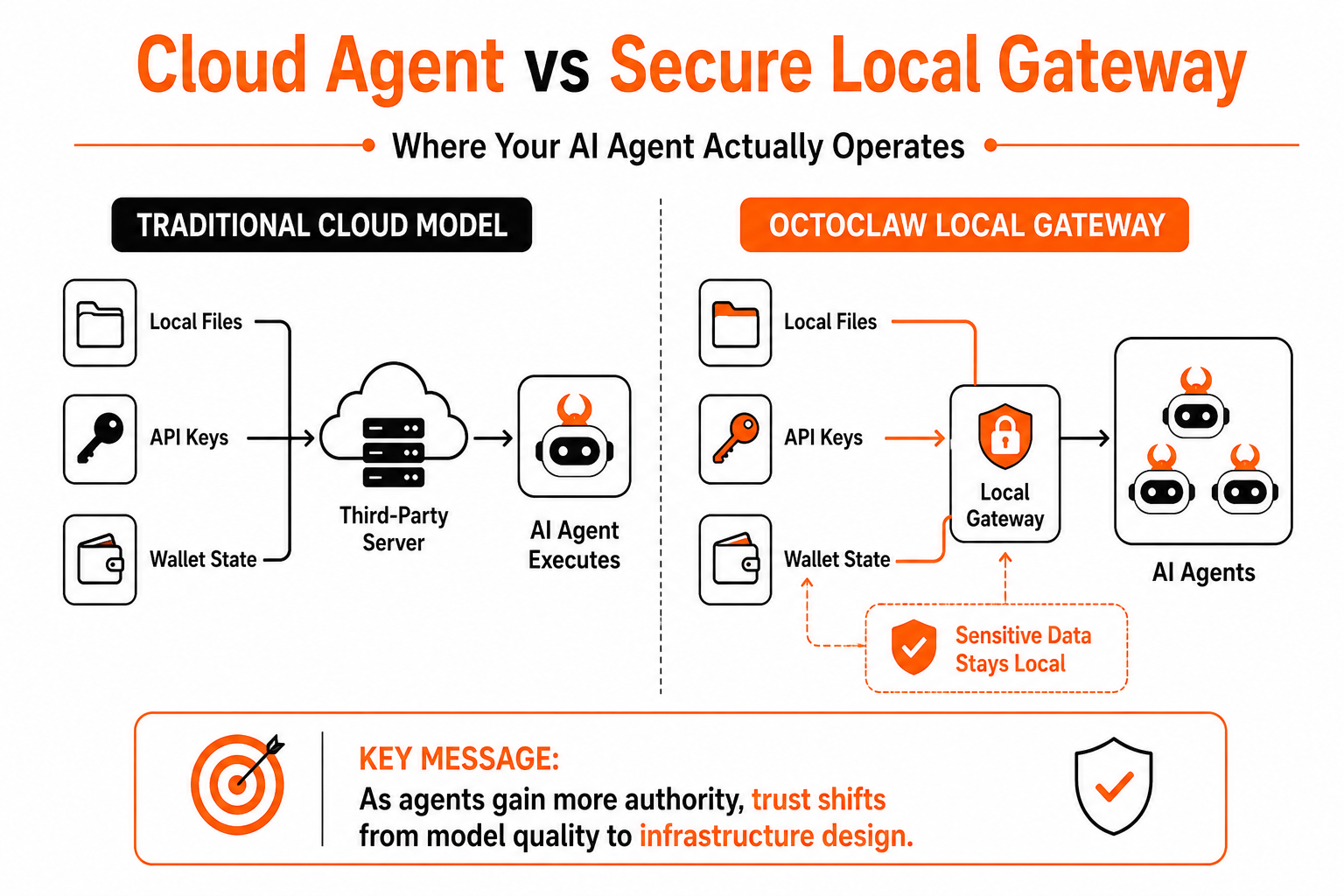
That distinction matters because the average agent today is no longer just generating text. It is reading files, executing commands, interacting with financial systems, and increasingly acting on behalf of users.
The more capable agents become, the more infrastructure trust becomes the real bottleneck.
There is a counterargument worth acknowledging. Local-first systems often introduce complexity. Setup friction can be higher. Resource requirements increase. Cloud-based systems remain easier for many users. Whether mainstream users ultimately prefer local control over convenience remains to be seen.
But early signs suggest the market is starting to care more about where execution happens, not just how intelligent the model appears.
We're already seeing that shift across AI. Enterprises increasingly ask about deployment environments. Developers ask about ownership of data flows. Crypto users ask where keys are stored. These questions all point toward the same underlying concern.
Trust is moving down the stack.
What OpenLedger OctoClaw reveals is that the next phase of agentic AI may not be defined by a single super-agent. It may be defined by coordinated teams of specialized agents operating within controlled environments where security, state management, and execution reliability matter as much as intelligence itself.
The models may get the attention, but the infrastructure quietly determines what they're actually allowed to become.
