
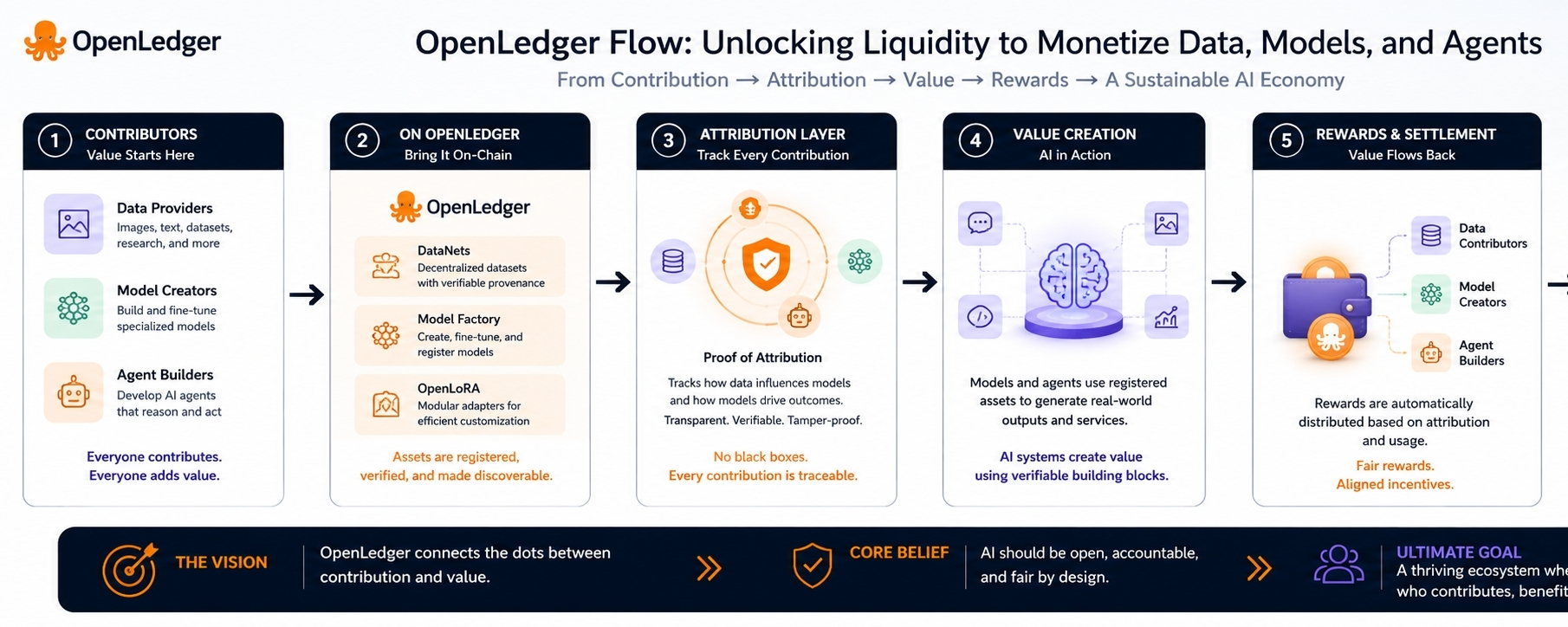
I’ve been thinking a lot about OpenLedger lately, and what keeps catching my attention isn’t the blockchain part or even the AI part. It’s the idea of ownership.
Right now, AI is everywhere. We use chatbots, AI assistants, image generators, and automated agents every day. But most people rarely stop to ask a simple question: who actually creates the value that makes these systems work?
Imagine a photographer uploads thousands of images online. A researcher publishes useful datasets. A developer builds a specialized AI model. Over time, these contributions help train and improve AI systems, yet the rewards often flow somewhere else. The connection between contribution and value becomes blurry.
This is where OpenLedger is trying a different approach.
Instead of treating data, models, and AI agents as invisible building blocks, OpenLedger wants them to become assets that can be tracked, verified, and monetized. If a dataset helps train a model, or if a model contributes to an AI application, the system aims to record that relationship and reward contributors accordingly.
A real-world example is similar to how music streaming platforms track song plays and distribute royalties. OpenLedger is attempting to create a comparable system for AI, where data providers, model creators, and agent builders can potentially receive value when their work is used.
What makes this interesting isn't the technology itself. Plenty of projects have impressive technology. The real challenge is trust.
Anyone can build a system that works when conditions are perfect. The difficult part is maintaining fairness when millions of interactions happen, when data quality varies, and when economic incentives start influencing behavior.
That’s why OpenLedger’s focus on attribution stands out. The project is investing heavily in mechanisms that track how data influences models and how models contribute to outcomes. Recent developments around its AI Studio, Model Factory, OpenLoRA infrastructure, and Attribution Engine all point toward the same goal: making AI value flows more visible rather than hiding them behind a black box.
Still, there are risks.
Verification doesn't automatically create quality. A dataset can be verified and still be poor. A model can be attributable and still perform badly. An AI agent can be transparent and still make mistakes. Real-world reliability comes from balancing accountability with execution.
In many ways, OpenLedger sits between two competing forces. On one side is the fast-moving world of AI, where systems constantly adapt and evolve. On the other side is the need for clear ownership, trust, and economic accountability. Most projects focus heavily on one side. OpenLedger is attempting to connect both.
Whether that vision succeeds remains an open question. But I think the more important insight is that the future AI economy may depend less on building smarter models and more on building systems that fairly recognize everyone who helps create them.
Because in the long run, the strongest AI networks may not be the ones that generate the most intelligence. They may be the ones that make contribution visible, trust measurable, and value distribution sustainable.
And that's the question I keep coming back to whenever I look at OpenLedger.
