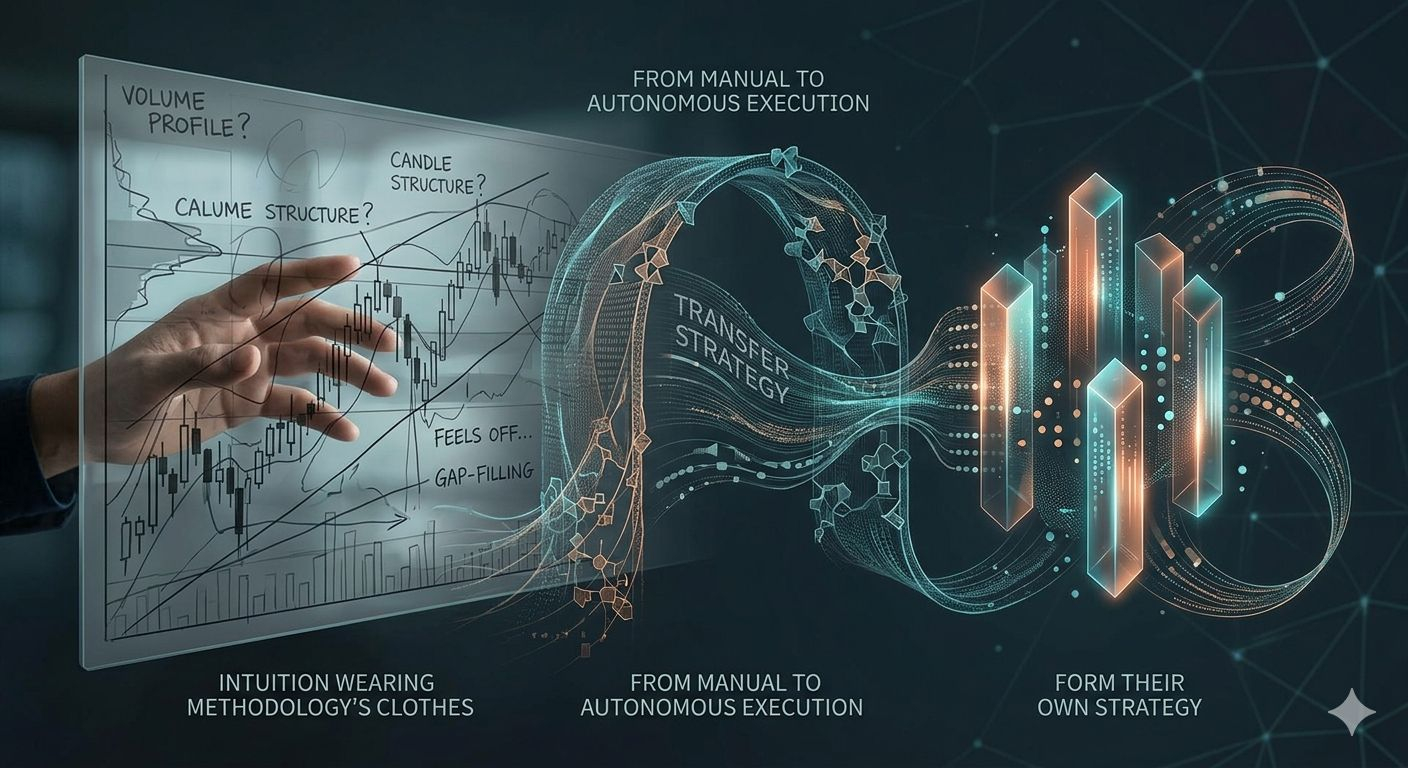
Tried to Automate My Edge. Realized I Couldn't Define It.
Market felt hollow today. Not the bad kind — just that in-between state where nothing's moving and you keep pulling up charts out of habit, not because you actually see something. I sat there for a while, half-watching, not committing to anything. Eventually I closed the charts and went down a rabbit hole instead. Probably saved myself some money.
I'd been meaning to look at OpenLedger's trading agents for a few weeks. Not with any strong thesis — someone mentioned it in a thread, I clicked, then forgot about it. Today felt like the right kind of slow session to actually sit with it.
My first assumption was standard: another automation pitch. You have a strategy, the system learns it, now it runs without you. Removes emotion, improves discipline, executes faster. I've seen some version of this every cycle. I wasn't expecting anything different.
Then I hit a detail that stopped me.
These agents aren't designed to replicate your strategy. They're designed to form their own.
I had to read that twice. Because the entire framing — "from manual to autonomous execution" — implies a transfer. You hand something over. It runs on the other side. Manual to autonomous sounds like the same thing, just without the human finger on the button.
But that's not what the architecture is actually doing. The agents train on data. They weight patterns. The strategy doesn't come from you — it emerges from what the model learns to prioritize over time. You're not the input. You're, at best, the starting conditions.
And the moment I understood that, something clicked in a slightly uncomfortable way.
Here's the honest thing about manual trading that doesn't get said enough:
Most traders don't have strategies. They have patterns they recognize and explanations they construct afterward.
I know because I've tried to write mine down — really write it down, not sketch it. You tell yourself you're systematic. You've been doing this long enough to have an edge. Then someone asks you to define that edge precisely — not roughly, exactly — and you start hedging. Depends on the volume profile. You'd have to see the candle structure. There's a feel to it at the open. Those aren't rules. That's intuition wearing methodology's clothes.
For manual trading, that's fine. You fill the gaps in real time. Something feels off, you step back. Tape looks wrong, you size down. That real-time gap-filling is the hidden part of your "system" — the part that doesn't exist on paper, and the part that actually matters.
Now try to hand that to an autonomous agent.
That's what I think people are missing when they talk about autonomous execution.
The conversation is almost always framed as: faster, no emotion, better discipline. And maybe all of that is true. But underneath those claims is an assumption — that there's a defined strategy to execute in the first place. That the human element being removed is the trembling finger on the button, not the part that actually knows what the button is for.
OpenLedger's model sidesteps this by having the agent learn independently. Which is intellectually coherent — if the agent can develop a genuine edge through training, you're not limited by your own ability to articulate what you do. That's actually more interesting than the standard automation pitch.
But it's also a completely different product than most traders think they're signing up for.
Here's the part that bothers me.
Agents trained on historical data — even rich, on-chain behavioral data — are optimized for patterns that already existed. The events that define real performance are exactly the ones with the least clean training signal: the 3am flash crash, the news event that breaks every historical correlation, the liquidity vacuum where nothing behaves as expected. Those are the moments where experienced traders make or lose their accounts, and they're the moments an adaptive system has the least data to work from.
I'm not saying the system can't handle it. Maybe it can. Maybe the architecture is adaptive enough that genuine novelty gets absorbed rather than exploited. But I want to see evidence of that before I'd commit seriously. Right now it's an open question I can't answer from reading docs.
I also — and this took me a minute to work out — initially thought the "autonomous" in autonomous execution meant fast. Latency advantage. Execution without hesitation. The speed. But that's almost incidental. The real transfer is the strategic intent. The decision layer itself. And once I understood that, the whole concept felt heavier. In a productive way, mostly. But heavier.
There's something worth sitting with here for anyone who's been trading for a while.
The narrative around AI trading agents tends to get framed as a tool story. Better tools. Smarter tools. Tools that do more of the work while you stay in control. But what OpenLedger seems to be pointing toward is something more like: the separation between strategy formation and execution was always artificial. Hand them both to the same system and you don't just get efficiency. You get a different kind of market participant — one that isn't optimizing for your goals, it's optimizing for whatever the training rewarded.
That's either powerful or slightly unsettling depending on how you think about it. Probably both.
I'll keep watching how the agents actually perform in live conditions. The on-chain transparency angle is something I want to understand better before forming a harder view. And the underlying architecture genuinely is more interesting than the first impression suggested.
But I keep coming back to the same thought: the harder problem was never execution. The harder problem is knowing what you're actually trying to do and why it should work in conditions you haven't seen yet.
Anyway. Market still looks like it's waiting for something. Maybe it breaks tonight. Maybe nothing happens all week.