

Cryptocurrency gives you full control over your money—but with that freedom comes responsibility. Unlike traditional banks, crypto transactions are usually irreversible. If your funds are stolen, recovering them can be extremely difficult.
Here are some simple steps every beginner should follow to stay safe.
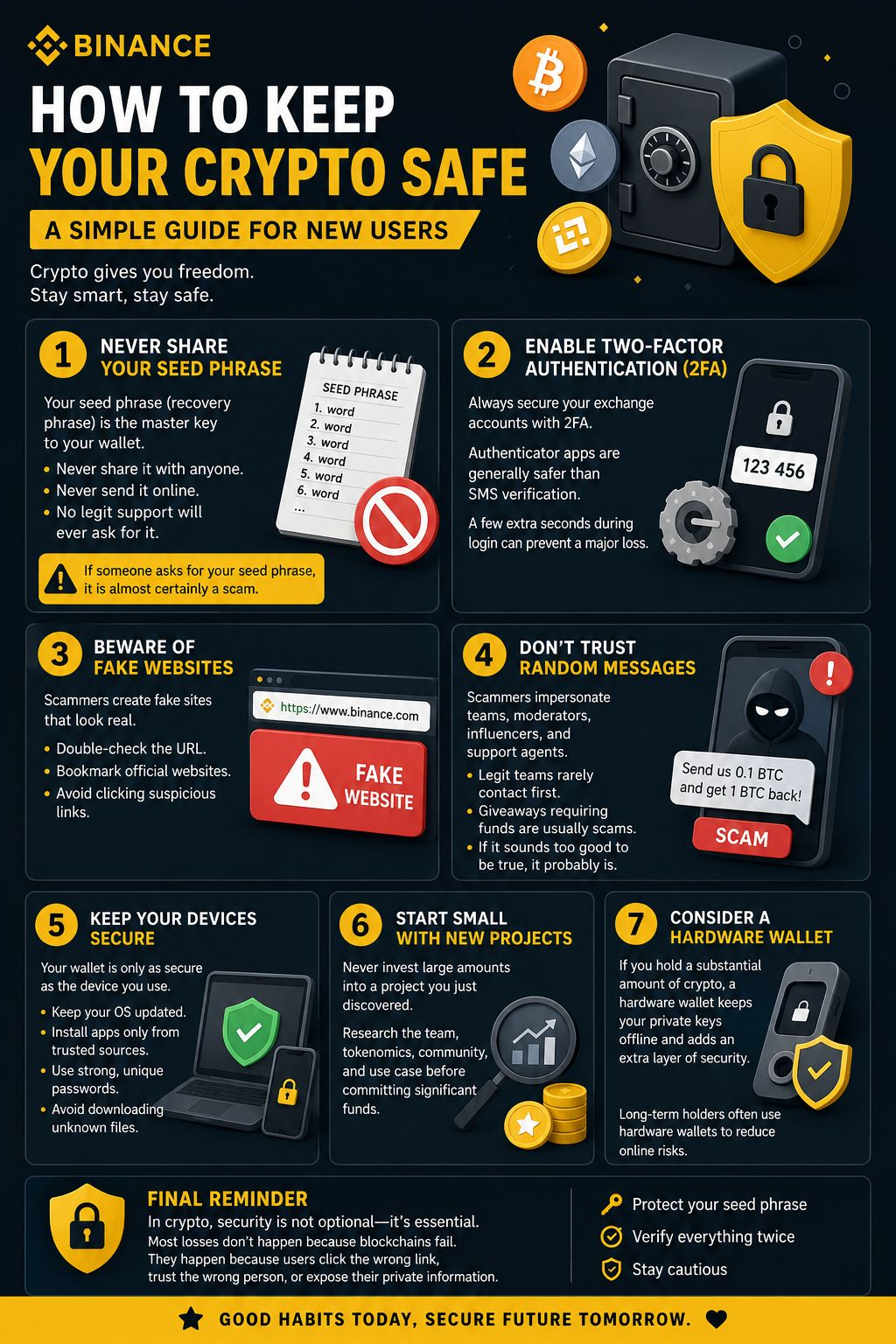
1. Never Share Your Seed Phrase
Your seed phrase (recovery phrase) is the master key to your wallet.
Anyone who has access to it can control your funds.
Never share it with anyone.
Never send it through Telegram, Discord, or email.
No legitimate support team will ever ask for it.
If someone asks for your seed phrase, it is almost certainly a scam.
2. Enable Two-Factor Authentication (2FA)
Always secure your exchange accounts with 2FA.
Authenticator apps are generally safer than SMS verification because SIM-swap attacks can compromise phone numbers.
A few extra seconds during login can prevent a major loss.
3. Beware of Fake Websites
Scammers often create websites that look identical to legitimate exchanges and wallets.
Before connecting your wallet:
Double-check the URL.
Bookmark official websites.
Avoid clicking suspicious links from social media or direct messages.
4. Don't Trust Random Messages
Scammers frequently impersonate project teams, moderators, influencers, and support agents.
Remember:
Legitimate teams rarely contact users first.
Giveaways that require sending funds first are usually scams.
If an offer sounds too good to be true, it probably is.
5. Keep Your Devices Secure
Your wallet is only as secure as the device you use.
Keep your operating system updated.
Install apps only from trusted sources.
Use strong, unique passwords.
Avoid downloading unknown files.
6. Start Small With New Projects
Never invest large amounts into a project you just discovered.
Research the team, tokenomics, community, and use case before committing significant funds.
A little patience can save a lot of money.
7. Consider a Hardware Wallet
If you hold a substantial amount of crypto, a hardware wallet can provide an additional layer of security by keeping private keys offline.
Long-term holders often use hardware wallets to reduce online risks.
Final Thoughts
In crypto, security is not optional—it's essential.
Most losses don't happen because blockchains fail. They happen because users click the wrong link, trust the wrong person, or expose their private information.
Protect your seed phrase, verify everything twice, and stay cautious.
The best investment you can make in crypto isn't a token—it's good security habits.
India Exclusive: Turn Your Network Into Creators to Share $20,000 in USDT FOR INDIAN CREATORS ONLY