
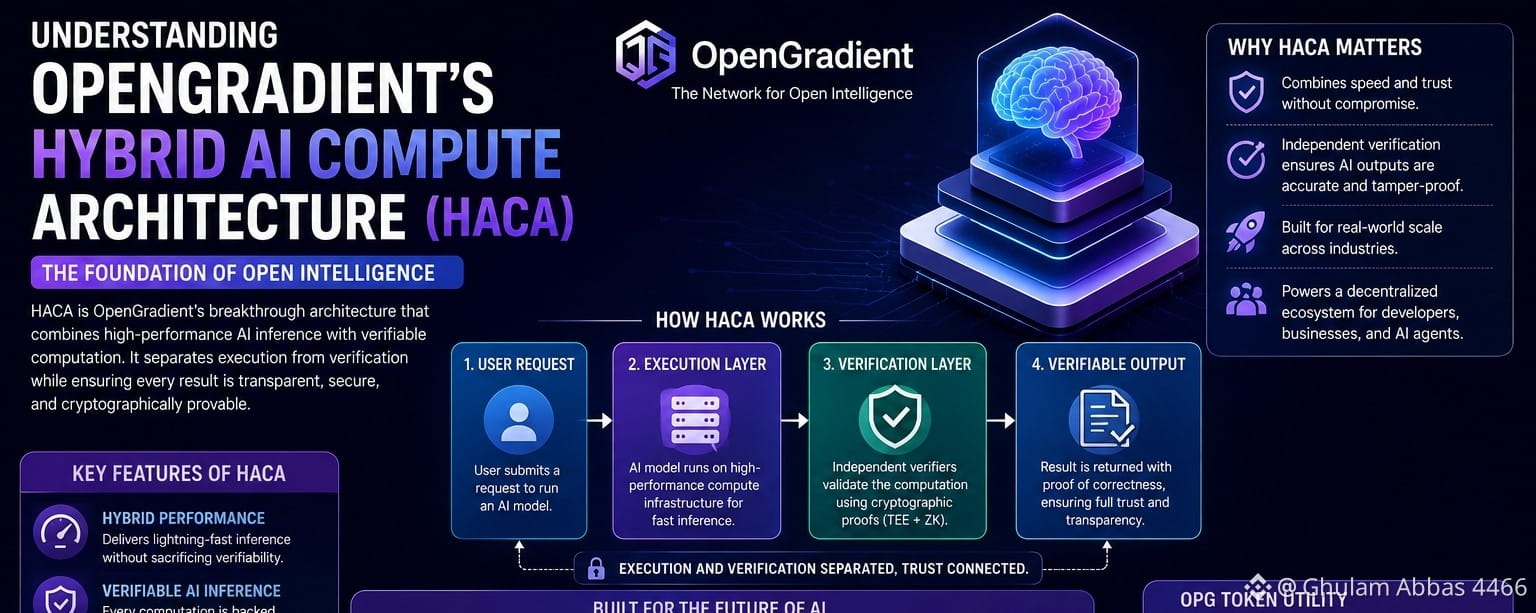
#opg $OPG HACA: The Trust Layer of Open Intelligence
Artificial Intelligence is growing at an extraordinary pace. Every day, millions of people rely on AI to answer questions, create content, analyze data, automate workflows, and support critical business decisions. Yet one major challenge continues to stand in the way of mass adoption: trust. Most AI systems operate as black boxes. Users receive results, but they rarely know how those results were generated, whether the model was changed, or if the computation was executed correctly. As AI becomes more powerful and influential, this lack of transparency creates a serious problem.
OpenGradient is working to solve this challenge through its vision of Open Intelligence. At the center of this vision is the Hybrid AI Compute Architecture, commonly known as HACA. This innovative framework is designed to combine the speed of modern AI infrastructure with the transparency and verification needed for trustworthy artificial intelligence. Rather than forcing developers and users to choose between performance and trust, HACA aims to deliver both.
The importance of HACA becomes clear when we look at how most AI systems work today. Traditional AI platforms prioritize speed and efficiency. Models run on powerful centralized servers and return results in seconds. While this approach delivers excellent performance, it provides very little transparency. Users must trust that the service provider executed the model honestly and accurately. There is usually no independent way to verify the process.
On the other hand, systems designed entirely around verification often face performance limitations. Verification can be computationally expensive, making it difficult to support large-scale AI applications. This creates a difficult trade-off between speed and trust.
OpenGradient's Hybrid AI Compute Architecture was designed specifically to solve this problem. HACA separates execution from verification while ensuring both remain connected through cryptographic proof. AI models can run on optimized infrastructure for maximum efficiency, while independent verification mechanisms confirm that computations occurred correctly. This approach allows the network to maintain high performance without sacrificing transparency.
One of the most powerful aspects of HACA is its ability to support verifiable AI inference. Inference is the process through which an AI model generates an output from a given input. Every chatbot response, recommendation, prediction, or generated image relies on inference. In traditional systems, users simply accept the output. With HACA, inference can be verified, providing greater confidence that results are authentic and trustworthy.
This capability is particularly important for industries where trust is essential. In healthcare, AI may assist with diagnostics and patient care. In finance, AI can influence investment decisions and risk analysis. In legal services, AI may help process sensitive documents and information. In each of these cases, organizations require confidence that AI systems are operating correctly. HACA provides a framework for delivering that confidence.
Another key component of OpenGradient's architecture is the use of Trusted Execution Environments, often referred to as TEEs. A Trusted Execution Environment creates a secure area within hardware where sensitive computations can take place. These environments help protect both the AI model and user data during execution. By combining TEEs with decentralized verification mechanisms, OpenGradient creates a stronger foundation for secure and transparent AI applications.
Security is only one part of the equation. Scalability is equally important. AI demand is growing rapidly, and future AI systems will need to process enormous numbers of requests. HACA was designed with scalability in mind. By separating execution and verification, OpenGradient allows AI workloads to run efficiently while maintaining verifiability. This architecture supports the development of applications that require both large-scale performance and strong trust guarantees.
The benefits of HACA extend beyond individual applications. The architecture supports OpenGradient's broader mission of building the Network for Open Intelligence. This vision is based on the belief that AI should not be controlled exclusively by a small number of centralized organizations. Instead, intelligence should be accessible through open, decentralized infrastructure that promotes transparency, collaboration, and innovation.
Developers play a critical role in this ecosystem. OpenGradient provides tools that make it easier to build and deploy AI applications. Through its developer SDK, creators can interact with the network, integrate AI functionality, and launch innovative products without relying entirely on traditional cloud providers. This reduces barriers to entry and encourages broader participation in the AI economy.
The OpenGradient Model Hub is another important component of the ecosystem. The hub provides access to a growing collection of AI models that developers can use for various applications. By supporting model accessibility and deployment, OpenGradient helps accelerate innovation while maintaining its commitment to openness and transparency.
Memory is becoming increasingly important as AI evolves. Future intelligent systems will need to remember previous interactions, maintain context, and provide more personalized experiences. OpenGradient addresses this challenge through MemSync, a memory layer designed to support persistent AI experiences. MemSync helps create AI systems that are more useful, more adaptive, and more capable of maintaining continuity over time.
HACA also provides a foundation for AI agents. Autonomous AI agents are expected to become one of the most significant developments in the next generation of artificial intelligence. These systems can perform tasks, make decisions, and interact with digital environments with minimal human involvement. For AI agents to operate effectively, they require infrastructure that is secure, scalable, and verifiable. OpenGradient's architecture is specifically designed to support these requirements.
Recent developments demonstrate growing momentum behind the project. OpenGradient has successfully attracted significant investor support, including approximately $9.5 million in funding. This funding reflects confidence in the project's vision and its potential role in the future of AI infrastructure.
Network growth statistics further highlight this progress. The ecosystem has expanded to include more than 2,000 available AI models, over 100 developers building within the network, and more than one million processed inferences. These figures indicate that OpenGradient is not simply presenting a theoretical concept. It is actively building and growing a functional ecosystem.
Another important element of OpenGradient is the utility of the OPG token. In decentralized networks, utility tokens often play a critical role in coordinating participation and supporting ecosystem growth. The OPG token helps facilitate network operations, supports infrastructure activity, and contributes to the overall functionality of the platform. As adoption increases, token utility becomes increasingly important for aligning incentives across developers, operators, and users.
The economic structure created through OPG utility supports long-term sustainability. Participants can contribute resources, engage with network services, and help strengthen the ecosystem while benefiting from network growth. This creates a more collaborative model compared to traditional centralized AI platforms.
The significance of HACA becomes even more apparent when considering the future direction of artificial intelligence. As AI systems become integrated into critical areas of society, expectations around transparency and accountability will continue to increase. Businesses, governments, and consumers will demand greater visibility into how AI systems operate. They will seek proof that outputs are accurate and that processes can be independently verified.
HACA directly addresses these emerging requirements. Rather than treating trust as an optional feature, OpenGradient places verification at the center of its architecture. This proactive approach positions the project to support future applications that require both intelligence and accountability.
The rise of Open Intelligence represents more than a technological trend. It represents a shift in how society thinks about artificial intelligence. The next generation of AI will not be defined solely by model size or computational power. It will be defined by trust, transparency, and accessibility. OpenGradient's Hybrid AI Compute Architecture helps provide the infrastructure needed to support this transformation.
As AI adoption accelerates across industries, architectures like HACA may become essential rather than optional. Organizations will increasingly seek systems that can deliver powerful AI capabilities while maintaining transparency and security. OpenGradient's combination of decentralized infrastructure, verifiable computation, secure execution environments, developer tools, and AI-focused innovation positions it as a significant contributor to this future.
The future of artificial intelligence is not only about creating smarter machines. It is about creating systems that people can trust. Through HACA, OpenGradient is building the foundation for a future where intelligence remains open, transparent, and verifiable. In a world increasingly shaped by AI, that may become one of the most valuable innovations of all.