
Meta Description:
Discover why DeFi failures begin in communities, not code. Explore cognitive drift, the fragile reality layer, and how APRO strengthens resilience through interpretability and shared understanding.
Introduction: Where Real DeFi Risk Begins
Most DeFi risk models start with code.
Audits. Exploits. Oracle failures. Liquidity math.
That is already too late.
The most dangerous phase in decentralized systems begins before any technical failure — when humans stop reacting, questioning, and understanding.
Long before dashboards flash red, communities reveal what is about to happen.
The Phase Analytics Cannot Detect
Dashboards measure what has already occurred.
They do not measure attention.
Before every major failure, participation subtly changes:
Questions become repetitive instead of investigative
Governance turns procedural instead of thoughtful
Data is consumed instead of challenged
Nothing appears “broken,” yet nothing is protected.
This is the pre-risk layer — the silent stage where real danger accumulates unnoticed.
Community Is Infrastructure, Not Noise
A healthy DeFi community is not marketing.
It is a security layer.
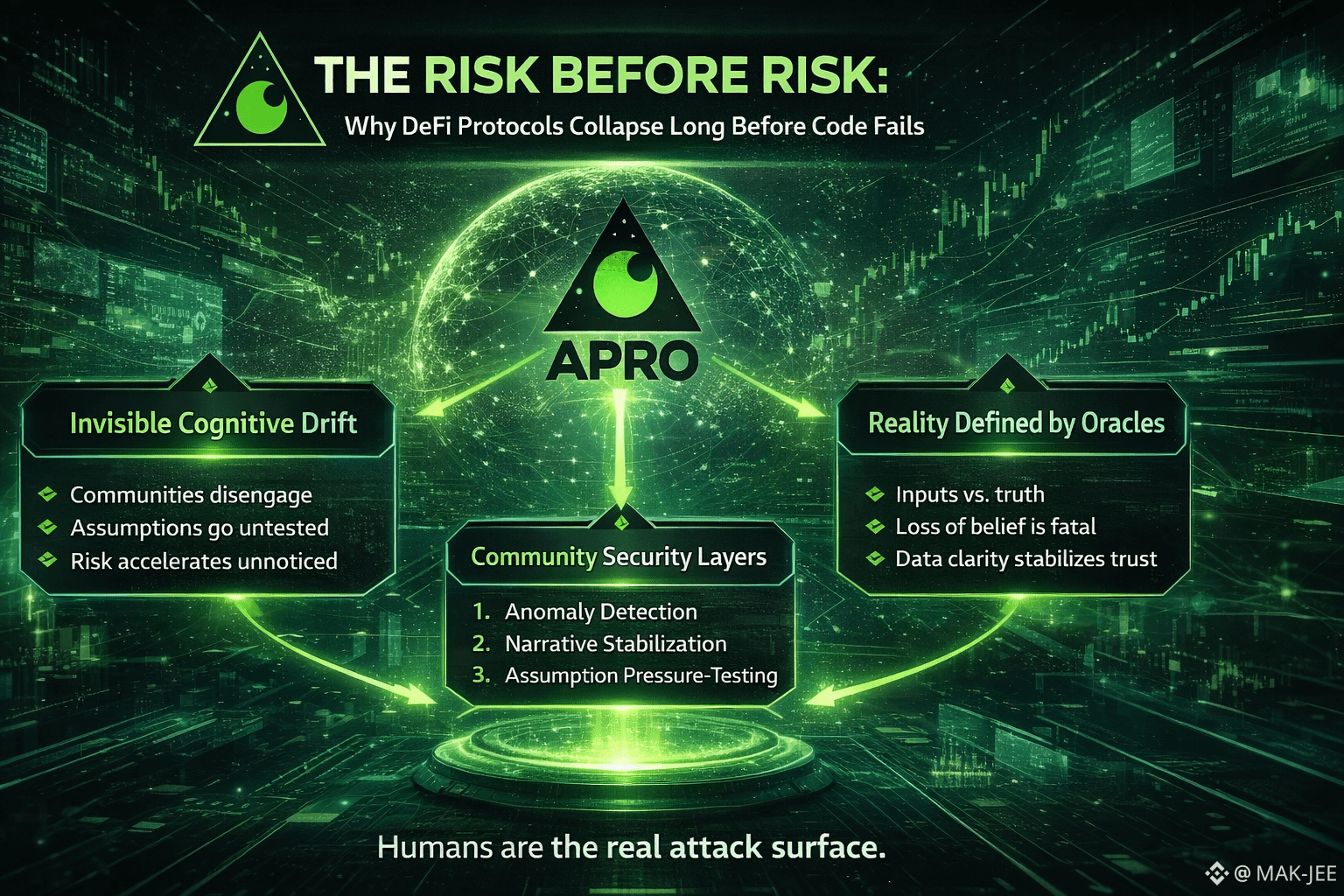
Strong communities perform three critical functions:
Anomaly Detection – spotting inconsistencies before metrics do
Narrative Stabilization – preventing panic during uncertainty
Assumption Pressure-Testing – questioning what models silently accept
When this layer weakens, technical defenses lose effectiveness — no matter how robust the code.
Silence Is the Most Dangerous Signal
Anger, criticism, and debate are manageable.
Silence is not.
A quiet community does not reduce risk — it compresses it.
By the time technical symptoms appear, social resilience has already vanished.
At that point, even correct data can trigger collapse.
Cognitive Drift: The Invisible Failure Phase
Most DeFi collapses appear sudden.
In reality, they are slow.
They pass through Cognitive Drift — a gradual loss of collective attention that analytics cannot measure.
Signs of Cognitive Drift
Governance participation drops, but votes still pass
Discussions continue, but lose depth
Assumptions stop being questioned
The system functions — yet failure becomes inevitable.
Why Cognitive Drift Is So Dangerous
Smart contracts execute perfectly.
But the assumptions behind them go untested.
Risk accelerates silently.
Social resilience erodes before technical indicators appear.
When failure finally surfaces, recovery is no longer possible.
Preventing Cognitive Drift
Healthy friction is protection.
Resilient systems actively:
Reward curiosity over passive participation
Explain decisions, even when answers are incomplete
Encourage disagreement instead of suppressing it
Comfort is fragile.
Engagement is defense.
When Oracles Define Reality
Smart contracts understand inputs — not truth.
Oracles decide which version of reality the system accepts.
And belief in that reality is fragile.
A protocol can survive downtime.
It can survive volatility.
It cannot survive a collapse of belief in its reality layer.
Accuracy Alone Is Not Enough
Data accuracy does not prevent panic.
Users need clarity around:
Where data comes from
How it is validated
How corrections propagate
Without interpretability, even correct data destabilizes systems under stress.
APRO and the Reality Definition Problem
This is where APRO’s role becomes structural, not promotional.
APRO doesn’t just deliver data — it distributes understanding.
By making validation processes interpretable, APRO turns community members into stabilizers rather than spectators.
Anomalies are contextualized instead of triggering panic.
Cognition is shared alongside data — slowing drift and increasing survivability.
Decentralization Requires Awareness
Decentralization without understanding is fragile.
Systems fail not when contracts break, but when understanding disappears.
Risk leaks first through people, not code.
Conclusion: The Real Defense Layer
In DeFi, collapse is rarely a technical surprise.
It is a human one.
Protocols fail when communities disengage, assumptions go unchallenged, and reality becomes opaque.
Belief is not secured by code alone.
It is earned through clarity, participation, and shared awareness.
That is the risk before risk — and the layer that matters most.