Every financial system eventually reveals what it truly values. Traditional markets value certainty over flexibility. Crypto, for a long time, valued speed over stability. Both inherited the same flaw. Liquidity has almost always demanded a sacrifice. If you want access, you sell. If you want flexibility, you exit. Ownership becomes optional the moment liquidity becomes necessary. Walrus begins with a quiet rejection of that logic and builds something far more patient in its place.
Rather than treating liquidity as an emergency tool, Walrus treats it as an ongoing condition of capital. The protocol is built around a simple but powerful observation. Most holders do not want to abandon their assets. They believe in them. They want exposure, not liquidation. Yet markets move, opportunities arise, and capital must remain usable. Walrus steps into this tension and resolves it not with leverage or complexity, but with structure.
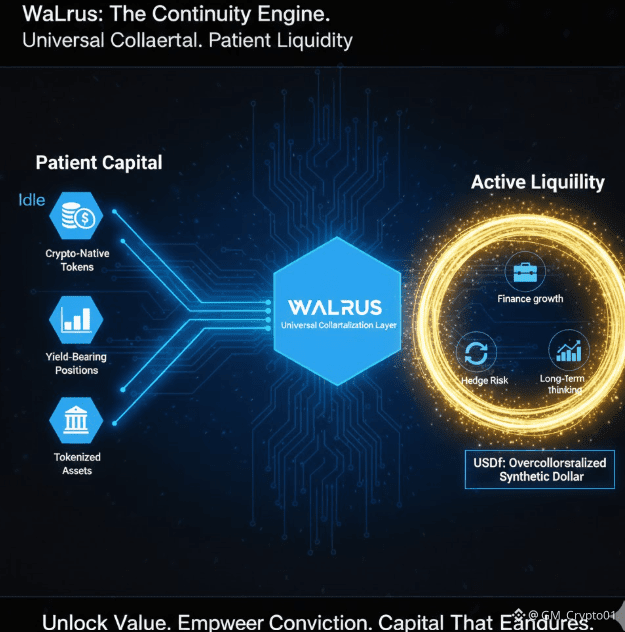
At the heart of Walrus is the idea that collateral should not be frozen value waiting for permission to move. By accepting liquid digital assets and tokenized real world assets as onchain collateral, Walrus allows capital to remain intact while still unlocking utility. From this foundation, USDf is issued as an overcollateralized synthetic dollar. It is not designed to replace belief with safety, but to allow both to exist at the same time. Hold what you trust. Access what you need.
What makes this approach especially relevant today is the maturity of the market itself. The era of aggressive narratives and fragile yield is fading. Users have lived through enough cycles to understand that complexity often hides risk rather than managing it. Institutions exploring tokenized real world assets are not looking for short lived opportunities. They are looking for infrastructure that behaves predictably under pressure. Walrus is clearly built with this environment in mind.
USDf reflects this mindset. It is not positioned as a speculative instrument or a growth hack. Its role is quieter and more important. It functions as a stable layer of liquidity that remains fully onchain and visibly collateralized. Risk is not outsourced or obscured. It is structured, measured, and transparent. This design choice signals a shift away from trust based systems toward verification based ones, a lesson the market has learned the hard way.
From a human perspective, Walrus aligns closely with how people actually want to manage value. Long term holders want to stay invested without being locked in. Builders want predictable liquidity without introducing instability into their systems. Participants bridging crypto and real world assets want models that do not force artificial exits. By standardizing diverse forms of collateral into a single liquidity framework, Walrus creates a shared financial space where different types of capital can coexist without friction.
This is not a story of disruption through noise. It is a story of refinement. Crypto is gradually moving from experimentation toward reliability. The protocols that matter now are not the loudest ones, but the ones that hold up when conditions change. Walrus feels like part of this quieter evolution. It does not promise to eliminate volatility or guarantee outcomes. It accepts uncertainty as a permanent feature and builds around it rather than against it.
There is also a deeper narrative at play. Walrus reframes the relationship between liquidity and ownership. Instead of forcing a choice between the two, it allows them to reinforce each other. Capital remains expressive while becoming more usable. Yield is no longer extracted through constant movement, but through intelligent structure. Liquidity stops being reactive and becomes ambient, always present without demanding attention.
In many ways, Walrus feels less like a product and more like an operating principle. It suggests a future where onchain finance is not defined by urgency, but by composability and calm efficiency. Where stable synthetic dollars like USDf are not endpoints, but connective layers linking belief, utility, and time.
As the onchain economy continues to mature, the systems that endure will be the ones that respect both capital and conviction. Walrus does exactly that. It allows value to move without being broken apart, offering a model of liquidity that no longer asks users to give something up in order to move forward.