
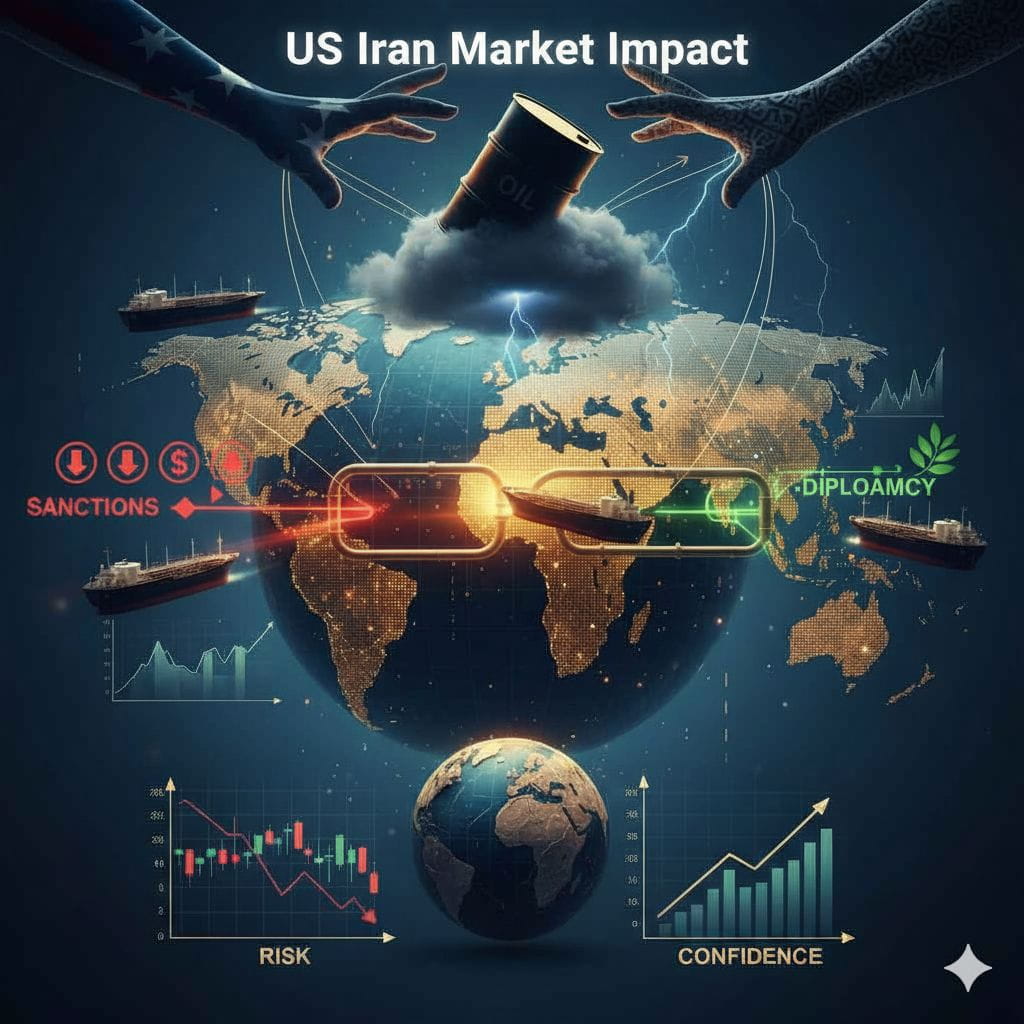
As of January 24, 2026, President Trump’s escalating threats of military action and broad secondary tariffs against Iran’s trade partners have triggered significant volatility across global financial and cryptocurrency markets.
Financial Market Impact
Energy Sector Volatility: Crude oil prices have spiked due to fears of disruption in the Strait of Hormuz, a critical chokepoint for 20% of global oil. Brent crude rose to approximately $65.88 per barrel as investors priced in a "geopolitical risk premium," though some analysts believe global oversupply may cap long-term gains.
Safe-Haven Inflows: Investors have rotated heavily into traditional safety assets. Spot gold reached a record high of $4,981.43 per ounce, and silver surpassed $100 per ounce for the first time in January 2026.
Equity Market Pressure: Major indices have faced sell-offs, with emerging markets like India being particularly vulnerable. The threat of 25% (and potentially up to 45%) tariffs on countries doing business with Iran has added a "macro overhang" for trade-dependent nations.
Currency Weakness: The Iranian rial has collapsed to approximately 1.42–1.47 million per USD on parallel markets. Emerging market currencies, such as the Indian rupee, are also under pressure, with analysts projecting a potential fall to 93–95 per USD.
Cryptocurrency Market Impact
"Digital Gold" Narrative: Bitcoin (BTC) has increasingly acted as a macro-hedging asset. On January 14, 2026, BTC surged to $97,694 as geopolitical tensions peaked, leading to over $500 million in short-position liquidations.
Capital Flight & Domestic Usage: Within Iran, crypto activity has surged to an estimated $7.8 billion ecosystem. High-level Iranian officials are reportedly using cryptocurrency to wire large sums—estimated at $1.5 billion—to offshore accounts in Dubai to evade potential asset freezes.
Parallel Financial Rails: Market participants are viewing crypto as a parallel settlement system to bypass US-led sanctions. However, this has also led to increased regulatory scrutiny and cyberattacks on major Iranian exchanges like Nobitex.
Economic Risks of Tariffs
Trade Disruptions: The 25% tariff on Iran's trade partners (including China, India, and the EU) risks a "meaningful shock" to the U.S. economy by raising costs for American importers.
Supply Chain Impacts: Sectors reliant on petroleum-based inputs—such as aviation, chemicals, and paints—are facing immediate margin pressure from the combined threat of higher energy costs and new trade barriers.
"Place a trade with us via this post mentioned coin's & do support to reach maximum audience by follow, like, comment, share, repost, more such informative content ahead"
#USIranMarketImpact #US #iran #market #oil $PAXG $XAU $XAG
