
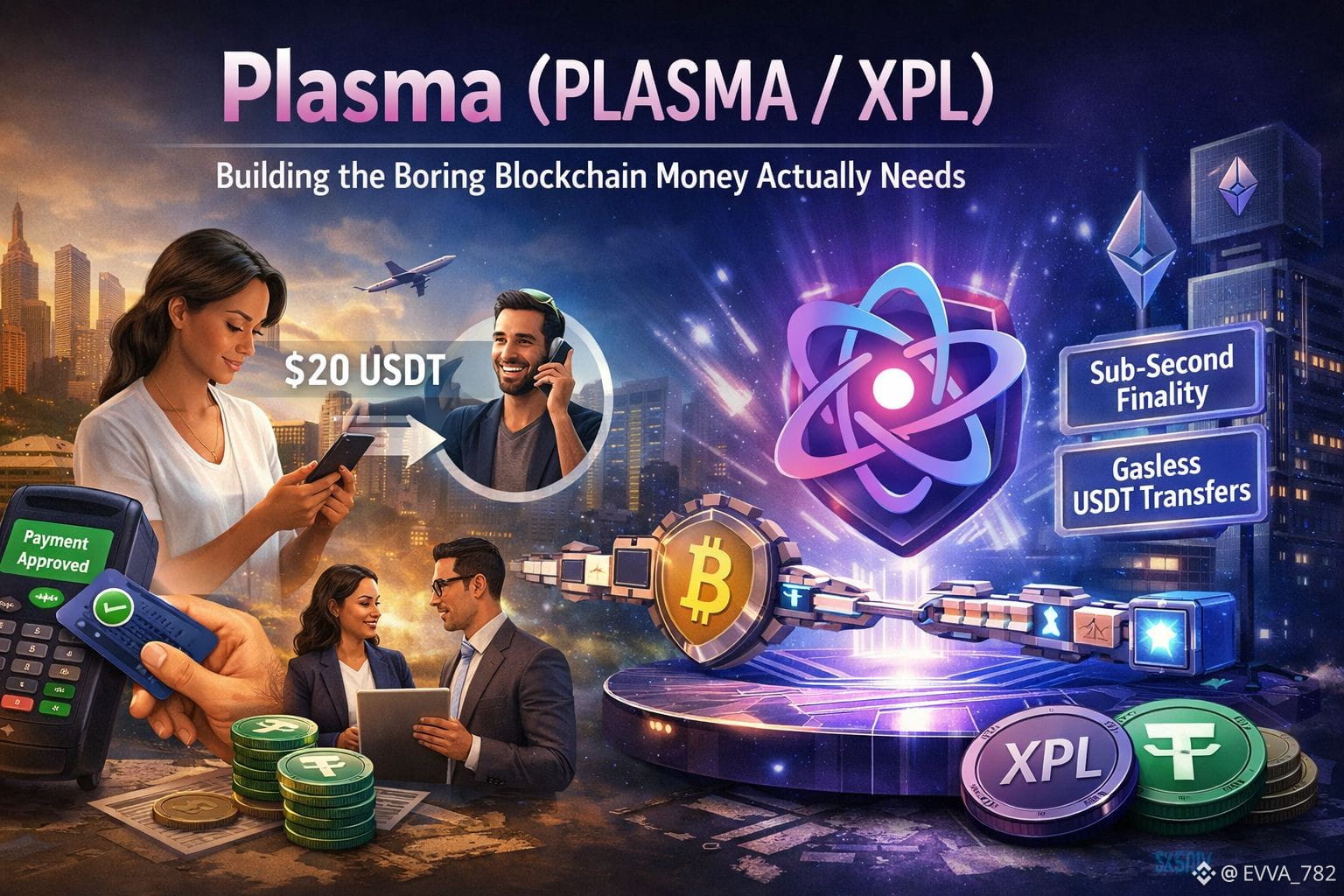
I remember the first time I tried to send a small amount of USDT to someone overseas. It wasn’t a big transfer. Just enough to help with a bill. I opened my wallet, copied the address, hit send… and then froze. The gas fee was almost as much as the amount I wanted to send. I waited, refreshed, worried I’d mess something up, worried the transaction would get stuck, worried I’d need more ETH just to move dollars.
That moment captures something a lot of crypto people don’t like to admit: using crypto for real money movement still feels stressful.
And it’s strange, because stablecoins are everywhere now. In many parts of the world, USDT is already money. People save in it, pay with it, move it across borders daily. But the blockchains underneath still feel like they were built for something else first, and money second.
That’s the gap Plasma is trying to live in.
Not by promising a new financial system. Not by talking about revolution. But by quietly asking: what if a blockchain was designed from day one around the boring, practical reality that most people just want to move stablecoins cheaply, quickly, and without friction?
Plasma is a Layer 1 blockchain, but it doesn’t behave like most Layer 1s. Instead of putting a native token at the center and making everything else revolve around it, Plasma puts stablecoins first. Everything else is built around that decision.
The idea is simple to explain if you imagine how payments work in everyday life. When you tap your card or send money through a banking app, you don’t think about the infrastructure underneath. You don’t need to hold a special asset just to pay a fee. You don’t wait minutes wondering if your payment might fail. It just goes through.
Crypto never quite got that part right. Plasma is trying to.
At a technical level, Plasma is fully compatible with Ethereum. That matters more than it sounds. Ethereum is where developers already are, where wallets already exist, where tools are battle-tested. Plasma doesn’t ask the ecosystem to start from zero. It speaks the same language, using a modern Ethereum client called Reth, but tunes the system for speed and payments.
One of the most noticeable differences is finality. On many chains, a transaction is “probably final” after some time. On Plasma, the goal is sub-second finality. You send a transaction, and it’s done fast enough that you don’t second-guess it. For payments, that psychological difference matters. Merchants don’t want “probably final.” They want “done.”
Then there’s the part that really changes the user experience: gasless USDT transfers and stablecoin-first gas. This is where Plasma starts to feel less like crypto and more like infrastructure.
If you’re just sending USDT, you shouldn’t need to own another volatile token just to make that happen. Plasma removes that requirement. Fees can be abstracted away or paid directly in the stablecoin. From the user’s point of view, you send dollars, and dollars move. No extra mental steps.
That design choice sounds small, but it removes a surprising amount of friction. It’s fewer failed transactions, fewer confused users, fewer “why do I need this token?” moments. For institutions and fintechs, it also means cleaner accounting and predictable costs.
Security-wise, Plasma makes an interesting philosophical choice by anchoring itself to Bitcoin. Bitcoin is slow, conservative, and stubborn. It doesn’t change easily. But that’s exactly why it has credibility as neutral infrastructure. By tying parts of its security assumptions to Bitcoin, Plasma is signaling that it cares about censorship resistance and long-term trust more than flashy experimentation.
This matters if you’re building a payments network meant to be used across borders, jurisdictions, and political systems. Money infrastructure needs to be boring and neutral to survive.
The people Plasma seems to be built for are not the loudest voices on crypto Twitter. They’re retail users in places where stablecoins are already everyday tools. They’re payment companies that care more about reliability than narratives. They’re institutions that want speed and compliance without surprises.
That focus shows up in the role of the XPL token as well. XPL exists to secure the network, align validators, and participate in governance. But it’s not forced into every user interaction. You don’t need it just to send USDT. It’s not pretending to be digital gold or a meme asset. It’s infrastructure glue, not the product itself.
The ecosystem around Plasma is likely to grow slowly and deliberately. Wallets, payment apps, on-ramps, settlement tools. Less emphasis on speculative DeFi, more emphasis on things that quietly work in the background. This kind of growth isn’t exciting to watch in real time, but it’s often how durable systems are built.
Of course, there are real risks. Plasma is deeply tied to stablecoins, and stablecoins live in a complex regulatory world. If issuers change rules or governments apply pressure, Plasma has to navigate that reality carefully. There’s also the simple challenge of adoption. Payments networks only matter if people actually use them. Technical elegance alone isn’t enough.
Gasless systems are also tricky. Someone always pays in the end, and designing that sustainably without opening abuse vectors is hard. Plasma will need to prove that these abstractions hold up at scale.
And then there’s the cultural risk. Plasma is intentionally boring. In crypto, boring often loses attention to louder, shinier ideas. That can slow momentum, even if the fundamentals are strong.
When I think about Plasma, I’m not watching charts or hype cycles. I’m watching whether real payments start flowing through it. Whether wallets feel simpler. Whether businesses trust it enough to build on it. Whether finality stays fast when usage grows. Whether the Bitcoin anchoring remains meaningful over time.
If Plasma succeeds, most people won’t talk about it much. They’ll just use it, without thinking too hard about what’s underneath.
And honestly, that’s probably the point.