
Most blockchain conversations obsess over movement. Faster blocks. Higher throughput. More activity per second. Everything is framed around speed and motion. But when I step back and think about how money actually behaves in the real world, the opposite becomes obvious. Most money doesn’t move at all. It sits.
It sits in corporate treasuries, payroll accounts, settlement buffers, merchant balances, and savings pools. Traditional finance is built around this stillness. Accounting systems assume it. Auditors depend on it. Banks design around it. Crypto, for the most part, ignores it. Plasma feels like one of the few networks that starts from that reality instead of fighting it.
What caught my attention is how Plasma flips the mental model. Most blockchains treat every user like a trader. Fees fluctuate. Congestion rises unexpectedly. Finality comes with probabilities and waiting periods. That makes sense in speculative markets. It makes no sense for finance teams who manage balance sheets, not price charts. Plasma seems to assume users are operators, not gamblers. The goal is not excitement. It’s predictability. Money should behave in a way that can be explained to an auditor without footnotes.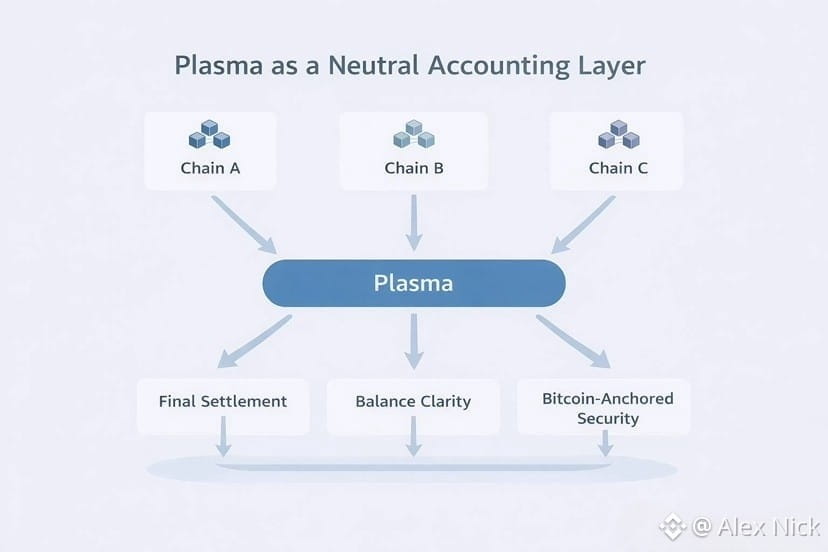
One design choice changes everything. Plasma removes the link between activity and instability. On most chains, more usage creates more congestion, which leads to higher fees and uncertainty. The system becomes more fragile the more it’s used. Plasma breaks that loop. Zero fee stablecoin transfers mean activity does not distort cost. PlasmaBFT finality means once a transaction settles, it’s done. No reorg anxiety. No probability math. No waiting for comfort confirmations.
That difference sounds technical, but it’s emotional too. A business cannot tell employees that payroll costs more this week because the network was busy. A finance team cannot justify variable settlement expenses to regulators. Plasma doesn’t copy traditional finance’s centralization, but it does copy its reliability. And that matters more than ideology when money is involved.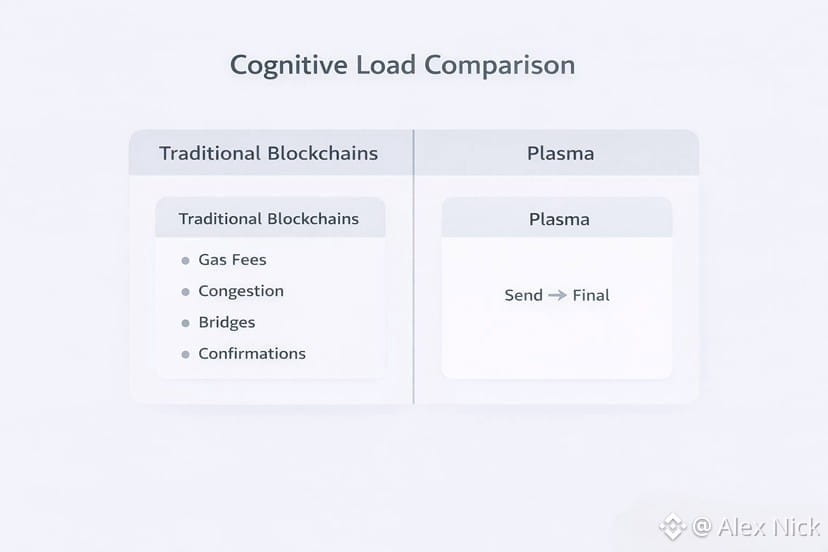
Another thing I don’t see discussed enough is Plasma’s role as a neutral accounting layer. Instead of competing with every chain to host all applications, Plasma behaves more like a financial spine. Assets may live elsewhere, but balances can settle cleanly on Plasma. That starts to resemble clearinghouses more than smart contract playgrounds. I find that framing important because real finance has always separated execution from settlement.
Security follows the same logic. Plasma doesn’t try to invent trust from scratch. It borrows it. By anchoring its security assumptions to Bitcoin, Plasma separates belief from activity. Bitcoin provides credibility. Plasma provides usability. That split is rare in crypto, but it feels mature. Trust does not need to be fast. Payments do.
Privacy also looks different through this lens. It’s not about hiding wrongdoing. It’s about reducing noise. Internal transfers, salaries, and vendor payments were never meant to be public entertainment. Plasma allows confidentiality by default, with verification when required. That matches how real compliance works instead of pretending it doesn’t exist.
What I personally notice most is how Plasma reduces cognitive load. Most chains constantly demand attention. Gas prices. Network choices. Bridges. Liquidity paths. Timing. Plasma removes many of those decisions entirely. When systems stop asking for constant thought, people trust them more. Adoption doesn’t feel forced. It happens quietly because nothing feels risky anymore.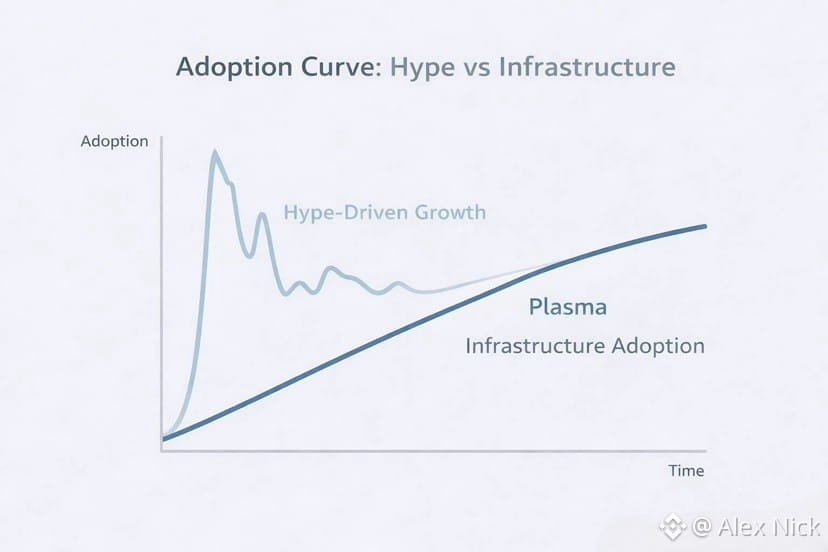
That leads to a very different growth curve. Plasma doesn’t grow virally through hype. It grows through repetition. One payroll integration becomes monthly usage. One treasury account becomes permanent infrastructure. Growth is slower, but it sticks. That kind of adoption rarely trends on social media, but it survives market cycles.
Decentralization in Plasma is reframed too. Instead of decentralizing every application, it decentralizes financial truth. Settlements, balances, and records remain neutral and verifiable. Applications stay flexible. It reminds me of the internet’s structure where protocols stay stable at the bottom while interfaces evolve above.
Resilience might be the most overlooked piece. Plasma is built for long periods of boredom. It does not depend on speculative volume to justify itself. When markets cool, it keeps working. When narratives disappear, the system doesn’t care. That makes it strangely anti fragile in downturns.
To me, Plasma feels like a sign of crypto growing up. It accepts that not all value comes from growth charts and activity metrics. Sometimes value comes from silence. From reliability. From systems that don’t need attention to function.
Plasma isn’t trying to replace banks overnight. It replaces friction quietly. Fees vanish. Finality becomes absolute. Accounting becomes simple. Over time, expectations shift. Once people experience money that just works, everything else starts to feel broken.
That’s why Plasma doesn’t fit neatly next to high performance L1s or DeFi ecosystems. It’s not chasing apps. It’s not chasing scale headlines. It’s aiming to be financial infrastructure that lasts decades, not cycles.

