

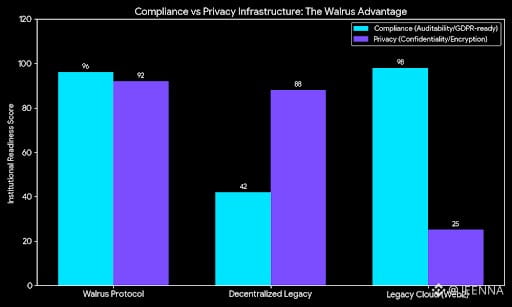
In 2026, Walrus Protocol stands at a rare inflection point for Web3 infrastructure: it has progressed beyond conceptual promise into actual deployment, ecosystem traction, and real usage, positioning itself as a foundational data layer that many decentralized applications and emerging AI systems will depend on. Originally incubated within the architecture of the Sui blockchain, Walrus offers decentralized, programmable storage that addresses a fundamental limitation of blockchains today — the inability to efficiently and trustlessly store large, unstructured data like media, AI models, game assets, and archival information without relying on centralized clouds.
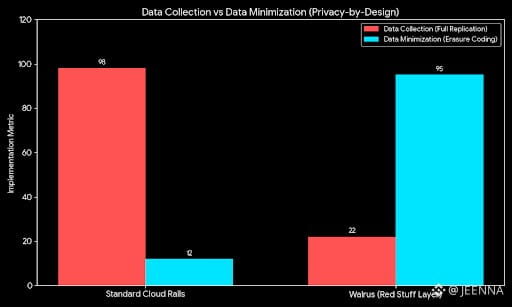
At the core of Walrus’s value proposition is its innovative approach to blob storage. Unlike typical blockchain storage, which struggles with scalability and cost due to full replication requirements, Walrus breaks files into pieces using advanced erasure coding techniques (often referred to as “Red Stuff”) that spread encoded slivers across a network of independent nodes. This design ensures high fault tolerance, resilience, and reliability — data can be fully reconstructed even if many storage nodes go offline — while reducing storage overhead dramatically compared with traditional decentralized storage systems.
The WAL token sits at the economic heart of the network’s incentives, fueling its storage marketplace. Network participants use WAL to pay for storing and retrieving data, while storage providers and node operators earn WAL rewards for contributing capacity and uptime. Additionally, WAL holders can participate in governance and staking, aligning economic and security incentives across the protocol. This multi-role utility helps anchor the token within the protocol’s long-term infrastructure narrative, rather than relegating it to a speculative asset detached from concrete utility.
Walrus’s trajectory from testnet to mainnet adoption has been buttressed by both technical and ecosystem milestones. The protocol’s mainnet launch has seen broad integration announcements across the Sui stack — from media and content platforms storing large data sets to prediction market protocols and decentralized applications embedding programmable storage directly into their smart contract logic. This real usage contrasts with many layer-1 narratives that talk about theoretical capacity; Walrus’s focus is on serving apps that actually write, verify, and access data onchain.
Investment and ecosystem backing have been strong from the outset. In 2025, the Walrus Foundation raised $140 million in a private token sale led by major venture investors like Standard Crypto and a16z Crypto, signaling confidence from institutional backers in decentralized storage as a core infrastructure primitive for Web3’s evolution. These funds are intended to expand node incentives, developer tooling, integration initiatives, and long-term security research, acknowledging that decentralized storage networks require sustained economic support to flourish.
For developers, Walrus’s programmability is a game changer. Storage isn’t simply a passive archive; data becomes a first-class asset that can interact with smart contracts, trigger logic, and be composed into complex applications. This live programmability is particularly relevant for AI agents, gaming ecosystems, media platforms, and cross-chain applications — domains where simple decentralized data storage engines struggle to deliver both performance and cost-effectiveness. By aligning data availability and programmability, Walrus is laying the groundwork for a new breed of decentralized services that traditional cloud storage cannot support without central points of control.
Market narratives around WAL vary: some observers focus on short-term price fluctuations and resistance levels, while others emphasize its role as critical infrastructure that could underpin future decentralized data markets beyond Sui. What unites both perspectives is acknowledgment that despite market cycles, the fundamental utility of decentralized, verifiable data ownership is enduring — a reality only amplified by the rise of data-driven applications in Web3 and AIAl
Looking ahead, Walrus Protocol’s evolution will be measured by how deeply its storage layer embeds into real-world workflows: how many developers leverage its programmable storage primitives, how many datasets — from NFT media to AI training sets — are hosted trustlessly, and how effectively node incentives scale to support global decentralized storage demand. In a landscape where data is increasingly the limiter of growth, not compute or compute speed, Walrus’s architecture and integrations suggest it is not merely an add-on to blockchain infrastructure — but a necessary cornerstone for the next era of decentralized computing and data sovereignty.