
Vanar feels like it was built by people who’ve actually shipped products to normal users, not just to crypto natives. The whole idea is simple: an L1 should be something a game studio, an entertainment platform, or a consumer brand can plug into without forcing their users to learn “gas,” wallets, or weird blockchain rituals. That’s why their messaging keeps coming back to real-world adoption and the “next 3 billion” people—because they’re not trying to win a technical purity contest, they’re trying to win distribution.
Vanar interesting is that it doesn’t present itself as only a base chain. They’re pushing a bigger picture where the chain is the foundation, but the real magic is the layers they want to stack on top of it: memory, context, reasoning, and eventually automation. In their world, apps shouldn’t just store transactions onchain; they should be able to store meaning and context too, so applications can feel more intelligent and personalized without everything living in offchain databases and centralized backends. That’s where their “semantic memory” and “contextual AI reasoning” positioning comes in—whether you love the narrative or you’re skeptical, it’s at least a clear attempt at differentiation.
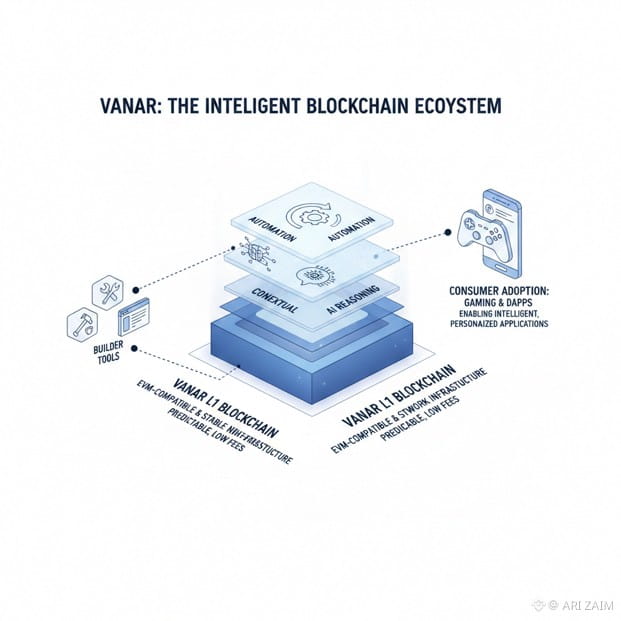
Vanar Behind the scenes, the practical work is exactly what you’d expect from a chain that wants consumer adoption: keep the network stable, keep costs predictable, and make it easy for builders to ship. Vanar leans into an EVM-friendly world so developers can build with familiar tooling, and they’ve put a lot of emphasis on fees that don’t swing wildly. That matters more than people admit. In gaming or mass-market apps, you can’t wake up to “today it costs 10x more to do the same action.” Stable, tiny fees are the difference between a real product and a demo.
Vanar The project’s roots in gaming and entertainment show up in what they spotlight. They talk about mainstream verticals—gaming networks, metaverse experiences, brand solutions, and now a heavier AI direction. This isn’t them trying to be everything to everyone; it’s them trying to build rails where high-volume consumer interactions actually make sense. If you’ve ever tried using a blockchain app and felt like you were doing paperwork just to click a button, you understand the problem they’re aiming at.
Vanar Then there’s the token side, and Vanar’s story here is unusually clean compared to many projects. VANRY is the evolved identity after the TVK → VANRY transition, designed as continuity rather than a messy restart. It exists as an ERC-20 on Ethereum (the contract you linked), and it’s meant to be the fuel and alignment tool for the ecosystem. In plain terms, it’s used to pay for activity, secure the network through staking/validator incentives, and power incentives and participation across what Vanar is building. That’s the “why it exists”: not as a decorative ticker, but as the economic engine that keeps validators, users, and builders aligned—assuming the network grows.
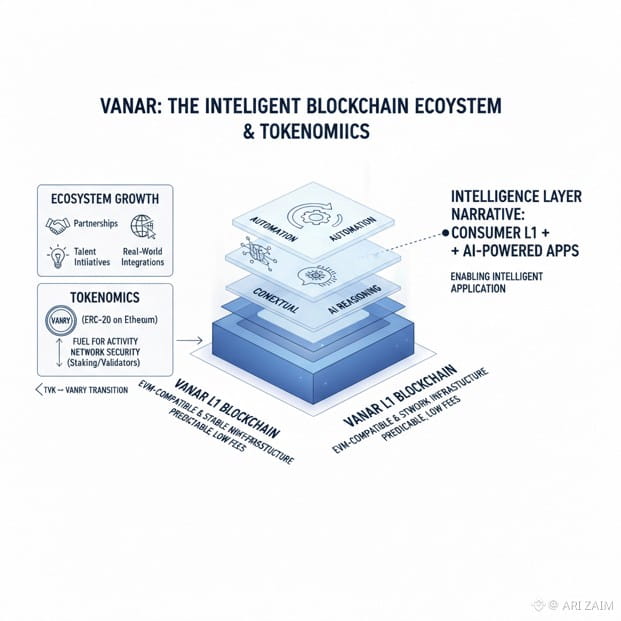
Vanar What’s been happening lately is that Vanar’s public direction has been leaning harder into the “intelligence layer” framing. Earlier, people mostly categorized it as a consumer/gaming-leaning chain. Now the narrative is increasingly: consumer L1 plus onchain memory + reasoning + automation layers that could make apps feel more native to how people actually use technology today. It’s also clear they’re investing in ecosystem growth through partnerships and talent initiatives—basically trying to widen the funnel of builders and real-world integrations, not just social attention.
Vanar The “what’s next” is where you can stay grounded. The strongest future signal for Vanar isn’t another announcement—it’s shipping. If the automation and packaged application layers they tease become real, usable products with documentation, tooling, and actual teams building on them, the project levels up. If the semantic memory and reasoning concepts show up inside real applications in a way that obviously improves user experience, that’s when the story becomes a moat instead of marketing. And if you see consumer-facing apps scaling smoothly on Vanar—apps where users don’t even realize they’re interacting with a blockchain—that’s the endgame they’re aiming for.
