
Most blockchains behave like receipts.
They can prove that something happened, that a file existed, that a transaction was executed, or that a document was uploaded at a specific time. But once that proof exists, the chain’s job is essentially over. If you want to use the data, understand it, or act on it, you have to move everything off-chain and rebuild the meaning somewhere else.
That design made sense when blockchains were created mainly for settlement and verification. But it begins to break down as software itself changes.
We are moving into a world where applications are not driven by humans clicking buttons, but by automated systems. AI agents will verify documents, check rules, trigger payments, and update states continuously. In that environment, data that only proves existence is not enough. Machines do not just need storage. They need context.
This is the gap Vanar Chain is trying to address.
Vanar’s central thesis is simple but radical: a blockchain should be able to understand data, not merely hold it.
The Problem of Dead Files and Lost Meaning
Web3 has become very good at preserving information, but very bad at preserving meaning.
An invoice stored on IPFS can last forever, yet the chain cannot tell whether it has been paid. A compliance document can be immutable, yet no system can confirm if it still meets regulatory requirements. A hash can prove integrity, but it cannot answer basic questions like who is allowed to use this data, what changed since last month, or whether a rule was violated.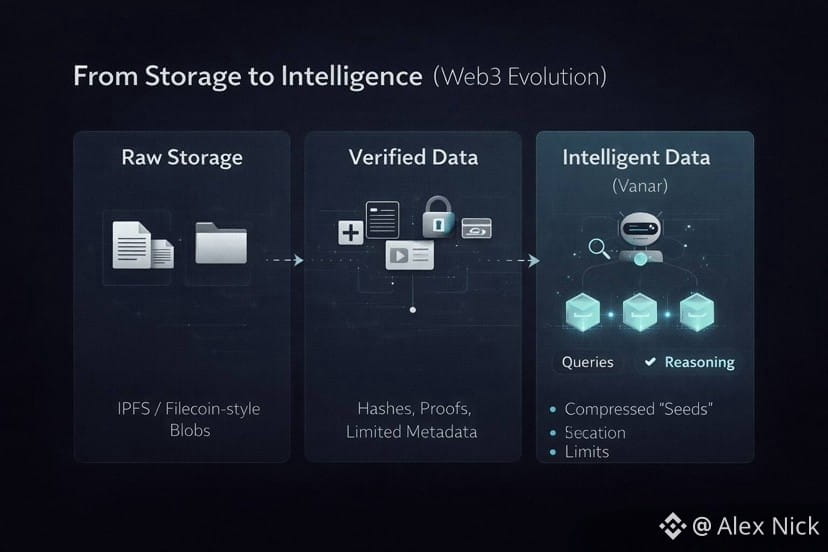
These are not technical edge cases. They are everyday questions in finance, compliance, and enterprise systems.
Today, meaning lives off-chain. Humans interpret PDFs. Backend servers rebuild context. AI systems scrape and reconstruct information that blockchains themselves cannot reason about. The chain becomes a passive archive rather than an active participant.
Vanar’s approach begins from the assumption that this model will not survive an agent-driven future.
If AI systems are expected to operate continuously, verify rules, and trigger payments autonomously, then data must arrive in a form that machines can read, query, and reason over directly.
That is where Vanar’s architecture begins to diverge.
Neutron and the Idea of Semantic Memory
At the core of Vanar’s design is a system called Neutron.
Neutron is not traditional storage and it is not compression in the usual sense. It is a semantic transformation layer. Instead of preserving full raw files on-chain, Neutron converts unstructured data into compact representations called Seeds.
A large document, image, or video does not get stored as a static blob. It is analyzed, summarized, and transformed so that its meaning is preserved rather than its full physical form.
According to Vanar’s documentation, Neutron can reduce files measured in tens of megabytes into Seeds measured in tens of kilobytes while keeping their semantic structure intact. These Seeds live on-chain and can be verified, referenced, and queried directly.
This represents a shift in mindset.
Instead of storing proof and rebuilding context elsewhere, Vanar attempts to store context itself. The chain is no longer just a memory vault. It becomes a memory system.
In practical terms, this means applications do not need to download documents and parse them off-chain just to understand their contents. They can query the Seed directly and receive structured answers.
For automation, this difference is enormous.
From Storage to Actionable Objects
Neutron effectively turns data into objects rather than files.
A Seed is not simply something that exists. It is something that can be inspected. Programs can ask questions of it. Agents can compare it against rules. Systems can detect changes without reprocessing entire documents.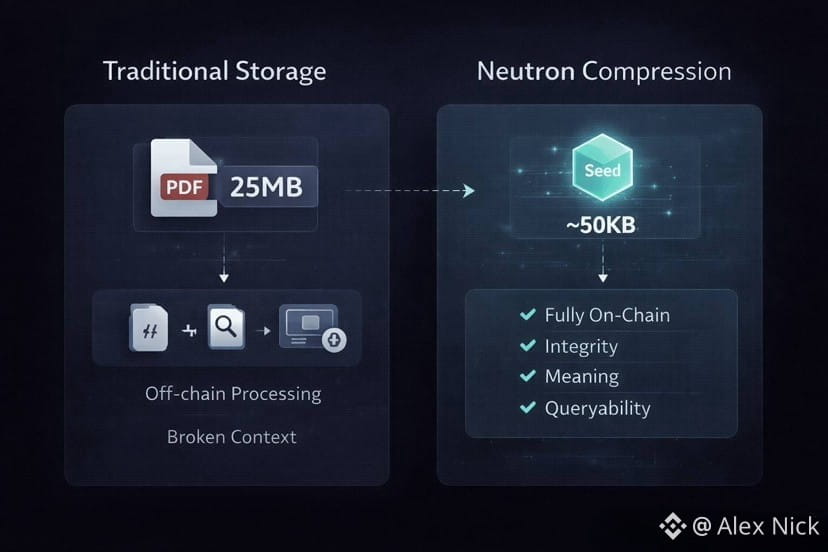
This is why Vanar often describes Neutron as a data-to-object pipeline.
Once information is converted into this form, automation becomes possible at a much deeper level. A compliance engine does not need to reread PDFs. A payment system does not need to infer intent from metadata. The meaning is already structured.
In this model, data behaves less like an archive and more like software.
It can be tested. Queried. Reasoned over.
That is a fundamental departure from how most blockchains treat information.
Kayon and Reasoning as Infrastructure
Shrinking data is not the end goal. Understanding it is.
Above Neutron sits Kayon, Vanar’s reasoning layer. Kayon is designed to allow contextual analysis and decision-making over on-chain information. Instead of relying purely on rigid if-then logic, Kayon introduces contextual evaluation.
This matters because real-world systems rarely operate on binary rules alone.
Compliance depends on interpretation. Payments depend on conditions. Identity depends on history. Context is unavoidable.
Kayon allows applications and agents to ask higher-level questions. Not just “is this valid,” but “does this comply,” “does this meet requirements,” or “should this action be permitted now.”
Vanar describes Kayon as a form of on-chain intelligence that can interpret data rather than simply execute instructions.
The difference between attaching AI to a blockchain and embedding intelligence into the stack is subtle but important. In most systems, AI lives outside the chain and treats blockchain data as input. In Vanar’s model, reasoning becomes a native capability.
That is why Kayon is positioned less like a chatbot and more like a decision engine.
Why This Matters for Compliance and Finance
Finance is not just about transfers. Every transaction carries context.
Invoices, contracts, approvals, identities, thresholds, and reporting requirements all surround payment flows. Traditional blockchains largely ignore this layer and assume it will be handled off-chain.
Vanar takes the opposite position.
If payments are going to be automated by agents, then the surrounding context must be machine-readable. Otherwise automation breaks down or becomes unsafe.
This is why Vanar ties its AI-native architecture directly to PayFi and tokenized real-world assets. Payments are the distribution layer where friction is immediately felt.
If a system can verify documents, reason about rules, and trigger settlement automatically, then blockchain begins to resemble financial infrastructure rather than experimental tooling.
PayFi as the Distribution Path
Many AI and blockchain narratives remain abstract because they lack distribution.
Vanar grounds its strategy in payments.
The collaboration announced between Vanar and Worldpay is significant not because of marketing value, but because payments expose weaknesses instantly. If fees are unpredictable, automation fails. If compliance checks cannot run in real time, integration fails. If systems cannot explain themselves to auditors, adoption fails.
PayFi forces the chain to operate under real constraints.
For automated payment flows, predictability matters more than raw speed. That is why Vanar emphasizes fixed low fees rather than variable auctions. An AI agent cannot operate safely when transaction costs fluctuate unpredictably.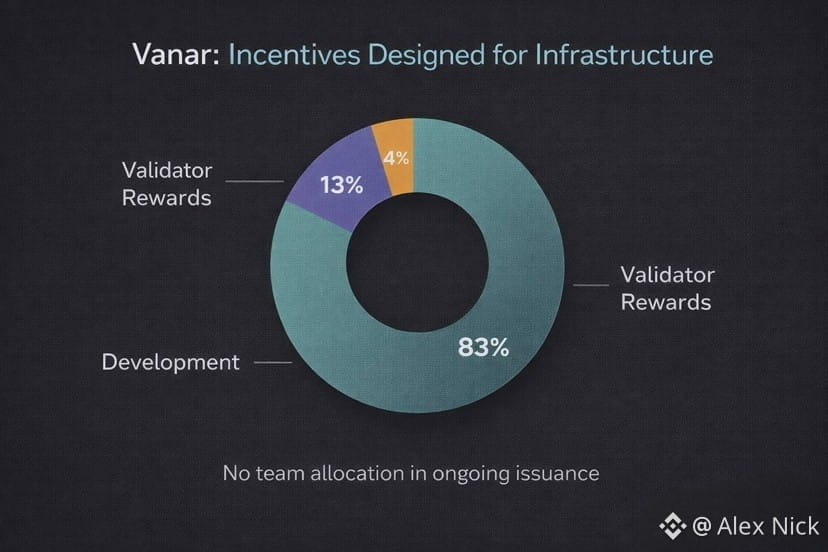
A stable cost model allows systems to plan. It allows automation to scale. It allows enterprises to forecast.
This design may not excite speculative markets, but it aligns closely with how real financial systems behave.
The VANRY Transition and the Strategic Pivot
Vanar did not emerge in isolation.
The project transitioned from its earlier identity through a one-to-one token migration from TVK to VANRY. This was not merely cosmetic. It marked a shift away from platform branding toward chain-first infrastructure.
The rebrand coincided with a broader repositioning around Neutron, Kayon, and PayFi.
Rather than being another application ecosystem, Vanar reframed itself as an intelligent base layer. The focus moved from experiences to systems. From users to agents. From content to meaning.
In that context, the rebrand functions less as marketing and more as a declaration of direction.
Data as Software, Not Archives
One of the most overlooked ideas in Vanar’s design is how it treats information.
Most chains treat data as something that exists.
Vanar treats data as something that functions.
Seeds are not passive records. They are semantic components that can be consumed by applications. They can participate in workflows. They can trigger decisions.
This reframes what on-chain data actually is.
Instead of storing proof and computing elsewhere, Vanar attempts to store meaning and compute decisions directly. That shift changes what becomes automatable.
Legal documents, compliance checks, payment conditions, and operational records stop being external dependencies and become part of the programmable environment itself.
This is why Vanar does not fit neatly into the category of storage networks. It is not trying to compete on availability or redundancy. It is attempting to build an intelligent data layer.
How to Evaluate Vanar Without the Buzzwords
The strongest way to judge Vanar is not by narrative, but by tooling.
Do developers actually use Neutron to transform documents into Seeds.
Can agents reliably query those Seeds and act on them.
Does Kayon simplify compliance logic or add complexity.
Do PayFi integrations meaningfully reduce friction in real payment flows.
These questions matter far more than token price movement.
If Neutron and Kayon become practical developer tools, Vanar’s positioning begins to make sense. It becomes infrastructure for a world where machines handle finance continuously and humans supervise outcomes rather than execute transactions manually.
If they remain conceptual, the story collapses.
Looking Forward
Blockchains were originally built to make transactions trustworthy.
The next phase may be about making decisions trustworthy.
Vanar is placing a bet that the future of on-chain systems will not be driven by people signing transactions, but by intelligent agents interpreting data, enforcing rules, and settling value automatically.
In that future, a chain that merely stores information is not enough.
A chain must understand it.
Whether Vanar succeeds will depend entirely on execution. But the direction it points toward is increasingly difficult to ignore. As automation grows and AI systems take on more responsibility, the infrastructure beneath them must evolve as well.
If blockchains are to become part of real economic machinery, they cannot remain passive ledgers forever.
They will need memory, context, and reasoning.
That is the future Vanar is trying to build.
