
When I first started paying attention to how people actually use stablecoins, something felt off. Everyone talks about adoption, volumes, and growth charts, but when I looked closer, the experience itself still felt unfinished. Sending USDT should feel simple. Instead, it often feels like I am stepping into a technical process that demands attention, preparation, and sometimes luck. That is where Plasma enters the picture, and why its approach feels different from most blockchains I have seen.
Plasma is not trying to impress anyone with how many features it can support. It does not try to host every possible crypto activity. Instead, it starts from one grounded idea that most chains quietly overlook. Stablecoins are already being used as money. The missing piece is not demand. The missing piece is infrastructure that treats them like money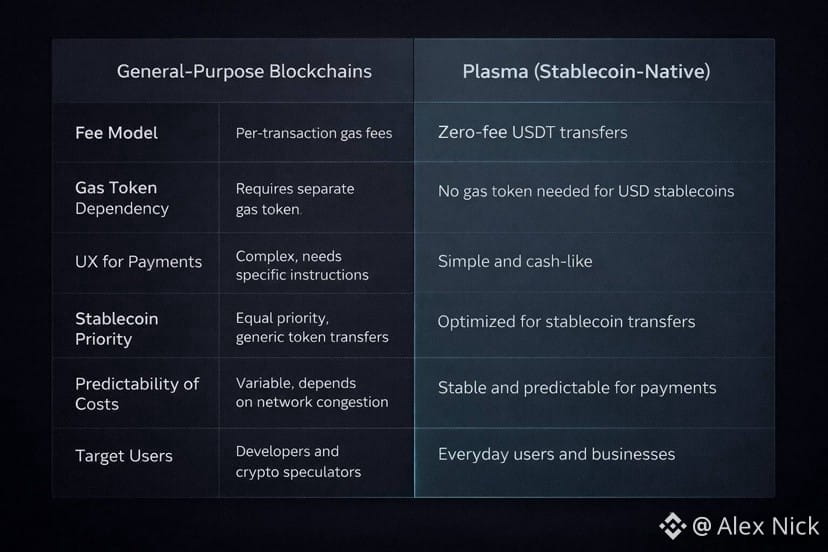
Why stablecoins still feel unfinished
Stablecoins already move billions every day. I see them used for trading, cross border payments, informal payroll, and even business settlements. Yet the strange part is that the networks they run on were not designed with those use cases in mind. Most blockchains were built for speculation first. Payments came later as an afterthought.
That shows up in small but important ways. I still need a separate token just to move my stablecoins. Fees change without warning. Network congestion decides whether a transfer feels instant or stressful. Even when everything works, it never feels natural. It feels like money pretending to be software instead of software supporting money.
Plasma starts by questioning that entire setup.
A chain built around how money is actually used
Instead of assuming every user is a trader, Plasma assumes people are moving balances. That mental shift changes everything. I notice that the design does not revolve around excitement or competition for block space. It revolves around predictability.
Stablecoins are treated as the primary asset on the network, not a guest. Transfers are meant to be smooth, repeatable, and boring in the best way. That may sound unexciting, but in finance, boring is exactly what builds trust.
When I think about real world payments, nobody celebrates how clever the system is. They just expect it to work every time.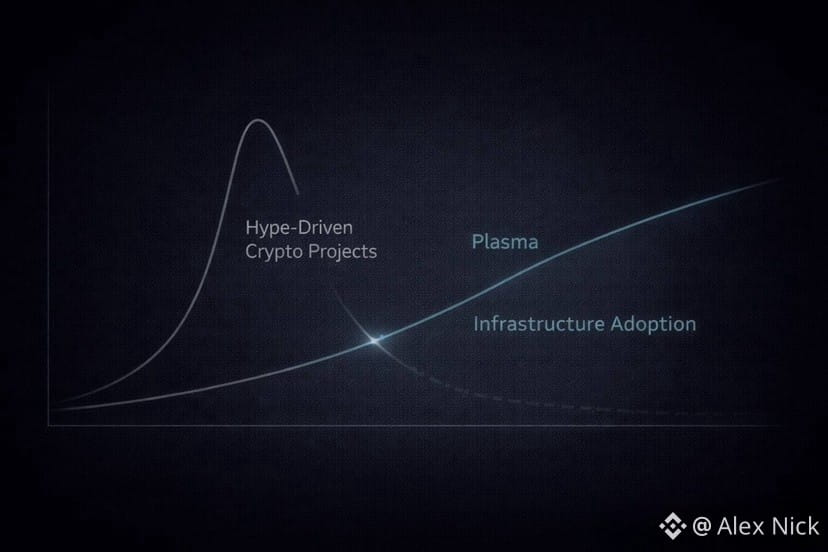
Why free USDT transfers are more psychological than technical
One of the most talked about features of Plasma is zero fee USDT transfers. On the surface, it sounds like a pricing advantage. But after thinking about it longer, I realized it is more about behavior than cost.
The moment I have to check whether I hold enough gas tokens, my mindset changes. I stop thinking about sending money and start thinking about managing risk. That hesitation kills everyday usage. It discourages small payments and makes frequent transfers feel annoying rather than natural.
By removing that friction, Plasma removes a mental burden. I can focus on the payment itself instead of the process behind it. Over time, that kind of simplicity matters more than saving a few cents.
Programmable payments without complexity
Payments alone are not enough. Modern money flows involve conditions. I see this everywhere. Salaries split across accounts. Subscriptions that renew automatically. Escrow systems that release funds only when rules are met.
Plasma keeps full EVM compatibility so developers can build these systems without starting from scratch. From my perspective, that choice is practical rather than flashy. It means builders can keep using familiar tools while users interact mostly with stablecoins.
That balance matters. Programmability stays powerful, but the user experience remains clean.
Trust is not just about speed
Many chains focus on how fast transactions settle. Speed matters, but trust matters more. Plasma anchors part of its security narrative to Bitcoin through a trust reduced bridge design. The idea is not to copy Bitcoin’s function, but to inherit its credibility.
Bitcoin represents long term reliability. Plasma combines that with a system designed for modern payments. I see this as separating belief from usability. Bitcoin provides confidence. Plasma provides convenience.
For money rails, that combination feels intentional rather than accidental.
Where XPL fits into the picture
In a stablecoin centered network, the role of the native token has to be carefully defined. Plasma does not force everyday users to interact with XPL just to move money. Instead, XPL exists mainly for validators, security, and governance.
From my point of view, that separation is healthy. People sending digital dollars should not be exposed to price volatility they did not ask for. Infrastructure costs belong at the infrastructure level, not at the user level.
This design explains how fee free transfers can exist without pretending the network has no expenses.
Adoption that happens quietly
What stands out to me is that Plasma does not chase loud retail hype. Real infrastructure rarely grows that way. It spreads through integrations, custodians, and operational workflows.
When large custody providers integrate a network, it signals something different from social media attention. It suggests reliability. Payment rails usually enter through the back door, not the spotlight.
That kind of adoption is slower, but it tends to last.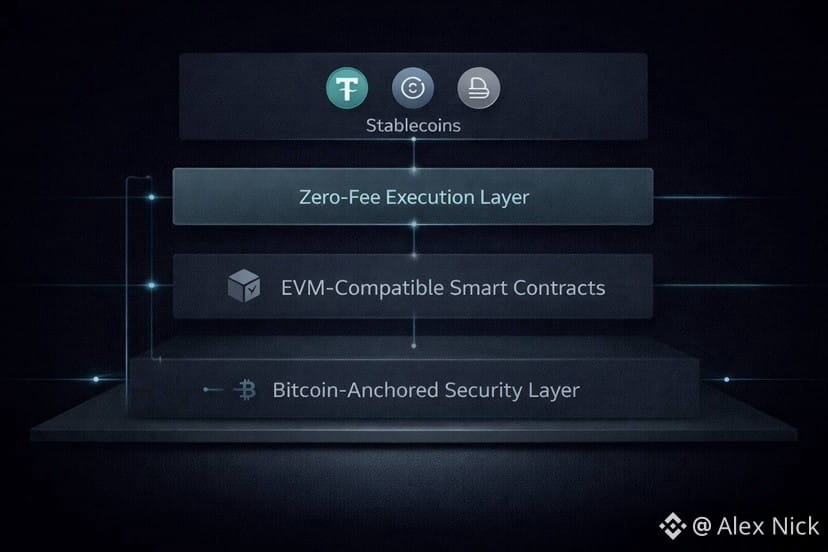
The risks are real and visible
None of this means Plasma is guaranteed to succeed. A stablecoin focused design depends on issuers, regulation, and long term sustainability. Free transfers must be carefully managed to avoid abuse. Competition from existing networks is intense.
I do not see these as deal breakers. I see them as tests. Money infrastructure is not allowed to be fragile. If Plasma wants to occupy this role, it has to meet higher standards than speculative chains.
Why the idea itself still matters
What keeps Plasma interesting to me is not any single feature. It is the focus. In a space obsessed with expansion, Plasma chooses constraint. It does not try to become everything. It tries to make one thing work properly.
Send stablecoins.
Settle instantly.
Avoid surprises.
Move on with life.
If Plasma succeeds, most users will never talk about it. They will just say that sending money feels normal now.
And in crypto, making something feel normal might be the most ambitious goal of all.

