
When I first started digging deeper into privacy projects, I kept running into the same problem. Most of them talked about secrecy as if secrecy alone was the goal. That sounds attractive at first, but the moment I tried to imagine real markets running that way, it stopped making sense. Companies cannot operate without records. Funds cannot move without audits. Courts cannot function without evidence. Pure opacity does not create freedom. It creates paralysis.
That is why Dusk Network feels fundamentally different to me. It is not trying to escape markets. It is trying to rebuild how markets protect themselves.
Why privacy alone was never enough
Most privacy projects sell one idea only. Hide everything. That sounds powerful until you ask a harder question. How do you run businesses, funds, or regulated products when nothing can be proven?
I kept noticing the same pattern. If privacy is optional, almost nobody uses it and the chain becomes public by default. If privacy is absolute, institutions pull back because they cannot explain activity to auditors or regulators. That tension has trapped privacy in crypto for years.
Dusk takes a different route. Instead of choosing between exposure and secrecy, it focuses on privacy supported by proof. That small shift changes the entire structure. Transactions can remain confidential, but when evidence is required, it can be produced cryptographically rather than socially.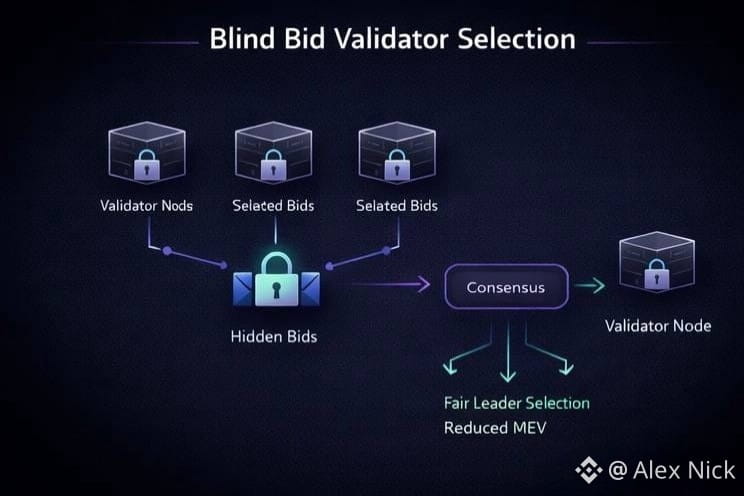
To me, that feels closer to how real finance actually works.
Privacy as protection not as disguise
One thing I strongly agree with is Dusk’s view that privacy is not about hiding wrongdoing. It is about preventing unfair advantage.
If every bid, balance, contract term, and trade is visible in real time, markets stop being fair. Front running becomes standard behavior. Copy strategies dominate. Information warfare replaces price discovery. The richest observers gain power simply by watching.
That is not a free market. That is surveillance trading.
At the same time, regulators still need visibility. Courts need records. Auditors need defensible trails. Issuers need compliant documentation.
Dusk tries to mirror this reality. Activity stays discreet by default, but it is provable when required. Not public spectacle. Not invisible chaos. Something in between that resembles actual market hygiene.
Why confidential smart contracts matter more than private transfers
Many chains can hide token transfers. That is not enough.
Real finance does not revolve around sending tokens. It revolves around conditions. If identity is verified then trade is allowed. If collateral exists then settlement proceeds. If rules are met then assets unlock.
Dusk is built around confidential smart contracts, meaning the logic itself can run without exposing sensitive inputs. That is the part that made me pause when I first understood it. It means financial rules can live on chain without publishing personal data to the internet.
Think about what normally cannot be public. Salaries. Capital tables. Bond agreements. OTC trades. Corporate finances. Everyday business payments. Nobody wants an open ledger version of their internal operations.
If Dusk works as intended, these activities can exist on chain without becoming public theater.
Why validator privacy also matters
Something that surprised me is that Dusk does not stop at user privacy. It also protects validator selection.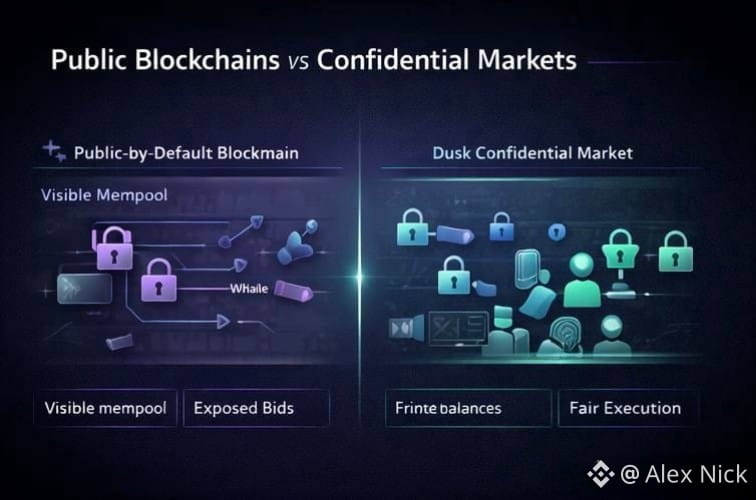
In many systems, everyone knows who will produce the next block. That visibility creates attack surfaces. Bribes. Targeted pressure. Coordinated disruption.
Dusk uses a Segregated Byzantine Agreement with Proof of Blind Bid. Validators submit bids privately. Leader selection happens without revealing identities or intentions beforehand.
I am not obsessed with the technical details here. What matters is the mindset. Dusk treats privacy as infrastructure, not decoration. It looks for every place where information leakage creates unfair advantage and tries to seal it.
Moving from theory to a live network
A lot of crypto projects live permanently in whitepapers. What changed the conversation for Dusk was shipping.
The rollout process was deliberate. On ramp contracts activated in late December 2024. The network cluster launched days later. The first immutable block followed in early January.
Once a chain is live, excuses disappear. What matters becomes uptime, developer experience, incentives, upgrades, and whether anyone actually builds on it. At that point, the discussion stops being philosophical and becomes operational.
That transition matters more than most people realize.
The role of the DUSK token in this structure
I stopped looking at infrastructure tokens like stocks a long time ago. They behave more like fuel mixed with insurance.
On Dusk, staking is central to security. Validators must stake DUSK to participate. There are defined maturity periods, locking rules, and exit delays. That structure creates economic resistance against attacks.
But there is another layer. Because block production relies on blind bids, staking is not just passive locking. It becomes a competitive filter. Participation is earned under uncertainty rather than guaranteed by size alone.
This design quietly reduces the information advantage of whales. Not perfectly, but meaningfully.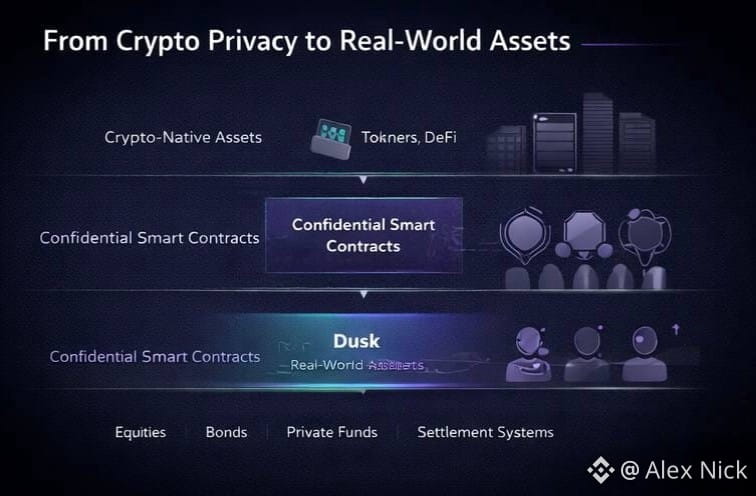
Trust is built through boring systems
One thing I appreciate is that Dusk talks openly about verifiable builds. This is not glamorous. It does not pump charts.
Verifiable builds allow developers and institutions to confirm that deployed code matches published source code. That matters in courtrooms, audits, and internal reviews. Trust is not just believing the math. It is being able to reproduce it.
Institutions care deeply about this. They need systems they can explain, test, and defend legally. Innovation without explanation is unusable to them.
What Dusk is not trying to be
Understanding Dusk becomes easier when I look at what it avoids.
It is not chasing meme liquidity.
It is not trying to host every consumer application.
It is not positioning itself as a casino.
Its focus is controlled assets, regulated marketplaces, private settlement, and business grade contracts. Privacy here is not a lifestyle choice. It is a requirement.
This puts Dusk in a very specific lane. Open everything crypto on one side. Regulated on chain finance on the other. Dusk is clearly betting on the second.
The hardest problem is not technology
The biggest challenge is not cryptography. It is adoption.
Institutions move slowly. Developers prefer simplicity. Liquidity needs incentives. Privacy systems are harder to integrate than transparent ones.
There is also a storytelling issue. Dusk does not fit into a single slogan. Privacy with proof is harder to explain than pure anonymity or pure transparency.
The real question is whether Dusk can package this power into tools that feel normal. If privacy and proof feel like advanced research topics, adoption stalls. If they feel like basic developer primitives, momentum builds.
What success would actually look like
When I think about Dusk succeeding, I imagine three things happening at once.
First, applications launch where privacy is not optional but simply how things work from the start.
Second, markets operate on Dusk because participants feel safer from information leakage, not because they are forced to hide.
Third, selective disclosure becomes routine. Not surveillance, but controlled proof shared with the right party at the right moment.
That is the real promise here. Not escaping oversight. Not broadcasting everything. Participating in markets with dignity.
Dusk is not building a privacy coin. It is building confidential rails for real financial activity. That path is slower. It rarely trends. But if the next cycle truly revolves around tokenized assets and compliant markets, this direction stops looking niche and starts looking early.
Sometimes the most important infrastructure is the kind that does not shout at all.
