
When I look at WAL lately, I get why people feel confused. The price keeps drifting lower, yet trading activity refuses to disappear. At the time I was checking, it was hovering close to ten cents, down noticeably on the day depending on where you look, while daily volume stayed strong in the high teens of millions. That mix usually tells me something important. People are selling, yes, but they are also actively engaging. When a token is truly dead, volume dries up first. That has not happened here.
Why Walrus Does Not Fit the Typical Storage Box
I think one of the biggest mistakes people make is treating Walrus like every other storage project. It is not built to be a passive data warehouse. The idea is programmable storage, where data is not just saved and forgotten but managed through logic that lives on chain.
What that means in practice is that $SUI acts as the coordination layer. Storage rules, access permissions, lifetimes, and payments are all governed on chain, while the heavy files themselves live across decentralized storage nodes. To me, that distinction matters more than marketing language. It turns storage into something applications can actually reason about instead of blindly trusting.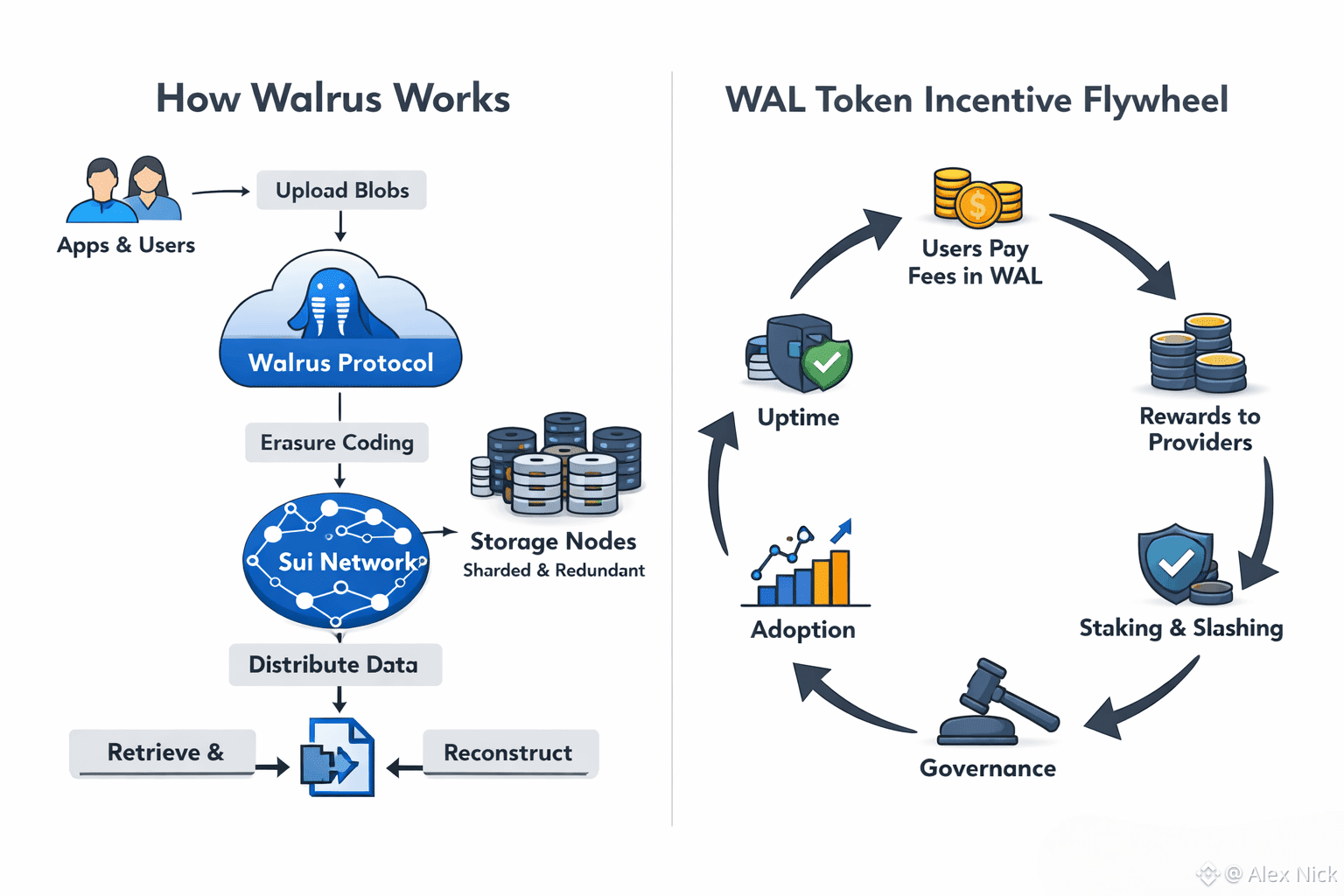
Why This Quietly Becomes an Application Bet
When I think about it honestly, Walrus feels less like a pure infrastructure trade and more like an application ecosystem bet in disguise. If Sui continues pulling in consumer focused apps, games, social platforms, or AI driven tools, they will all hit the same wall sooner or later. Large media files do not belong directly on chain, but relying on centralized cloud services creates censorship risk and reliability issues.
Walrus is stepping into that gap. The idea is simple in spirit. Keep the data heavy lifting off chain, but keep control, verification, and economics on chain. I see why that becomes attractive once an app scales beyond a prototype.
How the Data Actually Stays Safe
Under the surface, the system relies heavily on erasure coding and committee based security. When a file is uploaded, it is broken into many pieces with redundancy and spread across multiple storage nodes. You do not need every node online to recover the data. Even if a meaningful portion fails or behaves maliciously, reconstruction is still possible.
I like this approach because it replaces trust with math. Instead of hoping providers behave, availability becomes something you can reason about. That is boring engineering, but boring engineering is exactly what storage needs.
Token Design and What I Actually Watch
With WAL, I care less about narratives and more about whether demand is real. The token is used to pay for storage, and pricing is designed to stay relatively stable in dollar terms so users are not forced to speculate just to keep data alive.
Payments are made upfront for a defined storage period, then distributed gradually to nodes and stakers. If this system works as intended, WAL demand should come from actual data being stored and renewed, not from people staking tokens just to earn more tokens. That difference is everything.
Why the Chart Still Looks Heavy
So why does the price still feel weak? From my side, it is not surprising. Storage takes time. It is easy to announce integrations. It is much harder to show that teams are paying for storage month after month and renewing contracts when incentives fade.
There is also real competition. Centralized providers are cheap, familiar, and easy. Walrus only wins when teams genuinely value decentralization, censorship resistance, and tight integration with the Sui ecosystem enough to change workflows.
On top of that, there is supply pressure. Storage networks need operators. Operators earn rewards. Rewards often get sold. Add the fact that WAL previously traded far higher and many holders are underwater, and overhead supply becomes very real.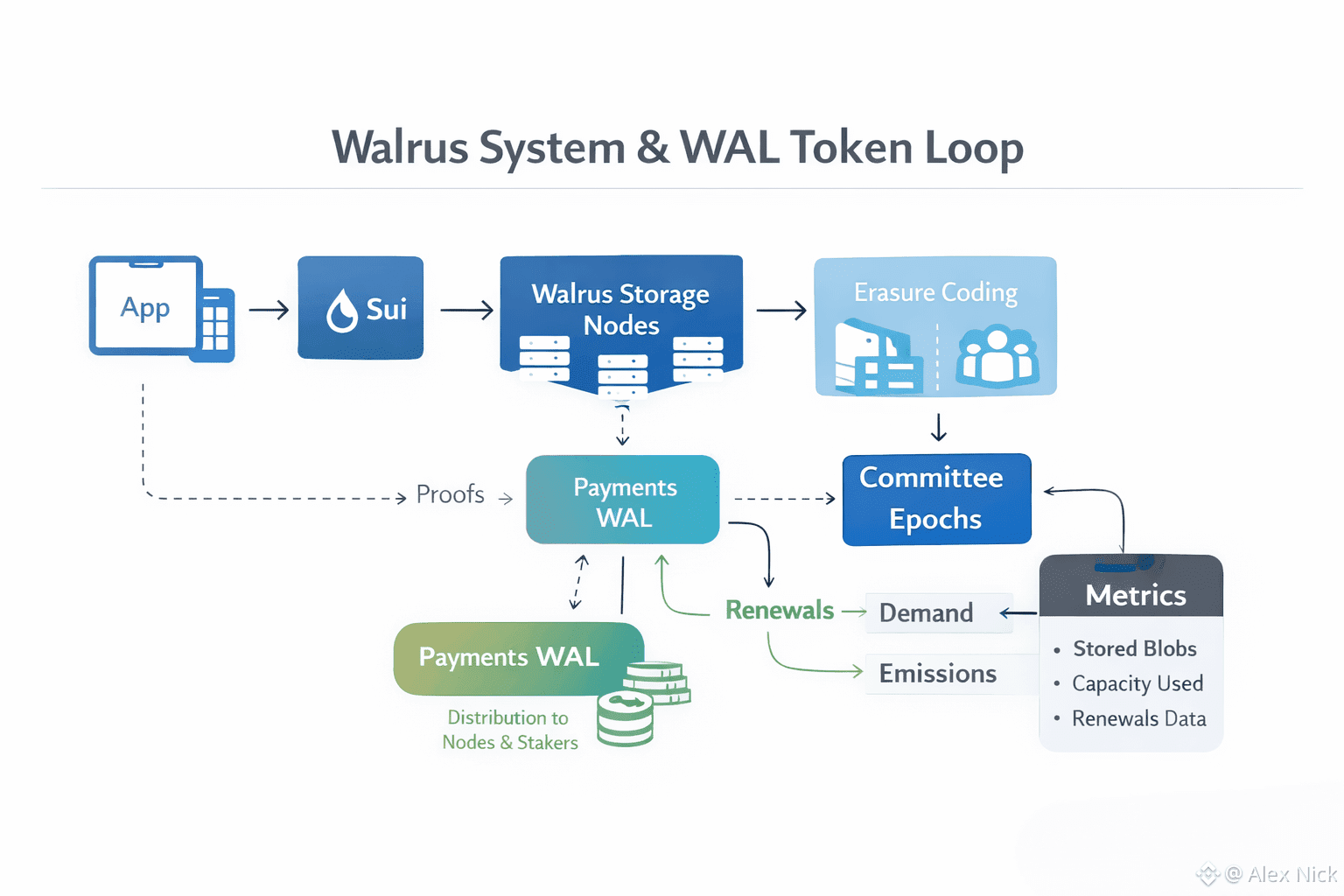
What a Real Upside Case Would Look Like
The upside case is not fantasy. Walrus launched mainnet in March 2025 and sits close to the Mysten and Sui orbit, with serious funding and runway behind it. If the network begins showing sustained growth in stored data, renewals, and paying applications, the market narrative shifts.
At that point, WAL stops being priced as a speculative infrastructure token and starts being valued as a usage driven commodity. At the current market cap range, it would not take extreme numbers for that re rating to happen. It just takes consistency.
The Risk That Cannot Be Ignored
At the same time, I do not ignore the downside. The risk is simple and uncomfortable. Developers may like the tech but users may not pay. Storage might happen once and never renew. Incentives might mask weak organic demand. Or growth inside the Sui ecosystem could slow, removing Walrus main distribution advantage.
In that scenario, WAL keeps trading like a risk on asset that bleeds slowly while waiting for a catalyst that never arrives.
What I Personally Track Going Forward
If I am honest, I am not watching price first. I am watching behavior. Are blobs being stored at increasing volume. Are renewals happening. Is capacity usage rising. Are storage nodes staying active without constant incentive tuning. Are real applications treating Walrus as default infrastructure instead of optional branding.
When usage metrics rise and price does not respond, that tells me supply dynamics are heavier than expected. When price moves without usage, that tells me speculation is driving. The interesting moment is when those two start to disagree.
Where This Leaves Walrus Today
Right now, the market looks skeptical. The tape reflects caution. But skepticism does not mean failure. It means proof is still required.
Walrus is trying to make data programmable in a way that fits how on chain applications actually behave. If it succeeds, storage becomes part of application logic rather than an external dependency. If it fails, it becomes another well engineered idea waiting for

