
Vanar reads like a project that’s trying to make blockchain feel less like a “crypto product” and more like infrastructure you can actually build mainstream apps on. Instead of chasing the loudest narrative, the whole vibe is: keep it familiar for developers, keep it predictable for businesses, and build around the kinds of users who don’t care what chain they’re on—as long as the experience is fast, cheap, and smooth.
Vanar At the base, they lean into the practical route: EVM compatibility and an Ethereum-style client foundation, so teams can ship with tools they already know. That matters because the fastest way to get real adoption isn’t inventing a brand-new dev universe, it’s letting builders bring what already works and just giving them a chain that behaves better under consumer-level usage. Their docs also describe a consensus approach that starts with tight coordination for stability, then opens up validator participation through a reputation-focused model. It’s a “walk before you sprint” approach—optimize for reliability first, then prove you can decentralize responsibly as the network grows.
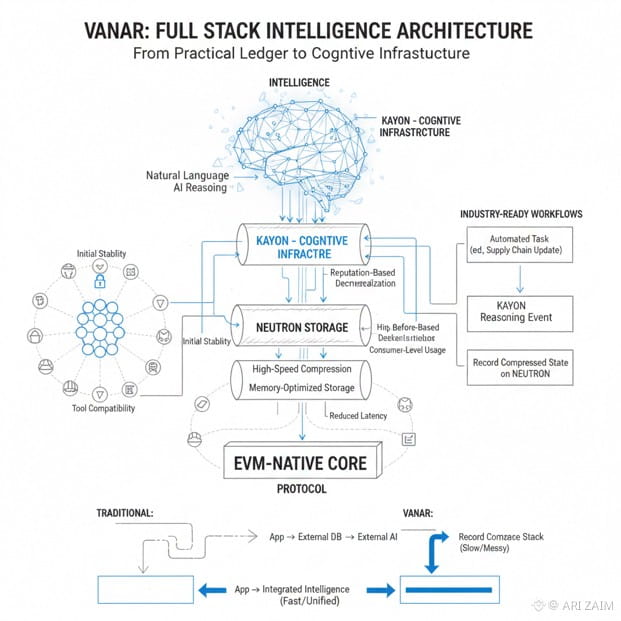
Vanar starts to separate itself is the way it talks about “intelligence” as native infrastructure, not just an app feature. Their site frames the chain as the foundation of a bigger stack: memory-like storage and compression (Neutron), reasoning and natural-language style querying (Kayon), and then automation and industry-ready workflows positioned as the next layers. The point they’re aiming at is pretty clear: in most ecosystems, the chain is only the ledger and everything meaningful lives off-chain in databases and servers. Vanar wants more context to live closer to the chain so apps can read it, understand it, and act on it without turning into a spaghetti monster of external services.
Vanar The token story is one of the more straightforward parts, and that’s a good thing. Vanar’s own materials describe the shift from the older Virtua token era into VANRY through a 1:1 migration, and their whitepaper lays out the supply framing and emissions approach. On Ethereum, the contract you shared is the live ERC-20 footprint people can verify on-chain, which also matters because it keeps VANRY portable and liquid in the wider EVM world.
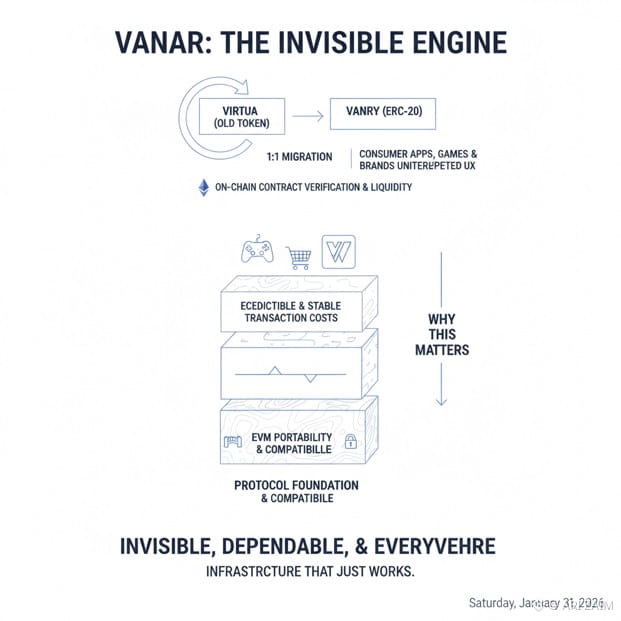
Vanar The real “why this matters” isn’t in any single feature—it’s in the combination. Consumer apps need predictable costs. Game studios and brands don’t want the user experience held hostage by fee spikes. Builders want to ship without rewriting everything. And if Vanar can keep transaction costs stable, keep the stack easy to build on, and actually land real usage from consumer verticals, then it becomes a chain people use without thinking about it. That’s the highest compliment for infrastructure: invisible, dependable, and everywhere.
Vanar What I’d personally watch next is simple: execution and proof. Not announcements—proof. Do Neutron and Kayon show up in real products with real users? Do developers outside the core circle choose Vanar because it’s easier, not because it’s trendy? Does the validator story become more open over time in a way that feels transparent and credible? Those are the milestones that turn a project into a network.
