
Crypto often frames itself as a replacement for markets, banks, or payment systems. What it almost never addresses is the layer that quietly sits between those things: the accounting and settlement layer that makes markets legible and institutions functional.
Plasma is interesting precisely because it targets that missing layer.
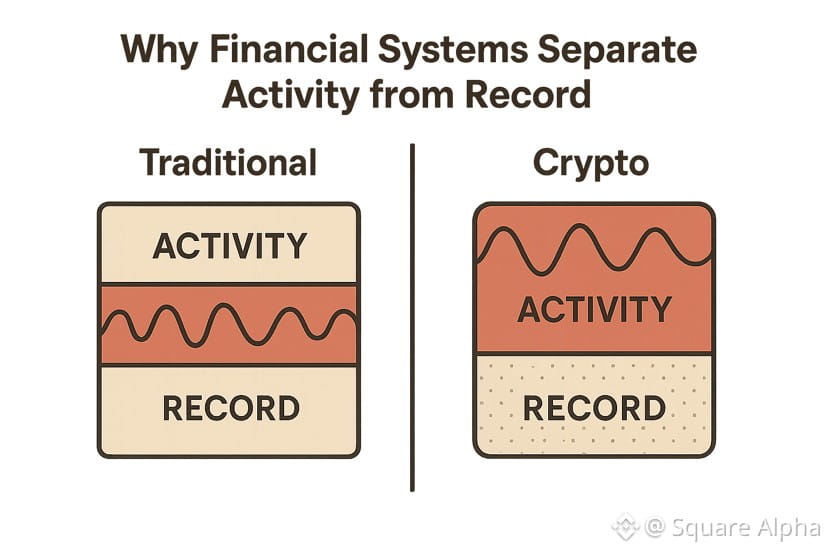
In traditional finance, markets are not where truth is finalized. Trades happen, positions change, but reality is confirmed elsewhere — in ledgers, clearing systems, and settlement rails designed to reconcile activity into something stable and explainable. Most blockchains collapse all of this into a single surface. Plasma deliberately pulls them apart again.
Why Financial Systems Separate Activity From Record
Markets are noisy by design. Prices fluctuate, orders fail, liquidity shifts. Institutions accept this because they rely on a separate layer to turn chaos into clarity. That layer is boring, slow-moving, and deeply conservative — and it is where trust actually accumulates.
Crypto systems rarely respect this separation. Activity and record coexist in the same space, which means volatility bleeds directly into accounting. Plasma takes a different stance: activity can be expressive, but the record must be stable.
That one distinction reshapes how the system behaves.
Plasma as a Settlement Spine, Not a Destination
Plasma makes the most sense when viewed not as a place where things happen, but as a place where things are finalized. Assets may originate elsewhere. Applications may live on other chains. Plasma’s role is to anchor balances and settlements in a neutral, legible environment.
This mirrors how clearinghouses function. They do not compete with markets for attention. They exist so markets can operate without collapsing under their own complexity. Plasma adopts that same posture inside crypto.
It is infrastructure that does not demand loyalty — only correctness.
Finality That Eliminates Explanation
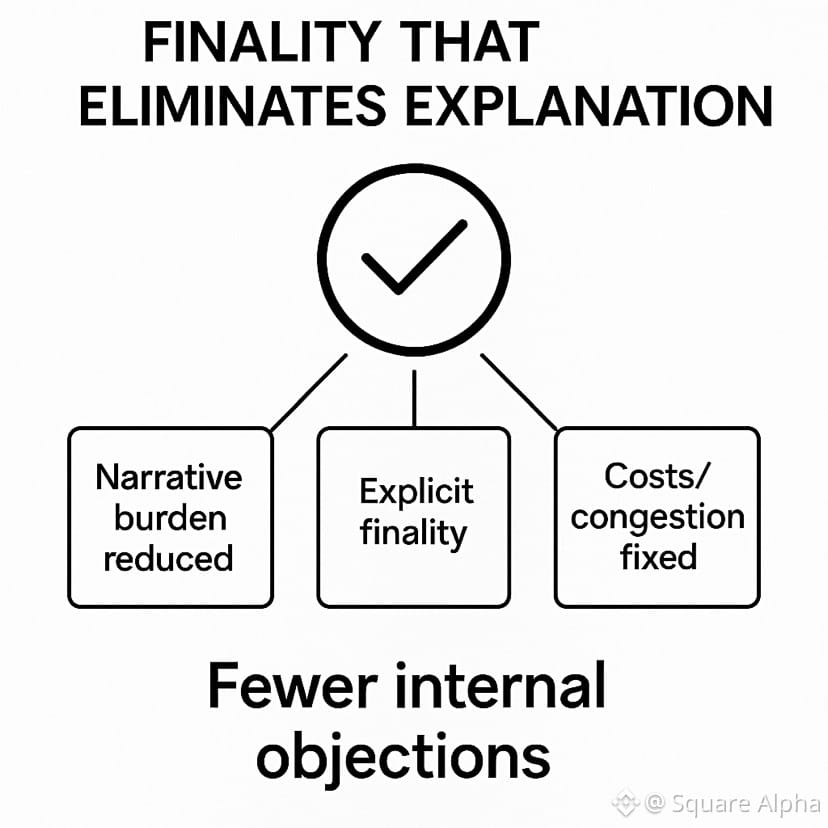
One of the most underrated costs in finance is explanation. Every delay, reorg, or probabilistic outcome creates a narrative burden. Someone must explain why a transaction is “probably final” or why a fee changed unexpectedly.
Plasma removes much of that burden by design. Finality is explicit. Costs do not drift with usage. Outcomes do not depend on timing games. This is not about speed; it is about removing ambiguity.
For finance teams, fewer explanations mean fewer internal objections. That alone is a powerful adoption driver.
Trust Is Accumulated, Not Engineered
Plasma does not attempt to manufacture trust through incentives or visibility. It borrows trust where trust already exists and extends it into a more usable form. This approach is slower, but it aligns with how institutions actually evaluate systems.
They do not ask whether something is innovative. They ask whether it behaves consistently when no one is watching. Plasma’s architecture suggests it is built for precisely those moments.
Silence, in this context, is not a lack of progress. It is a signal of maturity.
Privacy as Operational Hygiene
In institutional environments, privacy is rarely ideological. It is procedural. Internal transfers, reserves, and payments are not secrets; they are simply not public events. Plasma’s approach to confidentiality reflects this reality.
Information is hidden by default, but provable when required. This aligns far more closely with regulatory and audit processes than the binary public/private debates common in crypto.
Again, Plasma is not resisting oversight. It is accommodating it.
The Role of XPL in a Non-Speculative System
In a system oriented around settlement and record, the native asset cannot dominate behavior. $XPL exists to support alignment and participation, not to drive activity through incentives. This restraint is intentional.
Speculative energy distorts accounting systems. Plasma avoids injecting that distortion into its core. The result is slower visibility, but greater coherence.
Institutions value coherence far more than momentum.
A Different Adoption Curve
Plasma will not grow through campaigns or viral moments. It will grow the way infrastructure always does: one integration at a time, quietly embedding itself into workflows that do not tolerate disruption.
When adoption comes, it will not feel like adoption. It will feel like normalization.
That is usually when infrastructure has already won.
Conclusion
Plasma is not trying to redefine finance. It is trying to stabilize the part finance depends on but rarely talks about. By separating activity from record, motion from truth, it restores a structure that traditional systems have relied on for decades.
This is not a narrative that excites markets.
It is a design that satisfies institutions.
And in the long arc of financial infrastructure, satisfaction lasts longer than excitement.