
Most blockchains are built as if their primary audience is other blockchains.
They optimize for metrics that look good on dashboards, slogans that travel well on social media, and narratives that assume users want to participate in the system rather than simply rely on it. Vanar reads differently. It feels like it was designed by people who expect users to arrive impatient, distracted, and largely uninterested in how the underlying technology works.
That assumption changes everything.
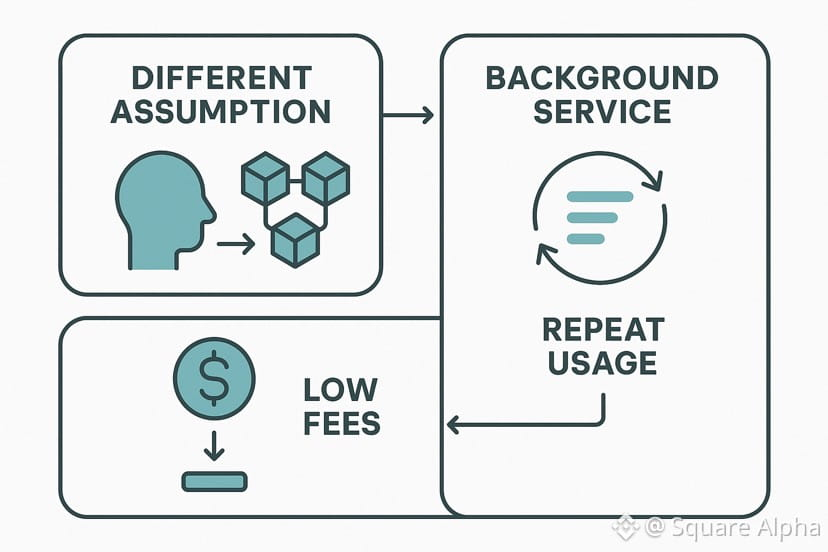
Instead of framing blockchain as something people should learn, Vanar treats it as something people should barely notice. The chain behaves less like a speculative venue and more like a background service—closer to a payments processor or game backend than a financial experiment.
You can see this philosophy reflected in how activity accumulates. Hundreds of millions of transactions don’t necessarily mean mass adoption, but they do indicate repetition. Something is returning again and again to the network. That kind of usage only happens when friction is low enough that systems don’t need to “think” before interacting.
Fees are where this mindset becomes most obvious. In crypto, fees are often treated as a market signal or a congestion management tool. Vanar treats them as a usability constraint. The goal is not to discover the highest price someone will pay, but to maintain a cost level that applications can safely design around.
That distinction matters more than it sounds.
Games, marketplaces, and consumer platforms cannot function when every interaction carries price uncertainty. A user clicking through a menu, minting an item, or completing a purchase doesn’t care about block space economics. They care that nothing unexpected happens. Vanar’s approach to stabilizing transaction costs—even as token prices fluctuate—suggests the chain is optimized for environments where surprises are bugs, not features.
This philosophy extends to governance and validation. Rather than maximizing openness from day one, Vanar appears to prioritize responsibility and continuity. Validator participation is structured in a way that emphasizes accountability and performance over ideological purity. That choice will alienate some crypto-native audiences, but it aligns closely with how real-world infrastructure is deployed.
Airports, payment networks, and content platforms do not begin as permissionless experiments. They begin controlled, monitored, and optimized for reliability. Decentralization becomes meaningful when it protects a working system, not when it excuses instability.
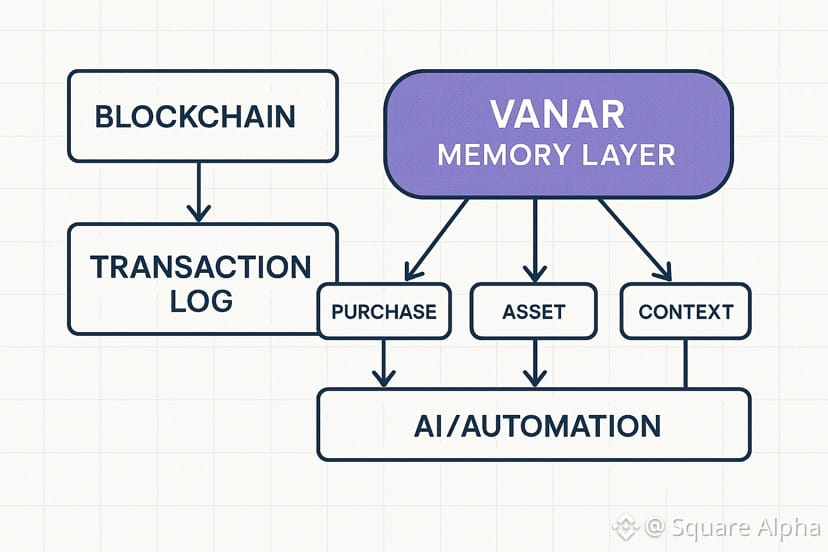
Vanar’s approach to data reinforces this pattern. Most blockchains treat data as something to be recorded and forgotten. Vanar treats it as something that needs to remain useful. By focusing on compressing and verifying contextual information, the chain positions itself as more than a transaction log. It becomes a memory layer that applications can reference without dragging complexity on-chain.
That’s especially relevant in environments where transactions don’t stand alone. Purchases reference assets. Assets reference identities. Identities reference permissions. When that context can be efficiently verified, systems can automate more without losing control.
This is where the conversation around AI and automation quietly fits in. Vanar doesn’t pretend intelligence belongs on-chain. Instead, it focuses on making the outputs of intelligent systems verifiable, consistent, and actionable. That’s a far more realistic role for blockchain in an automated future.
$VANRY reflects this same restraint. It exists to enable activity rather than dominate the narrative. Fees, staking, interoperability—functional roles that scale with usage rather than speculation. The presence of an ERC-20 version suggests an expectation that value will move fluidly between ecosystems, not remain captive to one.
That’s not a flashy vision. It doesn’t promise domination or inevitability. But it aligns with how successful infrastructure actually spreads: quietly, incrementally, and often invisibly.
The risk for Vanar isn’t relevance—it’s patience. Infrastructure that aims to be boring in the best way must resist the temptation to perform. If fees stay predictable, systems stay stable, and real products keep shipping, the chain doesn’t need to convince users it matters.
They’ll already be relying on it.